Thank you for visiting SNEWPapers!
Sign up free
Editorial
May 29, 1907
The Evening World
New York, New York County, New York
What is this article about?
This editorial critiques the American, especially New Yorker's, pervasive habit of public criticism ('knocking') of daily life, contrasting it with other cultures, noting its harm, and urging action over mere complaint, exemplified by 'Battery Dan' Finn's remarks.
Clipping
OCR Quality
98%
Excellent
Full Text
KNOCKING AND KNOCKERS.
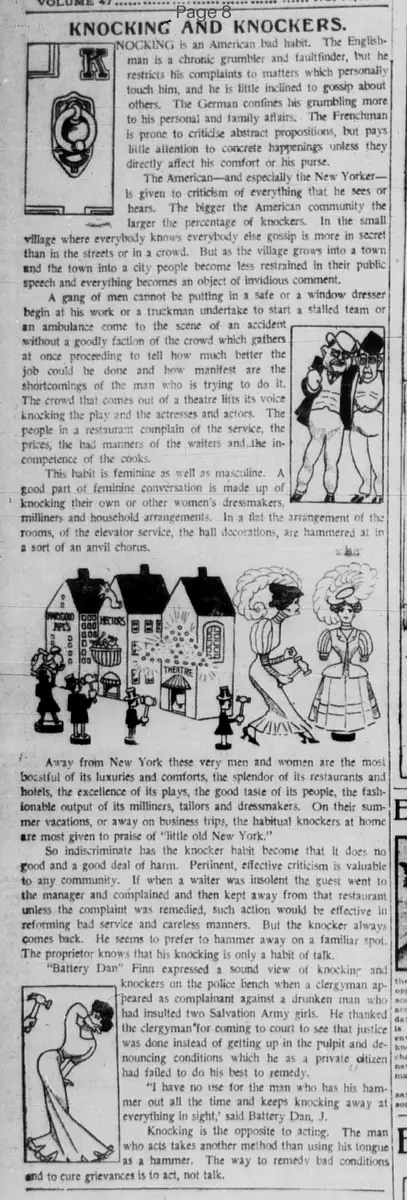
Knocking is an American bad habit. The Englishman is a chronic grumbler and faultfinder, but he restricts his complaints to matters which personally touch him, and he is little inclined to gossip about others. The German confines his grumbling more to his personal and family affairs. The Frenchman is prone to criticise abstract propositions, but pays little attention to concrete happenings unless they directly affect his comfort or his purse. The American—and especially the New Yorker—is given to criticism of everything that he sees or hears. The bigger the American community the larger the percentage of knockers. In the small village where everybody knows everybody else gossip is more in secret than in the streets or in a crowd. But as the village grows into a town and the town into a city people become less restrained in their public speech and everything becomes an object of invidious comment.
A gang of men cannot be putting in a safe or a window dresser begin at his work or a truckman undertake to start a stalled team or an ambulance come to the scene of an accident without a goodly faction of the crowd which gathers at once proceeding to tell how much better the job could be done and how manifest are the shortcomings of the man who is trying to do it. The crowd that comes out of a theatre lifts its voice knocking the play and the actresses and actors. The people in a restaurant complain of the service, the prices, the bad manners of the waiters and, the incompetence of the cooks.
This habit is feminine as well as masculine. A good part of feminine conversation is made up of knocking their own or other women's dressmakers, milliners and household arrangements. In a flat the arrangement of the rooms, of the elevator service, the hall decorations, are hammered at in a sort of an anvil chorus.
Away from New York these very men and women are the most boastful of its luxuries and comforts, the splendor of its restaurants and hotels, the excellence of its plays, the good taste of its people, the fashionable output of its milliners, tailors and dressmakers. On their summer vacations, or away on business trips, the habitual knockers at home are most given to praise of "little old New York."
So indiscriminate has the knocker habit become that it does no good and a good deal of harm. Pertinent, effective criticism is valuable to any community. If when a waiter was insolent the guest went to the manager and complained and then kept away from that restaurant unless the complaint was remedied, such action would be effective in reforming bad service and careless manners. But the knocker always comes back. He seems to prefer to hammer away on a familiar spot. The proprietor knows that his knocking is only a habit of talk.
"Battery Dan" Finn expressed a sound view of knocking and knockers on the police bench when a clergyman appeared as complainant against a drunken man who had insulted two Salvation Army girls. He thanked the clergyman for coming to court to see that justice was done instead of getting up in the pulpit and denouncing conditions which he as a private citizen had failed to do his best to remedy.
"I have no use for the man who has his hammer out all the time and keeps knocking away at everything in sight," said Battery Dan.
Knocking is the opposite to acting. The man who acts takes another method than using his tongue as a hammer. The way to remedy bad conditions and to cure grievances is to act, not talk.
Knocking is an American bad habit. The Englishman is a chronic grumbler and faultfinder, but he restricts his complaints to matters which personally touch him, and he is little inclined to gossip about others. The German confines his grumbling more to his personal and family affairs. The Frenchman is prone to criticise abstract propositions, but pays little attention to concrete happenings unless they directly affect his comfort or his purse. The American—and especially the New Yorker—is given to criticism of everything that he sees or hears. The bigger the American community the larger the percentage of knockers. In the small village where everybody knows everybody else gossip is more in secret than in the streets or in a crowd. But as the village grows into a town and the town into a city people become less restrained in their public speech and everything becomes an object of invidious comment.
A gang of men cannot be putting in a safe or a window dresser begin at his work or a truckman undertake to start a stalled team or an ambulance come to the scene of an accident without a goodly faction of the crowd which gathers at once proceeding to tell how much better the job could be done and how manifest are the shortcomings of the man who is trying to do it. The crowd that comes out of a theatre lifts its voice knocking the play and the actresses and actors. The people in a restaurant complain of the service, the prices, the bad manners of the waiters and, the incompetence of the cooks.
This habit is feminine as well as masculine. A good part of feminine conversation is made up of knocking their own or other women's dressmakers, milliners and household arrangements. In a flat the arrangement of the rooms, of the elevator service, the hall decorations, are hammered at in a sort of an anvil chorus.
Away from New York these very men and women are the most boastful of its luxuries and comforts, the splendor of its restaurants and hotels, the excellence of its plays, the good taste of its people, the fashionable output of its milliners, tailors and dressmakers. On their summer vacations, or away on business trips, the habitual knockers at home are most given to praise of "little old New York."
So indiscriminate has the knocker habit become that it does no good and a good deal of harm. Pertinent, effective criticism is valuable to any community. If when a waiter was insolent the guest went to the manager and complained and then kept away from that restaurant unless the complaint was remedied, such action would be effective in reforming bad service and careless manners. But the knocker always comes back. He seems to prefer to hammer away on a familiar spot. The proprietor knows that his knocking is only a habit of talk.
"Battery Dan" Finn expressed a sound view of knocking and knockers on the police bench when a clergyman appeared as complainant against a drunken man who had insulted two Salvation Army girls. He thanked the clergyman for coming to court to see that justice was done instead of getting up in the pulpit and denouncing conditions which he as a private citizen had failed to do his best to remedy.
"I have no use for the man who has his hammer out all the time and keeps knocking away at everything in sight," said Battery Dan.
Knocking is the opposite to acting. The man who acts takes another method than using his tongue as a hammer. The way to remedy bad conditions and to cure grievances is to act, not talk.
What sub-type of article is it?
Social Reform
Moral Or Religious
What keywords are associated?
Knocking Habit
American Criticism
New York
Social Manners
Action Over Talk
Vice Of Grumbling
What entities or persons were involved?
Battery Dan Finn
New Yorkers
Americans
Editorial Details
Primary Topic
Critique Of The American Habit Of Knocking
Stance / Tone
Critical Of Indiscriminate Criticism, Advocates Action Over Talk
Key Figures
Battery Dan Finn
New Yorkers
Americans
Key Arguments
Knocking Is An American Bad Habit More Prevalent In Larger Communities Like New York
It Contrasts With Grumbling Habits Of Englishmen, Germans, And Frenchmen
Crowds Criticize Workers, Plays, Restaurants Indiscriminately
The Habit Is Both Masculine And Feminine, Targeting Dressmakers And Household Arrangements
Away From Home, Americans Boast About New York's Luxuries
Indiscriminate Knocking Does Harm And No Good, Unlike Effective Criticism
Battery Dan Finn Criticizes Constant Knockers
Knocking Is Opposite To Acting; Remedy Bad Conditions By Action, Not Talk