Thank you for visiting SNEWPapers!
Sign up free
The Enquirer
Richmond, Henrico County, Virginia
What is this article about?
U.S. congressional proceedings in late November 1808 debating the Embargo Act's continuation amid British and French aggressions on American commerce and neutral rights. Features speeches by Senators and Representatives like Pope, Alston, Bacon, and others advocating resistance, non-intercourse, and defense preparations, culminating in unanimous resolutions against foreign edicts.
Merged-components note: This is a continuation of the congressional proceedings and embargo debate from page 1 to page 2, indicated by the text '(Mr. Pope's Speech to be continued.)' and seamless flow into House of Representatives coverage.
Clippings
1 of 2
OCR Quality
Full Text
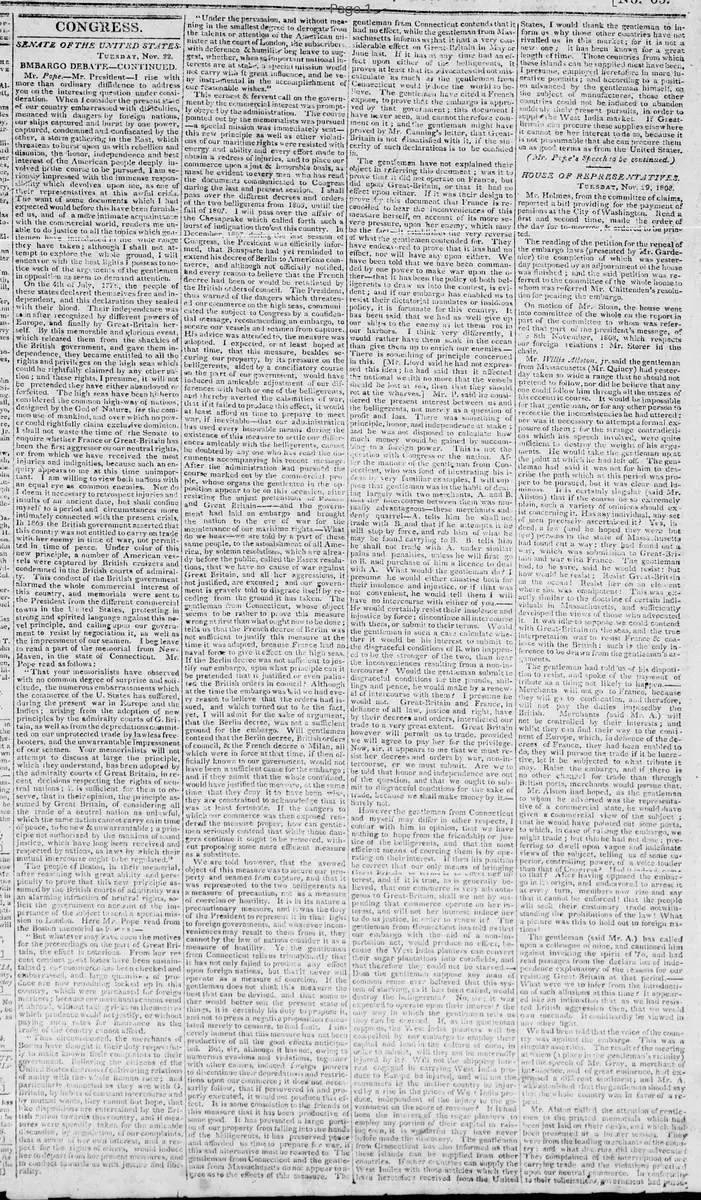
SENATE OF THE UNITED STATES.
Tuesday, Nov. 22.
EMBARGO DEBATE--CONTINUED.
Mr. Pope.--Mr. President--I rise with more than ordinary diffidence to address you on the interesting question under consideration. When I consider the present state of our country embarrassed with difficulties, menaced with dangers by foreign nations, our ships captured and burnt by one power, captured, condemned and confiscated by the other, a storm gathering in the East, which threatens to burst upon us with rebellion and disunion, the honor, independence and best interest of the American people deeply involved in the course to be pursued, I am seriously impressed with the immense responsibility which devolves upon me, as one of their representatives at this awful crisis. The want of some documents which I had expected would before this have been furnished us, and of a more intimate acquaintance with the commercial world, renders me unable to do justice to all the topics which gentlemen have introduced in the wide range they have taken: although I shall not attempt to explore the whole ground, I will endeavor with the best lights I possess to notice such of the arguments of the gentlemen in opposition as seem to demand attention.
On the 4th of July, 1776, the people of these states declared themselves free and independent, and this declaration they sealed with their blood. Their independence was soon after recognized by different powers of Europe, and finally by Great-Britain herself. By this memorable and glorious event, which released them from the shackles of the British government, and gave them independence, they became entitled to all the rights and privileges on the high seas which could be rightfully claimed by any other nation; and these rights, I presume, it will not be pretended they have either abandoned or forfeited. The high seas have been hitherto considered the common high-way of nations, designed by the God of Nature, for the common use of mankind, and over which no power could rightfully claim exclusive dominion.
I shall not waste the time of the Senate to enquire whether France or Great-Britain has been the first aggressor on our neutral rights, or from which we have received the most injuries and indignities, because such an enquiry appears to me at this time unimportant. I am willing to view both nations with an equal eye as common enemies. Nor do I deem it necessary to retrospect injuries and insults of an ancient date, but shall confine myself to a period and circumstances more intimately connected with the present crisis.
In 1805 the British government asserted that this country was not entitled to carry on trade with, her enemy in time of war, not permitted in time of peace. Under color of this new principle, a number of American vessels were captured by British cruizers and condemned in the British courts of admiralty. This conduct of the British government alarmed the whole commercial interest of this country, and memorials were sent to the President from the different commercial towns in the United States, protesting in strong and spirited language against this novel principle, and calling upon our government to resist by negociation it, as well as the impressment of our seamen. I beg leave to read a part of the memorial from New-Haven, in the state of Connecticut. Mr. Pope read as follows:
"That your memorialists have observed with no common degree of surprise and solicitude, the numerous embarrassments which the commerce of the U. States has suffered, during the present war in Europe and the Indies; arising from the adoption of new principles by the admiralty courts of G. Britain, as well as from the depredations committed on our unprotected trade by lawless free-booters, and the unwarrantable impressment of our seamen. Your memorialists will not attempt to discuss at large the principle, which they understand, has been adopted by the admiralty courts of Great Britain, in recent decisions respecting the rights of neutral nations: it is sufficient for them to observe, that in their opinion, the principle assumed by Great Britain, of considering all the trade of a neutral nation as unlawful, which the same nation cannot carry on in time of peace, to be new & unwarrantable; a principle not authorized by the maxims of sound justice, which have long been received and respected by nations, as laws by which their mutual intercourse ought to be regulated."
The people of Boston, in their memorial, after reasoning with great ability and perspicuity to prove that this new principle assumed by the British courts of admiralty was an alarming infraction of neutral rights, solicit the government on account of the importance of the subject to send a special mission to London. Here Mr. Pope read from the Boston memorial as follows:--
"But whatever may have been the motives for the proceedings on the part of Great Britain, the effect is notorious. From her recent conduct great losses have been sustained; commerce has been checked and embarrassed, and large quantities of produce are now remaining locked up in this country, which were purchased for foreign markets; because our merchants cannot send it abroad, without taking risks on themselves which prudence would not justify, or without paying such rates for insurance as the trade of the country cannot afford.
"Thus circumstanced, the merchants of Boston have thought it their duty respectfully to make known their complaints to their government. Believing the citizens of the United States desirous of cultivating relations of amity with the whole human race; and particularly connected as they are with G. Britain, by habits of constant intercourse and by mutual wants, they cannot but hope, that like dispositions are entertained by the British nation towards this country, and if measures were speedily taken for the amicable discussion, by negociation, of our complaints, that a sense of her own interest, and a respect for the rights of others, would induce her to depart from her present measures, and to conduct towards us with justice and liberality."
"Under the persuasion, and without meaning in the smallest degree to derogate from the talents or attention of the American minister at the court of London, the subscribers, with deference & humility beg leave to suggest, whether, when so important national interests are at stake, a special mission would not carry with it great influence, and be very instrumental in the accomplishment of our reasonable wishes."
This earnest & fervent call on the government by the commercial interest was promptly obeyed by the administration. The course pointed out by the memorialists was pursued --a special mission was immediately sent-- this new principle as well as other violations of our maritime rights were resisted with energy and ability and every effort made to obtain a redress of injuries, and to place our commerce upon a just & honorable basis, as must be evident to every man who has read the documents communicated to Congress during the last and present session. I shall pass over the different decrees and orders of the two belligerents from 1805, until the fall of 1807. I will pass over the affair of the Chesapeake which called forth such a burst of indignation throughout this country. In December 1807. during the last session of Congress, the President was officially informed, that Bonaparte had yet remained to extend his decree of Berlin to American commerce, and although not officially notified, had every reason to believe that the French decree had been or would be retaliated by the British orders of council. The President, thus warned of the dangers which threatened our commerce on the high seas, communicated the subject to Congress by a confidential message, recommending an embargo, to secure our vessels and seamen from capture. His advice was attended to, the measure was adopted. I expected, or at least hoped at that time, that this measure, besides securing our property, by its pressure on the belligerents, aided by a conciliatory course on the part of our government, would have induced an amicable adjustment of our differences with both or one of the belligerents, and thereby averted the calamities of war, that if it failed to produce this effect, it would at least afford us time to prepare to meet war, if inevitable--that our administration has used every honorable means during the existence of this measure to settle our differences amicably with the belligerents, cannot be doubted by any one who has read the documents accompanying his recent message.
After the administration had pursued the course marked out by the commercial people, whose organs the gentlemen in the opposition appear to be on this occasion, after resisting the unjust pretensions of France and Great Britain---and the government had laid an embargo and brought the nation to the eve of war for the maintenance of our maritime rights.--What do we hear--we are told by a part of these same people, to the astonishment of all America, by solemn resolutions, which are already before the public, called the Essex resolutions, that we have no cause of war against Great Britain, and all her aggressions, if not justified, are excused; and our government is gravely told to disgrace itself by receding from the ground it has taken. The gentleman from Connecticut, whose object seems to be rather to prove this measure wrong at first than what ought now to be done; tells us that the French decree of Berlin was not sufficient to justify this measure at the time it was adopted, because France had no naval force to give it effect on the high seas.
If the Berlin decree was not sufficient to justify our embargo, upon what principle can it be pretended that it justified or even palliated the British orders in council? Although at the time the embargo was laid we had every reason to believe that the orders had issued, and which turned out to be the fact, yet, I will admit for the sake of argument, that the Berlin decree, was not a sufficient ground for the embargo. Will gentlemen contend that the Berlin decree, British orders of council, & the French decree of Milan, all which were in force at that time, if then officially known to our government, would not have been a sufficient cause for the embargo; and if they admit that the whole combined, would have justified the measure, at the same time that they deny it to have been wise, they are constrained to acknowledge that it was at least fortunate. If the dangers to which our commerce was then exposed rendered the measure proper, how can gentlemen seriously contend that while those dangers continue it ought to be removed. without proposing some more efficient measure as a substitute.
We are told however, that the avowed object of this measure was to secure our property and seamen from capture, and that it was represented to the two belligerents as a measure of precaution, not as a measure of coercion or hostility. It is in its nature a precautionary measure, and it was the duty of the President to represent it in that light to foreign governments, and whatever inconveniences may result to them from it, they cannot by the law of nations consider it as a measure of hostility. Yet, the gentleman from Connecticut tells us triumphantly that it has not only failed to produce any effect upon foreign nations, but that it never will operate as a measure of coercion. If the gentleman does not think this measure the best that can be devised, and that some other would better suit the present state of things, it is certainly his duty to propose it, and not to press a negative proposition calculated merely to censure. to find fault. I sincerely lament that this measure has not been productive of all the good effects anticipated. But, sir, although it has not, owing to numerous evasions and violations, together with other causes, induced foreign powers to discontinue their depredations and restrictions upon our commerce; it does not necessarily follow, that if persevered in and properly executed, it would not produce this effect. It is some consolation to the friends of this measure that it has been productive of some good. It has prevented a large portion of our property from falling into the hands of the belligerents, it has preserved peace and afforded us time to prepare for war, if this sad alternative must be resorted to. The gentleman from Connecticut and the gentleman from Massachusetts do not appear to agree as to the effects of this measure, The gentleman from Connecticut contends that it had no effect, while the gentleman from Massachusetts informs us that it had a very considerable effect on Great-Britain in May or June last. If it has at any time had an effect upon either of the belligerents, it proves at least that its advocates did not miscalculate as much as the gentleman from Connecticut would induce the world to believe. The gentlemen have cited a French expose, to prove that the embargo is approved by that government; this document I have never seen, and cannot therefore comment on it; and the gentleman might have proved by Mr. Canning's letter, that Great-Britain is not dissatisfied with it. if the sincerity of such declarations is to be confided in.
The gentlemen have not explained their object in referring this document ; was it to prove that it did not operate on France, but did upon Great-Britain, or that it had no effect upon either. If it was their design to prove by this document that France is reconciled to bear the inconveniences of this measure herself, on account of its more severe pressure, upon her enemy, which may be the fact-it establishes the very reverse of what the gentlemen contended for. They have endeavored to prove that it has had no effect, nor will have any upon either. We have been told that we have been commanded by one power to make war upon the other-that it has been the policy of both belligerents to draw us into the contest, is evident; and if our embargo has enabled us to resist their dictatorial mandates or insidious policy, it is fortunate for this country. It has been said that we had as well give up our ships to the enemy as let them rot in our harbors. I think very differently, I would rather have them sunk in the ocean than give them up to enrich our enemies. There is something of principle concerned in this. [Mr. Lloyd said he had not expressed this idea; he had said that it affected the national wealth no more that the vessels should be lost at sea, than that they should rot at the wharves.] Mr. P. said he considered the present interest between us and the belligerents, not merely as a question of profit and loss. There was something of principle, honor, and independence at stake ; and he was not disposed to calculate how much money would be gained by succumbing to a foreign power. This is not the question with Congress or the nation. After the manner of the gentleman from Connecticut, who was fond of illustrating his ideas by very familiar examples, I will suppose that gentleman was in the habit of dealing largely with two merchants, A. and B. that their intercourse between them was mutually advantageous--these merchants suddenly quarrel--A. tells him he shall not trade with B. and that if he attempts it he will stop by force, and rob him of what he may be found carrying to B. B. tells him he shall not trade with A. under similar pains and penalties, unless he will first go to B. and purchase of him a licence to deal with A. What would the gentleman do? I presume he would either chastise both for their insolence and injustice, or if that was not convenient, he would tell them I will have no intercourse with either of you. He would certainly resist their insolence and injustice by force; discontinue all intercourse with them, or submit to their terms. Would the gentleman in such a case calculate whether it would be his interest to submit to the disgraceful conditions of B. who happened to be the stronger of the two, than bear the inconveniences resulting from a non-intercourse? Would the gentleman submit to disgraceful conditions for the pounds, shillings and pence, he would make by a renewal of intercourse with them? I presume he would not. Great-Britain and France, in defiance of all law. justice and right, have by their decrees and orders, interdicted our trade to a very great extent. Great Britain however will permit us to trade, provided we will agree to pay her for the privilege. Now, sir. it appears to me that we must resist her decrees and orders by war, non-intercourse, or we must submit. Are we to be told that honor and independence are out of the question, and that we ought to submit to disgraceful conditions for the sake of trade, because we shall make money by it.? Surely not.
However the gentleman from Connecticut and myself may differ in other respects, I concur with him in opinion, that we have nothing to hope from the friendship or justice of the belligerents, and that the most efficient means of coercing them is by operating on their interest. if then his position be correct that our only means of bringing Great Britain to terms is to cater her interest, and if it is true, as is generally believed, that our commerce is very advantageous to Great-Britain, shall we not by suspending that commerce operate on her interest, and will not her interest induce her to do us justice, in order to renew it? The gentleman from Connecticut has told us that our embargo with the aid of a non-importation act, would produce no effect, because the West India planters can convert their sugar plantations into cornfields, and that therefore they could not be starved.-- Does the gentleman suppose any man of common sense ever believed that this system of starving, as it has been called, would destroy the belligerents? No, sir; it was expected to operate upon their interest ? the only way in which the gentleman tells us they can be coerced. I, as the gentleman supposes, the West India planters will be compelled by our embargo to employ their capital and land in the culture of corn, in order to subsist, will they not be materially injured by it? will not the shipping interest engaged in carrying West India produce to Europe be injured, and will not the consumers in the mother country be injured by a rise in the prices of West India produce, independent of the injury to the government on the score of revenue? If it had been the interest of the sugar planters to employ any portion of their capital in raising corn, it is wonderful they have never before made the discovery. The gentleman from Connecticut has also informed us that these islands can be supplied from other countries. If other countries can supply the West Indies with those articles which they have heretofore received from the United States, I would thank the gentleman to inform us why those other countries have not rivalled us in this market; for it is not a new- one; it has been known for a great length of time. Those countries from which these islands can be supplied must have been, I presume, employed heretofore in more lucrative pursuits; and according to a position advanced by the gentleman himself, on the subject of manufactures; those other countries could not be induced to abandon suddenly their present pursuits, in order to supply the West India market. If Great-Britain can procure these supplies elsewhere it cannot be her interest to do so, because it is not presumable that she can procure them on as good terms as from the United States.
(Mr. Pope's Speech to be continued.)
HOUSE OF REPRESENTATIVES.
Tuesday, Nov. 29, 1808.
Mr. Holmes, from the committee of claims, reported a bill providing for the payment of pensions at the City of Washington. Read a first and second time, made the order of the day for to-morrow, & ordered to be printed.
The reading of the petition for the repeal of the embargo laws (presented by Mr. Gardner) the completion of which was yesterday postponed by an adjournment of the house was finished ; and the said petition was referred to the committee of the whole house to whom was referred Mr. Chittenden's resolution for repealing the embargo.
On motion of Mr. Sloan, the house went into committee of the whole on the report in part of the committee to whom was referred that part of the president's message, of the 8th November, 1808, which respects our foreign relations : Mr. Storer in the chair.
Mr. William Allston, jr. said the gentleman from Massachusetts (Mr. Quincy) had yesterday taken so wide a range that he should not pretend to follow, nor did he believe that any one could follow him through all the mazes of his eccentric course. It would be impossible for that gentleman, or for any other person to reconcile the inconsistencies he had uttered: nor was it necessary to attempt a formal exposure of them ; for the strange contradictions which his speech involved, were quite sufficient to destroy the weight of his arguments. He would take the gentleman up at the point at which he had left off. The gentleman had said it was not for him to describe the path which at this period was proper to be pursued, but it was clear and luminous.
It is certainly singular (said Mr. Allston) that if the course be so extremely plain, such a variety of opinions should exist concerning it. Has any individual, any set of men precisely ascertained it? Yes, indeed, a few (and he hoped they were but few) persons in the state of Massachusetts had found out a way: they had found out a way, which was submission to Great-Britain and war with France. The gentleman had, to be sure, said he would resist: but how would he resist: Resist Great-Britain on the ocean! Resist her on an element where she was omnipotent! This was exactly similar to the doctrine of certain individuals in Massachusetts, and sufficiently developed the views of those who advocated it. It was idle to suppose we could contend with Great-Britain on the seas, and the true interpretation was to resist France & coalesce with the British: such is the only inference to be drawn from the gentleman's arguments.
The gentleman had told us of his disposition to resist, and spoke of the payment of tribute as a thing not likely to happen.-- Merchants will not go to France, because they will go to confiscation, and therefore, will not pay the duties imposed by the British. Merchants (said Mr. A.) will not be controlled by their interests; and whilst they can find their way to the continent of Europe, which, in defiance of the decrees of France, they had been enabled to do, they will pursue the trade if it be lucrative, let it be subjected to what tribute it may. Raise the embargo, and if there is no other channel for trade than through British ports, merchants would pursue that.
Mr. Alston had hoped, as the gentleman to whom he adverted was the representative of a commercial state, he would have given a commercial view of the subject ; that he would have pointed out some ports, to which, in case of raising the embargo, we might trade ; but this he had not done ; preferring to dwell upon vague and indefinite views of the subject, telling us of some superior, controlling power, of a voice louder than that of Congress? Had it indeed, come to that? After having opposed the embargo in its origin, and endeavored to arrest it at every turn, members now rise and say that it cannot be enforced! that the people will seek their customary trade notwithstanding the prohibitions of the law ! What a picture was this to hold out to foreign nations!
The gentleman (said Mr. A.) has called upon a colleague of mine, and cautioned him against invoking the spirit of '76. and had read passages from the declaration of independence explanatory of the reasons for our resisting Great-Britain at that period.-- What were we to infer from the introduction of such allusions at this time? It appeared like an intimation that as we had resisted British aggression then, that we would now succumb. It could hardly be viewed in any other light.
We had been told that the voice of the country was against the embargo This was a singular assertion. The result of the meeting at Salem (a place in the gentleman's vicinity) and the Speech of Mr. Gray, a merchant of intelligence, and of great eminence, had expressed a different sentiment; and Mr. A. was astonished that the gentleman should say that the whole Country was in favor of a repeal.
Mr. Alston Called the attention of gentlemen to the printed memorials which had been just laid on their desks, and which had been presented at a former session. They were from the leading merchants of the country : and what doctrine did they advocate? They complained of the interruption of our carrying trade and the violations practiced upon our neutral commerce. In conformity to their solicitations, government had pursued--
As the measures suggested, and new gentlemen ask us to turn about & retrace our steps.
No, sir, this nation never will submit. A minister extraordinary had been required to be sent to G. Britain: this had been done, and negotiation had been exhausted. He hoped the house was not now prepared to retrograde.
If the embargo, (said Mr. A.) were at this time a question before the house, I would for some reasons in favor of its continuance. It might hereafter become a question, and I should be willing to take it off whenever he was persuaded the nation would reap more advantages from its abrogation than its existence.
Mr. Bacon said he had on a former occasion refrained from troubling the house with any observations concerning the embargo because he had considered that the subject was in abler hands than his. At such a crisis as this, he conceived that there ought to be more of action and less of argument; more of decision and less of declamation. He still considered the subject in abler hands, and he still considered that action and decision would be preferable to argument and declamation, and he thought that those who amused this house and the people with long speeches would not best have subserved the interests of the nation. But although he condemned the prevailing fashion, he considered himself in some measure excused for his present intrusion upon the patience of the committee inasmuch as he had yesterday been particularly alluded to by his colleague (Mr. Quincy,) and because he felt it to be his duty to endeavor to rescue the committee who made the report from the imputation attempted to be cast upon them for the sentiments which it contained--The speech of his colleague was evidently prepared with great care and deliberation--the arguments selected with skill and arranged with art; and was in truth, such a speech, as ought not to be answered, if he might use the phrase oRE Tenus. Indeed, although he had--
he did feel himself sufficiently prepared, from want of time for reflection, to unravel and expose it. His colleague had said the first resolution should have his sanction, because it contained a specific pledge that new measures should be pursued: why then did he attack that resolution? If his object was answered by it, why did he not let it pass without opposition? The gentleman refuted his own argument, and on this point he answered himself. He could only account for his conduct on the supposition that he thought the game in full view, and could not be satisfied unless he were in at the death, and assisted to demolish so odious a monster as the embargo--or, perhaps he had treasured up in his memory the choicest arguments against that measure, had his speech ripe and ready for utterance, and could not bear the idea that the house and the nation should lose the benefit of it. To use the language of the day, the gentleman had taken the embargo off its feet; he had assailed it before its time. But the reason alleged by his colleague for going so largely into the question was, that the report which preceded the resolution recommended the continuance of the embargo. This was totally a mistake. The report made no specific recommendation of the embargo. It had been drawn with special care to leave that point open. Mr. B. might be mistaken in his understanding of the language of the report, but he would read a paragraph, from which a determinate judgment might be formed. (Here Mr. Bacon read as follows:)
"It appears unnecessary to pursue any further the examination of propositions, which the difficult situation of the United States could alone have suggested, and which will prove more inadmissible, or impracticable as the subject is more thoroughly investigated.--The alternative is painful; it is between a continued suspension of commerce and a war with both England and France--But the choice must ultimately be made between the two, and it is important that we should be prepared for either the one or the other."
Was the gentleman authorized from this language to say, that the embargo is recommended in the report? The report applies to either alternative: and therefore his reason utterly fails him. As, therefore, the embargo was not recommended in the report, and was not before the house, his colleague in making his long speech had leaped before he came to the hedge--his observations did not apply. Mr. Bacon did not wonder that the gentleman from Kentucky, (Mr. Lyon,) had strayed in his speech yesterday from the subject: he was not a professional man, but his colleague was schooled in nice distinctions, was acquainted with the whole art of special pleadings, was a man of divisions and subdivisions, who made war upon verbs and adverbs. The gentleman had told us that the report contained principles loathsome to the nation: Mr. Bacon presumed he meant loathsome to himself: He should be sorry if his colleague spoke for the nation; but he had not pointed out what part of the report was loathsome; he had not put his finger upon any particular passage that was so. Was it this passage, said Mr. B. (Here Mr. Bacon read as follows:)
"For the question for every citizen now is, whether he will rally round the government of his choice, or enlist under foreign banners? Whether he will be for his Country, or against his country?"
was this the part of the report which was loathsome and disagreeable to the nation? Mr. B. hoped not. As the gentleman had made no specific reference, it was not for him to divine what portion of the report he adverted to; his colleague had been cautious to confine himself to general allegations, and although he had at the commencement of his speech inveighed against abstract legislation, as the resort of the weak or the ignorant, the gentleman himself had recourse to that very mode, and to avoid detection, dealt only in general denunciation.
Mr. Bacon was glad to hear, however, from that quarter, the acknowledgement that the orders of Great-Britain are an infraction of our rights. He hoped all the clamor of a contrary tendency would now be put down under the authority of his colleague. His colleague had said also, that he is averse to submission; yet in the true newspaper style, proves that the embargo is submission. "But how is the fact? Take the gentleman on his own grounds and he proves the reverse. He tells you that by your embargo you co-operate with France to compress Great-Britain. Well, sir, is not that, then, resistance to the British? If we compress her, do we not resist her? He has also said that the embargo co-operates with Great-Britain to the injury of France: Here, again, sir, he admits that we resist France, because if it co-operates with Great-Britain to the injury of France, it is very evident that we resist her. Does not the gentleman himself prove the correctness of the report's conclusions? Has he not fully substantiated what he so laboriously attempted to controvert? The mode of our resistance may, indeed, square with the policy of each of the belligerents in some degree; but this was unavoidable; for do you adopt what measure you will against either of the belligerents it will, necessarily, coincide in some respect, with the views of the other.
The gentleman seemed to be impressed with the notion that there was only one mode of resistance, and that unless we had recourse to the sword there was no resistance in the case. Mr. Bacon referred to the several species of animals, each of which had its respective mode of defence and assault. Because, said he, Great-Britain makes war with cannon and France with the bayonet, is there to be no other kind of resistance? In the capture of fortresses, some are taken by storm, some by siege and by cutting off supplies. Why may we not, therefore, pursue the latter mode, and by withholding necessaries of life from our enemy, induce him to do us justice?
The gentleman had taken upon himself to answer for Massachusetts. I am (said Mr. B.) astonished! I protest, sir, against his authority in that respect as it regards Massachusetts, much more as it relates to N. E. at large. It is true that in that quarter it is the general wish that the embargo could be removed; it is also my ardent wish that it should be raised if it can be done consistently with the maintenance of our rights. Whether it were better to raise it at the present moment or not is a question which no candid, considerate man in Massachusetts has decided: they rely on government--they know government has no interest in continuing the embargo, and that the moment it can be taken off with safety and propriety it will be done. He did not mean to say the embargo was a popular measure in New England; but that the idea did not prevail that it ought to be taken off at all events. Whatever might be the result, he was confident the people of New England would acquiesce and cheerfully carry all suitable measures into effect.
The gentleman had spoken of the great enchanter, and had asserted that the members of the house (not to use precisely his own expression) are a parcel of bedlamites. I recollect (said Mr. B.) something in Holy Writ, where it had been said to a reverend personage that too much learning had made him mad, but the madness was on the other side. Does the gentleman mean to insinuate that this house is guided by an improper influence; that it is under a spurious control? Such allusions ought not to be made. The clamour that the ocean was about to be abandoned ought to be hushed--the alarm ought no more to go forth. Mr. Bacon was sorry to see such representations sanctioned by any gentleman who had the honor of a seat on that floor.
With respect to the tragical effects of the embargo and the allusion which his colleague had made to his travels through Massachusetts, I can tell him (said Mr. Bacon) that I have once or twice travelled from the sea-board to the extreme Western frontier, and am enabled to say that the picture drawn by the gentleman is overcharged. He had not seen the cities deserted, nor the grass growing in the streets, nor the inhabitants starving. He had indeed seen industry at a stand, he had seen ships laying at the wharves: But he had found the merchants not complaining at the sacrifice, but rather in general approbating the policy of the embargo. He had conversed with merchants and seen their representations in print on the subject, and his colleague had doubtless seen them too--On the great subject which at present agitated the nation, there was as much unanimity as could be expected: public opinion was not entirely unanimous; but certainly as much so as it had ever been on any question of similar moment.
Mr. Bacon did not pretend to say there did not exist much embarrassment among all classes. The fact was too broad to be denied; the wound too deep to be overlooked. But in representing the case, there had been much deception, much delusion. The calamities of our present situation were compared with a situation of profound peace, when the commerce of the U. States had a free scope.--This was altogether uncandid. Will any gentleman say, that if any other mode had been pursued towards the belligerents evils equally oppressive would not have accrued? The true comparison lies between the present system of government and a course of actual war, and not between the embargo and peace. Will any one say that the loss and suffering has been as great under the embargo as they would have been during a similar period of war?
The gentleman says imperatively that the embargo must be repealed. And what are the reasons? Extraordinary, indeed! because it cannot be enforced: because the violators cannot be rendered odious much longer. If such an argument was to influence this house, Mr. Bacon believed it would be for the first time. That dissatisfaction prevailed, Mr. Bacon did not pretend to deny; but was it to be wondered at? Was it strange there should be dissatisfaction, when such uncommon pains were taken to excite it? To goad on opposition to the government, not only by anonymous paragraphs, but by honorable gentlemen of this house! Opinions were circulated that the people of the south were hostile to commerce, and thought it not worth pursuing. Honorable gentlemen returning from this house, had by their personal observations, corroborated such sentiments. He was sorry such was the fact: but it could not be denied. Was it singular that dissatisfaction should prevail when such ideas were inculcated from places of authority? A newspaper had yesterday fallen into his hands, which contained an extract of a letter from Washington city, which was enough to stir the people up to resistance; even to the shedding of blood. The paper he alluded to was the Repertory, and parts of the extracts he would read. [Having read them, he went on.]
Well, gentlemen talk of uneasiness under the embargo laws! And yet such pains are taken to create it. Surely it is not then strange that some dissatisfaction should exist.
The gentleman had said there was a superior influence and that we could not control nature. He ought to have been more explicit. Such language was mysterious, and ought not to be thrown out without any position of the specific meaning. Surely in such a case there could be no extraneous control which could influence the determinations of this house, or by which in the proper regulation of national affairs it could be rightfully checked.
It is said that you cannot shortly render infractions of the law odious. And wherefore? Because the temptation was too strong. Indeed Mr. B. from what he understood of ethics, had always considered that virtue was not virtue before it was tried: neither was patriotism really such until it was tested. What made a thief, if it were not temptation? And would it be said the thief was not viewed as a worthless outcast because the thing he had stolen had tempted him to the deed? The gentleman had said that patriotism did not work in this way; that it would to be sure, shed its blood for the welfare of the country, but when you touched the pocket it rebelled. Really! Was this the patriotism of merchants.? He hoped not. He thought it a libel on their character. Genuine patriotism, he believed, would give up its property, as well as blood for the vindication of national rights.
It was surprising (Mr. Bacon observed) that his colleague should at this time controvert the constitutionality of the embargo. Whatever others might have said, from that gentleman he had expected silence on that point after a solemn decision had been given in favor of its constitutionality by a judicial tribunal, inasmuch as gentlemen of his known sentiments had generally contended for the infallibility of judicial determinations. But, said the gentleman, the decision of the judiciary is one thing--the popular decision another. This was quite extraordinary.--Does my colleague (said Mr. B.) appeal from the judiciary to the people! He had heard of a similar appeal in the case of a foreign minister, but he had not expected his colleague would follow the example.
Mr. Bacon controverted the assertion of his colleague respecting the difference between the spirit of '76 and that of the present day, and in support of the consentaneousness of the temper of the two periods read several extracts from certain patriotic resolutions agreed upon in '74 and '75. And, as the sword was said to have been relied on in '76, he hoped the sword, when necessary, would be resorted to again. With respect to tribute, which it had been said was out of the question, so far from its being put out of view, it ought to be placed in the front. Mr. Bacon adverted to the practice of forged or stimulated papers to prove the practice of trading to the continent of Europe in defiance of the French decrees; and observed that if the embargo were raised the merchants of this country would carry on similar trade, and consequently pay the same tribute to G. Britain: for if the temptation were so strong in this country as to induce our citizens to violate positive laws as the gentleman had said, the temptation would be equally strong after their arrival in British ports to contravene by illicit practices the decrees of Bonaparte.
Alluding to the remarks of Mr. Quincy that the gentlemen of the majority were wringing their hands, not knowing what to do although the course was so plain. Mr. B. said the gentleman had really exhibited more than his usual modesty: that there had been occasions on which he had not been so diffident. If the way were so plain, it would be kind in the gentleman to point it out; and that he ought not, from a principle of pride, and because it would aid the government, to withhold the revelation of it. But, said Mr. B. I can hardly give the gentleman full credit for his professions of diffidence. I view his observations as being made with great skill, and much cunning. Adversion had been manifested by him in keeping his plan behind the curtain. But at all events the gentleman ought to come out, and it was desirable that he should be ferreted from his lurking hole. If there is a grand specific, we ought to know it: and I now call upon him said Mr. B. in the name of the nation, to come out with his PROJECT.
Mr. Sloan engaged the house with a variety of remarks. He justified the president in his conduct towards the belligerents; and dwelt upon the miseries of the embargo.--[The formal manner in which Mr. Sloan divided and proposed his argument excited some laughter: he arranged it under several heads, and said he would close with some miscellaneous observations.] He observed that the inhabitants of Philadelphia had particularly expressed to him the miseries they endured from the embargo; crying out whenever they saw him, "What's to be done with the embargo? For God's sake Mr. Sloan, do something for us." Mr. Sloan said he could not be otherwise than affected by these applications.
Mr. Smilie said he just rose to express his feeling at the fatherly regard the gentleman, (Mr. Sloan) had manifested for the people of Pennsylvania. He had expected, however, that he would have furnished the house with an account of the state of the people in his own district. It was a little strange that the city of Philadelphia which had two representatives on the floor, should have chosen the gentleman from New Jersey as the organ for communicating their complaints to the house. From them there had been no complaint. Indeed, said Mr. Smilie, there has been no petition or remonstrance from the state of Pennsylvania respecting the embargo. Perhaps the reason the gentleman from New Jersey was applied to was, the great weight which it was known he had in the house! But with respect to Pennsylvania the government might be easy--He pledged himself that that state would support government in all constitutional and necessary measures.
Mr. Rhea, (of Tennessee) made a very patriotic speech. He said the present was an enquiry which concerned ourselves alone, and it was not worth the trouble of ascertaining the particular dispositions of Great Britain and France on the occasion. The resolution under consideration was worthy of adoption by Americans, and he hoped every gentleman would respond to it. Mr. Rhea took a rational view of our present situation, vindicated the report of the committee, out of which he said the resolution naturally grew, declared his determination to resist foreign aggression, and advocated the question before the house as being consonant to national honor and feeling.
The committee rose, reported progress, & had leave to sit again.
WEDNESDAY, NOV. 30, 1808.
Mr. Burwell moved the following resolutions which were agreed to, and ordered to be printed:
Resolved, That the Committee of commerce and manufactures be instructed to enquire into the expediency of prohibiting the entry of any vessels into the United States from any port or place to which vessels of the U. States is not admitted by permanent regulation of the government owning such port or place, or be restricted.
Resolved, That the committee of commerce and manufactures be instructed to enquire into the expediency of prohibiting the masters, commanders, and owners of vessels of the United States from receiving British licences and of enforcing the return of all vessels of the United States now without the limits.
Mr. Burwell gave notice, at the same time, that he should introduce a provision to exclude from the vessels of the United States all foreign seamen.
The House then went into committee of the whole, on the report in part of the committee of foreign relations; Mr. Speaker in the chair.
Mr. Johnson (of Kentucky,) in a very nervous speech of considerable length advocated the resolution, and portrayed in glowing colors the wrongs of the United States. He had hoped, would have passed unanimously; and it was important, inasmuch as the proposition it contained met the sanction of the representatives from every quarter of the union, and he believed it would meet the sanction of the people--There would be no occasion for the wounding of feelings, after it was ascertained that all united in a determination to resist the encroachments of foreign powers, and the discussion would then be carried on with less asperity, seeing that every one had the same object in view.
It was time (Mr. Johnson said.) that a line of distinction should be drawn between the friends of our republican institutions and their enemies, and that at a crisis like the present there should be no neutrals. Mr. J. conceived the question ought to be thoroughly discussed, because, although there might be no difference of sentiment in the house there was some contrariety of opinion outside, and liberal and candid discussion would serve to put an end to it, and introduce a spirit of unanimity in the country. He alluded to the licentious productions which issue from the press, urging the citizens to resist the laws; and declared that those who attempted to stir up treason, those miscreants who set the laws at nought, ought to be frowned upon indignantly.
Mr. Johnson took a copious view of the conduct of Great Britain towards this country, both as it respects their behaviour in Europe, on our sea-board and interior frontier: the vacillating policy she had adopted towards us, and the cunning and contumely which she had, as her interests demanded, played off upon our ministers from time to time.
Speaking of the Chesapeake, and alluding to Mr. Quincy's saying the liberty of New England was a sea nymph: yes, sir, said Mr. J. our goddess of liberty is born of the ocean: at the murder of our citizens she came angry and raging from the deep, and kindled throughout the land a flame of horrible indignation and resentment.
Mr. Johnson disclaimed all local feelings: whatever portion of the union was attacked, Kentucky felt it with keen sensibility and was ready to do its duty. it is not, sir, (said he,) the case of an individual, but of the seventeen states. It does not interest the present generation alone but posterity also. What have we to dread? Why should we, like the Athenians, go about enquiring is Philip dead? Let us act with unanimity and fear nothing.
Mr. Clopton would vote for the resolution, but not (as the gentleman from Massachusetts had said) as a pledge for a change of measures. He would vote for it because it was correct in itself. He was not of opinion with some gentlemen, that a suspension of commerce was submission to foreign edicts; it was resistance, because it was a refusal to trade under the terms prescribed. Mr. Clopton said a sentiment which he had uttered some time since had been mis taken by the gentleman from Massachusetts. The observation he had made was predicated upon the naked proposition of the gentleman from Vermont to repeal the embargo without substituting any other measure. Mr. Clopton did not mean that there might not be a time when the repeal of the embargo and a resort to other efficient measures would be necessary; but he certainly would not vote for a repeal without a very safe and effectual substitute. He expressed his decided approbation of the embargo, and said he wished the present policy strengthened instead of being weakened.
Mr. Clopton was followed by messrs. Randolph, Troup, Masters and Lyon, whose observations we shall notice hereafter, want of room excluding them to day.
The following message was received from the president of the United States, by Mr. Coles, and read by the speaker: the proclamation alluded to therein has already been published in the newspapers. It was ordered to be printed for the use of the house.
To the H. R. of the U. S.
According to the request of the house of representatives, expressed in their resolution of the 25th instant, I now lay before them a copy of my proclamation of the 19th April last.
TH: JEFFERSON.
Nov. 30.
THURSDAY, December 1.
FOREIGN RELATIONS.
The house again in committee of the whole; the first resolution under consideration in the following words:
Resolved, That the United States cannot, without a sacrifice of their rights, honor and independence, submit to the late edicts of Great-Britain and France.
The question was taken on the resolution and CARRIED NEM. CON.
The second resolution having been read in the following words:
Resolved, That it is expedient to prohibit, by law, the admission into the ports of the United States of all public or private, armed or unarmed ships or vessels belonging to Great-Britain or France, or to any other of the belligerent powers having in force orders or decrees violating the lawful commerce and neutral rights of the United States; --and also the importation of any goods, wares or merchandize, the growth, produce or manufacture of the dominions of any of the said powers, or imported from any place in the possession of either.
Mr. Randolph called for a division of the resolution, taking the question on each clause of it separately.
The question was taken on the first clause, ending with the words "U.S."--CARRIED without opposition.
The second clause was AGREED TO by the Committee, EIGHTY-FOUR TO TWENTY-ONE.
The third resolution in the following words, having been read:
Resolved, That measures ought to be immediately taken for placing the country in a more complete state of defence.
The resolution was AGREED TO without opposition.
The committee then rose and reported the resolutions to the house.
The first resolution was read, Mr. Dana moved to insert between the words to and the in the third line of the resolution the words. "abandon the navigation of the ocean in consequence of the."--Negatived, by yeas and nays, 96 to 25. A discussion rose on a point of order, which occupied the house until 4 o'clock, when they adjourned. [Details hereafter]
What sub-type of article is it?
What themes does it cover?
What keywords are associated?
What entities or persons were involved?
Where did it happen?
Story Details
Key Persons
Location
Washington City
Event Date
November 1808
Story Details
U.S. Congress debates the Embargo Act's effectiveness against British and French violations of neutral rights, with speeches defending its continuation as resistance, reviewing past memorials and aggressions like the Chesapeake affair, and passing resolutions for non-intercourse and defense preparations.