Thank you for visiting SNEWPapers!
Sign up free
Domestic News
October 24, 1811
Virginia Argus
Richmond, Virginia
What is this article about?
An observer in Orange, New York, reports on the Great Comet of 1811, estimating its distance at 70 million miles in early September, closest approach to Earth on October 7 at 35 million miles, and future perihelion near Earth's orbit by month's end.
Clipping
OCR Quality
95%
Excellent
Full Text
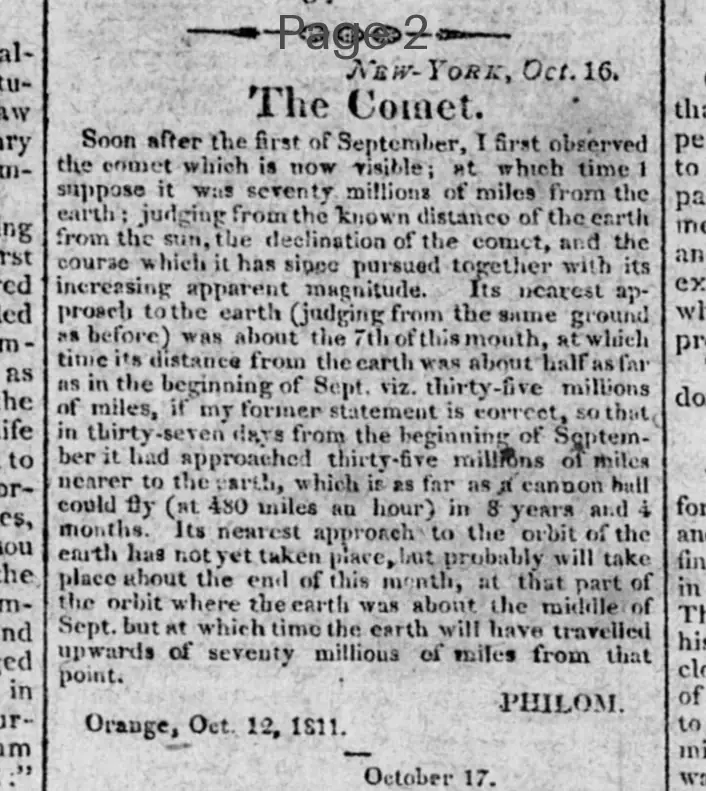
NEW-YORK, Oct. 16.
The Comet.
Soon after the first of September, I first observed the comet which is now visible; at which time I suppose it was seventy millions of miles from the earth; judging from the known distance of the earth from the sun, the declination of the comet, and the course which it has since pursued together with its increasing apparent magnitude. Its nearest approach to the earth (judging from the same grounds before) was about the 7th of this month, at which time its distance from the earth was about half as far as in the beginning of Sept. viz. thirty-five millions of miles, if my former statement is correct, so that in thirty-seven days from the beginning of September it had approached thirty-five millions of miles nearer to the earth, which is as far as a cannon ball could go (at 450 miles an hour) in 8 years and 4 months. Its nearest approach to the orbit of the earth has not yet taken place, but probably will take place about the end of this month, at that part of the orbit where the earth was about the middle of Sept. but at which time the earth will have travelled upwards of seventy millions of miles from that point.
PHILOM.
Orange, Oct. 12, 1811.
The Comet.
Soon after the first of September, I first observed the comet which is now visible; at which time I suppose it was seventy millions of miles from the earth; judging from the known distance of the earth from the sun, the declination of the comet, and the course which it has since pursued together with its increasing apparent magnitude. Its nearest approach to the earth (judging from the same grounds before) was about the 7th of this month, at which time its distance from the earth was about half as far as in the beginning of Sept. viz. thirty-five millions of miles, if my former statement is correct, so that in thirty-seven days from the beginning of September it had approached thirty-five millions of miles nearer to the earth, which is as far as a cannon ball could go (at 450 miles an hour) in 8 years and 4 months. Its nearest approach to the orbit of the earth has not yet taken place, but probably will take place about the end of this month, at that part of the orbit where the earth was about the middle of Sept. but at which time the earth will have travelled upwards of seventy millions of miles from that point.
PHILOM.
Orange, Oct. 12, 1811.
What sub-type of article is it?
Weather
What keywords are associated?
Comet
Observation
Astronomy
Distance
Earth Orbit
Philom
Orange
What entities or persons were involved?
Philom
Where did it happen?
Orange
Domestic News Details
Primary Location
Orange
Event Date
September To October 1811
Key Persons
Philom
Event Details
Observer first saw the visible comet soon after September 1, estimating its distance at 70 million miles from Earth. By October 7, it approached to 35 million miles. Nearest to Earth's orbit expected by end of October.