Thank you for visiting SNEWPapers!
Sign up free
The Patowmac Guardian, And Berkeley Advertiser
Martinsburg, Shepherdstown, Berkeley County, Jefferson County, West Virginia
What is this article about?
Algerine corsairs, following a pacification with Portuguese and Dutch possibly instigated by British, captured 14 American vessels in the Mediterranean in October 1793, leading to 115 captives enduring brutal slavery in Algiers. Eyewitness reports detail harsh treatment and trade exclusion impacts.
Merged-components note: Merged related foreign news reports on American vessels captured by Algerines, including a list of captures (originally labeled shipping) and an editorial commentary on the treatment of prisoners and need for relief, as they form a coherent logical unit on the topic.
Clipping
OCR Quality
Full Text
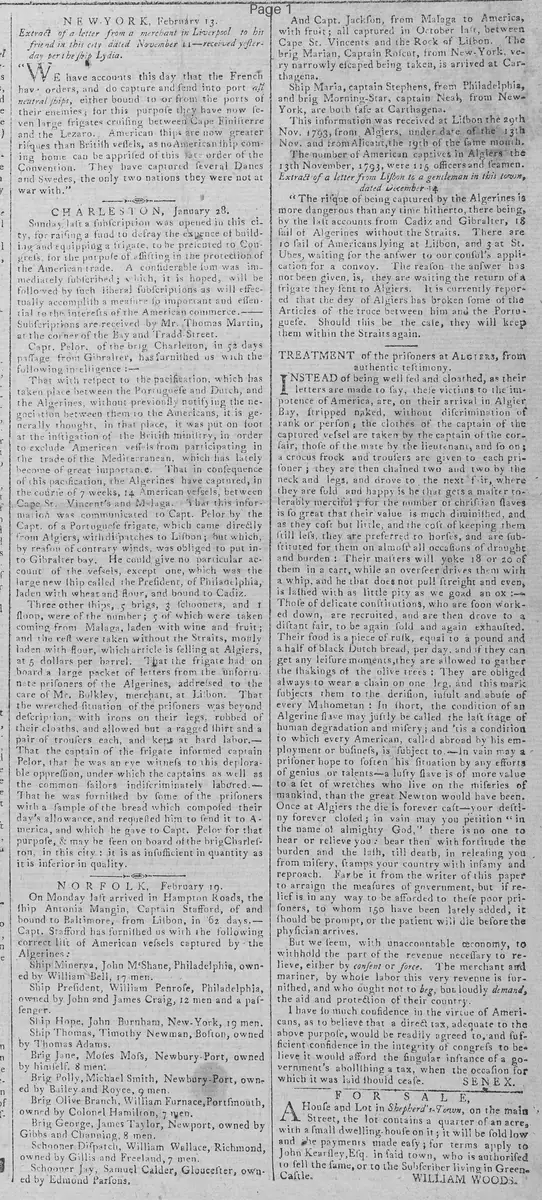
That with respect to the pacification, which has taken place between the Portuguese and Dutch, and the Algerines, without previously notifying the negotiation between them to the Americans, it is generally thought, in that place, it was put on foot at the instigation of the British ministry, in order to exclude American vessels from participating in the trade of the Mediterranean, which has lately become of great importance. That in consequence of this pacification, the Algerines have captured, in the course of 7 weeks, 14 American vessels, between Cape St. Vincent's and Malaga. That this information was communicated to Capt. Pelot by the Capt. of a Portuguese frigate, which came directly from Algiers, with dispatches to Lisbon; but which, by reason of contrary winds, was obliged to put into Gibraltar bay. He could give no particular account of the vessels, except one, which was the large new ship called the President, of Philadelphia, laden with wheat and flour, and bound to Cadiz.
Three other ships, 5 brigs, 3 schooners, and 1 sloop, were of the number; 5 of which were taken coming from Malaga, laden with wine and fruit; and the rest were taken without the Straits, mostly laden with flour, which article is selling at Algiers, at 5 dollars per barrel. That the frigate had on board a large packet of letters from the unfortunate prisoners of the Algerines, addressed to the care of Mr. Bulkeley, merchant, at Lisbon. That the wretched situation of the prisoners was beyond description, with irons on their legs, robbed of their clothes, and allowed but a ragged shirt and a pair of trousers each, and kept at hard labor.
That the captain of the frigate informed captain Pelot, that he was an eye witness to this deplorable oppression, under which the captains as well as the common sailors indiscriminately labored.
That he was furnished by some of the prisoners with a sample of the bread which composed their day's allowance, and requested him to send it to America, and which he gave to Capt. Pelot for that purpose, & may be seen on board of the brig Charleston, in this city: it is as insufficient in quantity as it is inferior in quality.
NORFOLK, February 19.
On Monday last arrived in Hampton Roads, the ship Antonia Mangin, Captain Stafford, of and bound to Baltimore, from Lisbon, in 62 days.
Capt. Stafford has furnished us with the following correct list of American vessels captured by the Algerines:
Ship Minerva, John M'Shane, Philadelphia, owned by William Bell, 17 men.
Ship President, William Penrose, Philadelphia, owned by John and James Craig, 12 men and a passenger.
Ship Hope, John Burnham, New York, 9 men.
Ship Thomas, Timothy Newman, Boston, owned by Thomas Adams.
Brig Jane, Moses Moss, Newbury-Port, owned by himself, 8 men.
Brig Polly, Michael Smith, Newbury-Port, owned by Bailey and Royce, 9 men.
Brig Olive Branch, William Furnace, Portsmouth, owned by Colonel Hamilton, 7 men.
Brig George, James Taylor, Newport, owned by Gibbs and Channing, 8 men.
Schooner Dispatch, William Wallace, Richmond, owned by Gillis and Freeland, 7 men.
Schooner Jay, Samuel Calder, Gloucester, owned by Edmond Parsons.
And Capt. Jackson, from Malaga to America, with fruit: all captured in October last, between Cape St. Vincent's and the Rock of Lisbon. The brig Marian, Captain Roscot, from New-York, very narrowly escaped being taken, is arrived at Carthagena.
Ship Maria, captain Stephens, from Philadelphia, and brig Morning-Star, captain Neah, from New-York, are both safe at Carthagena.
This information was received at Lisbon the 29th Nov. 1793, from Algiers, under date of the 13th Nov. and from Alicante, the 19th of the same month.
The number of American captives in Algiers the 13th November, 1793, were 115 officers and seamen.
Extract of a letter from Lisbon to a gentleman in this town, dated December 14.
"The risque of being captured by the Algerines is more dangerous than at any time hitherto, there being, by the last accounts from Cadiz and Gibraltar, 18 sail of Algerines without the Straits. There are 10 sail of Americans lying at Lisbon, and 3 at St. Ubes, waiting for the answer to our consul's application for a convoy. The reason the answer has not been given, is, they are waiting the return of a frigate they sent to Algiers. It is currently reported that the Dey of Algiers has broken one of the articles of the truce between him and the Portuguese. Should this be the case, they will keep them within the Straits again."
TREATMENT of the prisoners at ALGIERS, from authentic testimony.
INSTEAD of being well fed and clothed, as their letters are made to say, these victims to the impotence of America, are, on their arrival in Algier Bay, stripped naked, without discrimination of rank or person; the clothes of the captain of the captured vessel are taken by the captain of the corsair, those of the mate by the lieutenant, and so on; a crocus frock and trousers are given to each prisoner; they are then chained two and two by the neck and legs, and drove to the next fair, where they are sold and happy is he that gets a master tolerably merciful; for the number of christian slaves is so great that their value is much diminished, and as they cost but little, and the cost of keeping them still less, they are preferred to horses, and are substituted for them on almost all occasions of draught and burden: Their masters will yoke 18 or 20 of them in a cart, while an overseer drives them with a whip, and he that does not pull straight and even, is lashed with as little pity as we goad an ox.
Those of delicate constitutions, who are soon worked down, are recruited, and are then drove to a distant fair, to be again sold and again exhausted.
Their food is a piece of rusk, equal to a pound and a half of black Dutch bread, per day, and if they can get any leisure moments, they are allowed to gather the shakings of the olive trees: They are obliged always to wear a chain on one leg, and this mark subjects them to the derision, insult and abuse of every Mahometan: In short, the condition of an Algerine slave may justly be called the last stage of human degradation and misery; and 'tis a condition to which every American, called abroad by his employment or business, is subject to.
In vain may a prisoner hope to soften his situation by any efforts of genius or talents—a lusty slave is of more value to a set of wretches who live on the miseries of mankind, than the great Newton would have been.
Once at Algiers the die is forever cast—your destiny forever closed; in vain may you petition "in the name of almighty God," there is no one to hear or relieve you: bear then with fortitude the burden and the lash, till death, in releasing you from misery, stamps your country with infamy and reproach. Far be it from the writer of this paper to arraign the measures of government, but if relief is in any way to be afforded to these poor prisoners, to whom 150 have been lately added, it should be prompt, or the patient will die before the physician arrives.
But we seem, with unaccountable economy, to withhold the part of the revenue necessary to relieve, either by consent or force. The merchant and mariner, by whose labor this very revenue is furnished, and who ought not to beg, but loudly demand, the aid and protection of their country.
I have so much confidence in the virtue of Americans, as to believe that a direct tax, adequate to the above purpose, would be readily agreed to, and sufficient confidence in the integrity of Congress to believe it would afford the singular instance of a government's abolishing a tax, when the occasion for which it was laid should cease.
SENEX.
What sub-type of article is it?
What keywords are associated?
What entities or persons were involved?
Where did it happen?
Foreign News Details
Primary Location
Algiers
Event Date
October 1793
Key Persons
Outcome
14 american vessels captured by algerines in 7 weeks; 115 officers and seamen captives in algiers as of 13th november 1793; prisoners subjected to harsh treatment including chains, hard labor, and inadequate food.
Event Details
Pacification between Portuguese, Dutch, and Algerines allegedly instigated by British to exclude American trade from Mediterranean. Algerines captured 14 American vessels between Cape St. Vincent's and Malaga, including ship President from Philadelphia. List of captured vessels provided by Capt. Stafford. Prisoners stripped, chained, sold as slaves, forced into hard labor, fed insufficient bread. Letters from prisoners and eyewitness accounts detail deplorable conditions.