Thank you for visiting SNEWPapers!
Sign up free
Editorial
September 4, 1816
Daily National Intelligencer
Washington, District Of Columbia
What is this article about?
The editorial lauds the efficient US tax collection over the last three years, yielding more than estimated at just 6% cost, as proof of representative democracy's virtues, American prosperity, and a rebuttal to federalist war-era criticisms. It contrasts with higher costs in Europe.
Clipping
OCR Quality
98%
Excellent
Full Text
THE COLLECTION OF TAXES.
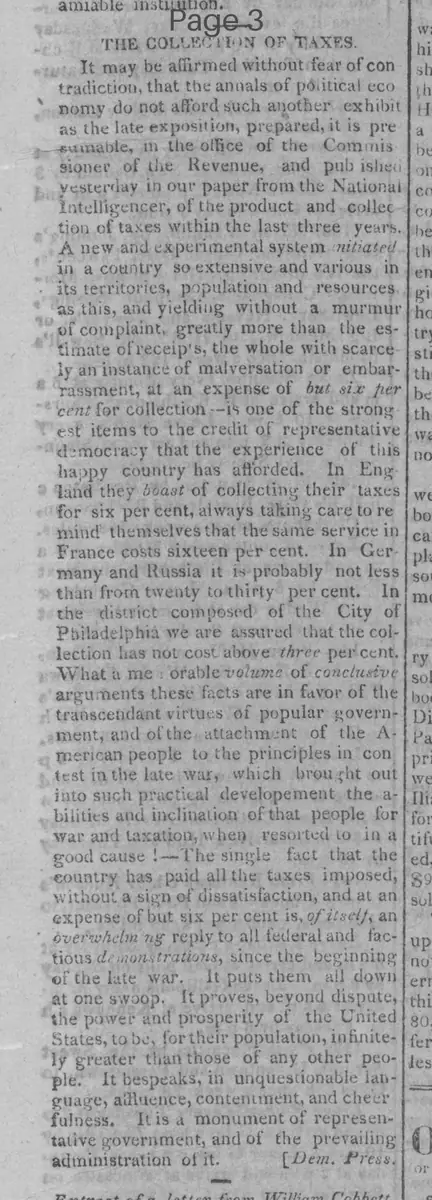
It may be affirmed without fear of contradiction, that the annals of political economy do not afford such another exhibit as the late exposition, prepared, it is presumable, in the office of the Commissioner of the Revenue, and published yesterday in our paper from the National Intelligencer, of the product and collection of taxes within the last three years. A new and experimental system initiated in a country so extensive and various in its territories, population and resources, as this, and yielding without a murmur of complaint, greatly more than the estimate of receipts, the whole with scarcely an instance of malversation or embarrassment, at an expense of but six per cent for collection -- is one of the strongest items to the credit of representative democracy that the experience of this happy country has afforded. In England they boast of collecting their taxes for six per cent, always taking care to remind themselves that the same service in France costs sixteen per cent. In Germany and Russia it is probably not less than from twenty to thirty per cent. In the district composed of the City of Philadelphia we are assured that the collection has not cost above three per cent. What a memorable volume of conclusive arguments these facts are in favor of the transcendent virtues of popular government, and of the attachment of the American people to the principles in contest in the late war, which brought out into such practical development the abilities and inclination of that people for war and taxation, when resorted to in a good cause! -- The single fact that the country has paid all the taxes imposed, without a sign of dissatisfaction, and at an expense of but six per cent is, of itself, an overwhelming reply to all federal and factious demonstrations, since the beginning of the late war. It puts them all down at one swoop. It proves, beyond dispute, the power and prosperity of the United States, to be, for their population, infinitely greater than those of any other people. It bespeaks, in unquestionable language, affluence, contentment, and cheerfulness. It is a monument of representative government, and of the prevailing administration of it.
[Dem. Press.
It may be affirmed without fear of contradiction, that the annals of political economy do not afford such another exhibit as the late exposition, prepared, it is presumable, in the office of the Commissioner of the Revenue, and published yesterday in our paper from the National Intelligencer, of the product and collection of taxes within the last three years. A new and experimental system initiated in a country so extensive and various in its territories, population and resources, as this, and yielding without a murmur of complaint, greatly more than the estimate of receipts, the whole with scarcely an instance of malversation or embarrassment, at an expense of but six per cent for collection -- is one of the strongest items to the credit of representative democracy that the experience of this happy country has afforded. In England they boast of collecting their taxes for six per cent, always taking care to remind themselves that the same service in France costs sixteen per cent. In Germany and Russia it is probably not less than from twenty to thirty per cent. In the district composed of the City of Philadelphia we are assured that the collection has not cost above three per cent. What a memorable volume of conclusive arguments these facts are in favor of the transcendent virtues of popular government, and of the attachment of the American people to the principles in contest in the late war, which brought out into such practical development the abilities and inclination of that people for war and taxation, when resorted to in a good cause! -- The single fact that the country has paid all the taxes imposed, without a sign of dissatisfaction, and at an expense of but six per cent is, of itself, an overwhelming reply to all federal and factious demonstrations, since the beginning of the late war. It puts them all down at one swoop. It proves, beyond dispute, the power and prosperity of the United States, to be, for their population, infinitely greater than those of any other people. It bespeaks, in unquestionable language, affluence, contentment, and cheerfulness. It is a monument of representative government, and of the prevailing administration of it.
[Dem. Press.
What sub-type of article is it?
Economic Policy
Partisan Politics
Constitutional
What keywords are associated?
Tax Collection
Representative Democracy
Political Economy
War Taxation
Federalist Criticisms
American Prosperity
What entities or persons were involved?
Commissioner Of The Revenue
National Intelligencer
England
France
Germany
Russia
City Of Philadelphia
United States
Federal And Factious Demonstrations
Editorial Details
Primary Topic
Efficient Tax Collection As Proof Of Representative Democracy
Stance / Tone
Strongly Supportive Of Popular Government And Administration
Key Figures
Commissioner Of The Revenue
National Intelligencer
England
France
Germany
Russia
City Of Philadelphia
United States
Federal And Factious Demonstrations
Key Arguments
Us Tax Collection Yielded More Than Estimated Without Complaints
Cost Only 6% For Collection, Lower In Philadelphia At 3%
Contrasts Favorably With Europe's Higher Costs (England 6%, France 16%, Germany/Russia 20 30%)
Demonstrates Virtues Of Representative Democracy
Shows American Attachment To War Principles
Refutes Federalist Criticisms Since The War
Proves Us Power And Prosperity Superior Per Population
Indicates Affluence, Contentment, And Cheerfulness