Thank you for visiting SNEWPapers!
Sign up free
Norfolk Gazette And Publick Ledger
Norfolk, Virginia
What is this article about?
In Letter VII to his constituents, James Elliot opposes Mr. Randolph's resolutions on Georgia's land claims, arguing that Congress cannot judge state legislative corruption or impair contracts, as it would violate the U.S. Constitution and usurp state powers. He emphasizes public faith and constitutional limits.
Merged-components note: Merged continuation of Mr. Elliot's letter to constituents across page break, as the text flows coherently from the end of the page 2 component into the page 3 component with sequential reading order.
Clippings
1 of 2
OCR Quality
Full Text
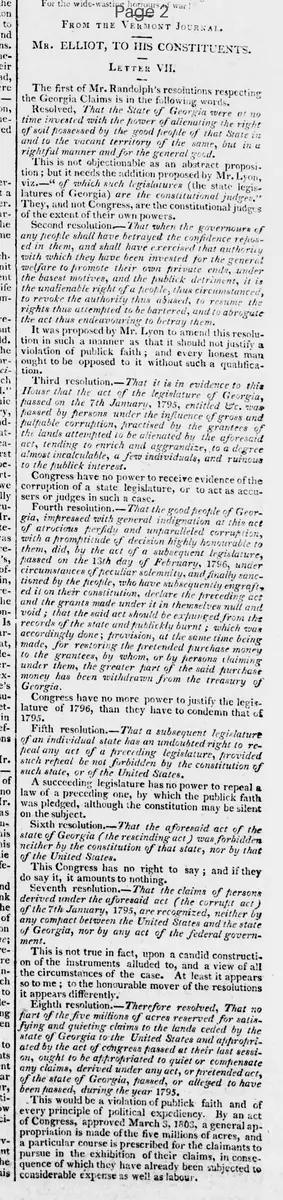
MR. ELLIOT, TO HIS CONSTITUENTS.
Letter VII.
The first of Mr. Randolph's resolutions respecting the Georgia Claims is in the following words.
Resolved, That the State of Georgia were at no time invested with the power of alienating the right of soil possessed by the good people of that State in and to the vacant territory of the same, but in a rightful manner and for the general good.
This is not objectionable as an abstract proposition; but it needs the addition proposed by Mr. Lyon, viz. "of which such legislatures (the state legislatures of Georgia) are the constitutional judges." They, and not Congress, are the constitutional judges of the extent of their own powers.
Second resolution—That when the governors of any people shall have betrayed the confidence reposed in them, and shall have exercised that authority with which they have been invested for the general welfare to promote their own private ends, under the basest motives, and the publick detriment, it is the unalienable right of a people, thus circumstanced, to revoke the authority thus abused, to resume the rights thus attempted to be bartered, and to abrogate the act thus endeavouring to betray them.
It was proposed by Mr. Lyon to amend this resolution in such a manner as that it should not justify a violation of publick faith; and every honest man ought to be opposed to it without such a qualification.
Third resolution.—That it is in evidence to this House that the act of the legislature of Georgia, passed on the 7th January, 1795, entitled &c. was passed by persons under the influence of gross and palpable corruption, practised by the grantees of the lands attempted to be alienated by the aforesaid act, tending to enrich and aggrandize, to a degree almost incalculable, a few individuals, and ruinous to the publick interest.
Congress have no power to receive evidence of the corruption of a state legislature, or to act as accusers or judges in such a case.
Fourth resolution. That the good people of Georgia, impressed with general indignation at this act of atrocious perfidy and unparalleled corruption, with a promptitude of decision highly honourable to them, did, by the act of a subsequent legislature, passed on the 13th day of February, 1796, under circumstances of peculiar solemnity, and finally sanctioned by the people, who have subsequently engrafted it on their constitution, declare the preceding act and the grants made under it in themselves null and void; that the said act should be expunged from the records of the state and publickly burnt; which was accordingly done; provision, at the same time being made, for restoring the pretended purchase money to the grantees, by whom, or by persons claiming under them, the greater part of the said purchase money has been withdrawn from the treasury of Georgia.
Congress have no more power to justify the legislature of 1796, than they have to condemn that of 1795.
Fifth resolution.—That a subsequent legislature of an individual state has an undoubted right to repeal any act of a preceding legislature, provided such repeal be not forbidden by the constitution of such state, or of the United States.
A succeeding legislature has no power to repeal a law of a preceding one, by which the publick faith was pledged, although the constitution may be silent on the subject.
Sixth resolution.—That the aforesaid act of the state of Georgia (the rescinding act) was forbidden neither by the constitution of that state, nor by that of the United States.
This Congress has no right to say; and if they do say it, it amounts to nothing.
Seventh resolution.—That the claims of persons derived under the aforesaid act (the corrupt act) of the 7th January, 1795, are recognized, neither by any compact between the United States and the state of Georgia, nor by any act of the federal government.
This is not true in fact, upon a candid construction of the instruments alluded to, and a view of all the circumstances of the case. At least it appears so to me; to the honourable mover of the resolutions it appears differently.
Eighth resolution.—Therefore resolved, That no part of the five millions of acres reserved for satisfying and quieting claims to the lands ceded by the state of Georgia to the United States and appropriated by the act of congress passed at their last session, ought to be appropriated to quiet or compensate any claims, derived under any act, or pretended act, of the state of Georgia, passed, or alleged to have been passed, during the year 1795.
This would be a violation of publick faith and of every principle of political expediency. By an act of Congress, approved March 3, 1803, a general appropriation is made of the five millions of acres, and a particular course is prescribed for the claimants to pursue in the exhibition of their claims, in consequence of which they have already been subjected to considerable expense as well as labour.
The United States never paid a cent for the five millions of acres, and but a mere trifle for the remaining part of the territory. Nothing can be clearer, therefore, than that it would be expedient to quiet the claims. But the great objections which I have constantly urged to the resolutions are founded upon the idea that they are repugnant to the constitution of the United States.
By the constitution, the states are interdicted from passing laws impairing the obligation of contracts. The act of 1795, created a contract upon the face of it, and if it be alleged that the apparent contract was void on the ground of corruption, the question must be determined by a court of law, and not by a succeeding state legislature, or by Congress. By one of the first amendments of the constitution, all those rights and powers, appertaining to the States, and not expressly yielded to the general government, are reserved to the states respectively, or to the people. The legislative powers of the state of Georgia, alluded to in these resolutions, belong to the class which has never been given up to the Union. We have no power therefore to make any decision upon their validity or invalidity, or to delineate the sphere or extent of their operation. It would be an act of usurpation. Whatever idea may be entertained of inquisitorial and censorial powers, in relation to other subjects, there can be no doubt that this would be an assumption, on the part of Congress, of inquisitorial and censorial powers over the state governments.
Applicable to my conduct in opposing those famous resolutions is the sentiment of the mover in reference to his able efforts in supporting them. "It will be a subject of never failing self gratulation to me that I have done so, as it would have been of remorse had I done otherwise."
JAMES ELLIOT.
What sub-type of article is it?
What themes does it cover?
What keywords are associated?
What entities or persons were involved?
Letter to Editor Details
Author
James Elliot
Recipient
His Constituents
Main Argument
congress lacks authority to invalidate georgia's 1795 land grant act due to alleged corruption or to judge state legislative actions, as this would impair contracts, violate public faith, and usurp reserved state powers under the u.s. constitution.
Notable Details