Thank you for visiting SNEWPapers!
Sign up free
Story
June 8, 1897
The River Falls Times
River Falls, Pierce County, Wisconsin
What is this article about?
Practical guide to raising ducks profitably on farms, highlighting benefits of water access, small flock management, daily egg production, and specific feeding to ensure health and nutrition for family provisions.
Clipping
OCR Quality
98%
Excellent
Full Text
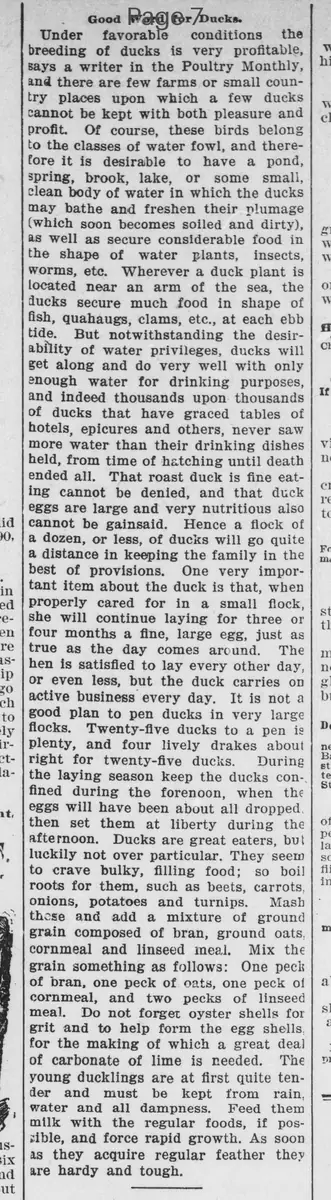
Under favorable conditions the breeding of ducks is very profitable, says a writer in the Poultry Monthly, and there are few farms or small country places upon which a few ducks cannot be kept with both pleasure and profit.
Of course, these birds belong to the classes of water fowl, and therefore it is desirable to have a pond, spring, brook, lake, or some small, clean body of water in which the ducks may bathe and freshen their plumage (which soon becomes soiled and dirty), as well as secure considerable food in the shape of water plants, insects, worms, etc.
Wherever a duck plant is located near an arm of the sea, the ducks secure much food in shape of fish, quahaugs, clams, etc., at each ebb tide.
But notwithstanding the desirability of water privileges, ducks will get along and do very well with only enough water for drinking purposes, and indeed thousands upon thousands of ducks that have graced tables of hotels, epicures and others, never saw more water than their drinking dishes held, from time of hatching until death ended all.
That roast duck is fine eating cannot be denied, and that duck eggs are large and very nutritious also cannot be gainsaid. Hence a flock of a dozen, or less, of ducks will go quite a distance in keeping the family in the best of provisions.
One very important item about the duck is that, when properly cared for in a small flock, she will continue laying for three or four months a fine, large egg, just as true as the day comes around. The hen is satisfied to lay every other day, or even less, but the duck carries on active business every day.
It is not a good plan to pen ducks in very large flocks. Twenty-five ducks to a pen is plenty, and four lively drakes about right for twenty-five ducks. During the laying season keep the ducks confined during the forenoon, when the eggs will have been about all dropped, then set them at liberty during the afternoon.
Ducks are great eaters, but luckily not over particular. They seem to crave bulky, filling food: so boil roots for them, such as beets, carrots, onions, potatoes and turnips. Mash these and add a mixture of ground grain composed of bran, ground oats, cornmeal and linseed meal. Mix the grain something as follows: One peck of bran, one peck of oats, one peck of cornmeal, and two pecks of linseed meal.
Do not forget oyster shells for grit and to help form the egg shells, for the making of which a great deal of carbonate of lime is needed.
The young ducklings are at first quite tender and must be kept from rain, water and all dampness. Feed them milk with the regular foods, if possible, and force rapid growth. As soon as they acquire regular feather they are hardy and tough.
Of course, these birds belong to the classes of water fowl, and therefore it is desirable to have a pond, spring, brook, lake, or some small, clean body of water in which the ducks may bathe and freshen their plumage (which soon becomes soiled and dirty), as well as secure considerable food in the shape of water plants, insects, worms, etc.
Wherever a duck plant is located near an arm of the sea, the ducks secure much food in shape of fish, quahaugs, clams, etc., at each ebb tide.
But notwithstanding the desirability of water privileges, ducks will get along and do very well with only enough water for drinking purposes, and indeed thousands upon thousands of ducks that have graced tables of hotels, epicures and others, never saw more water than their drinking dishes held, from time of hatching until death ended all.
That roast duck is fine eating cannot be denied, and that duck eggs are large and very nutritious also cannot be gainsaid. Hence a flock of a dozen, or less, of ducks will go quite a distance in keeping the family in the best of provisions.
One very important item about the duck is that, when properly cared for in a small flock, she will continue laying for three or four months a fine, large egg, just as true as the day comes around. The hen is satisfied to lay every other day, or even less, but the duck carries on active business every day.
It is not a good plan to pen ducks in very large flocks. Twenty-five ducks to a pen is plenty, and four lively drakes about right for twenty-five ducks. During the laying season keep the ducks confined during the forenoon, when the eggs will have been about all dropped, then set them at liberty during the afternoon.
Ducks are great eaters, but luckily not over particular. They seem to crave bulky, filling food: so boil roots for them, such as beets, carrots, onions, potatoes and turnips. Mash these and add a mixture of ground grain composed of bran, ground oats, cornmeal and linseed meal. Mix the grain something as follows: One peck of bran, one peck of oats, one peck of cornmeal, and two pecks of linseed meal.
Do not forget oyster shells for grit and to help form the egg shells, for the making of which a great deal of carbonate of lime is needed.
The young ducklings are at first quite tender and must be kept from rain, water and all dampness. Feed them milk with the regular foods, if possible, and force rapid growth. As soon as they acquire regular feather they are hardy and tough.
What sub-type of article is it?
Agricultural Advice
Poultry Farming
What keywords are associated?
Duck Breeding
Poultry Profit
Water Fowl
Egg Laying
Feeding Ducks
Story Details
Story Details
Article advises on profitable duck breeding, emphasizing water access for health and food, but noting ducks can thrive with minimal water. Recommends small flocks of 25 ducks with 4 drakes, daily egg-laying, specific feeding with boiled roots and grain mix, oyster shells for eggshells, and careful care for ducklings.