Thank you for visiting SNEWPapers!
Sign up free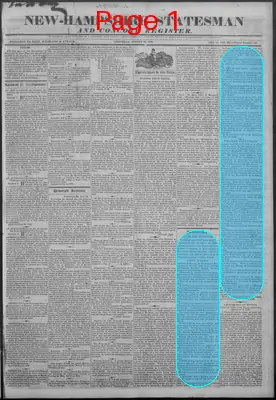
Story
August 26, 1826
New Hampshire Statesman And Concord Register
Concord, Merrimack County, New Hampshire
What is this article about?
Biographical timelines of John Adams and Thomas Jefferson, covering their births, educations, roles in American independence, diplomatic and political careers, presidencies, and synchronized deaths on July 4, 1826.
Clipping
OCR Quality
98%
Excellent
Full Text
Miscellaneous.
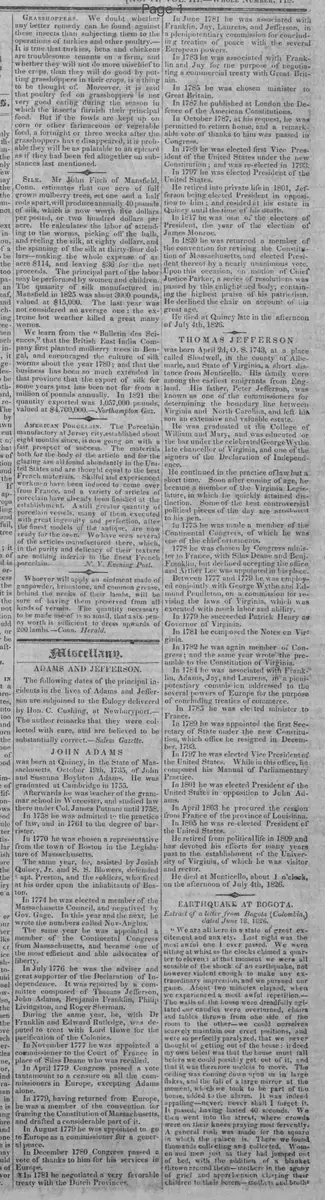
ADAMS AND JEFFERSON.
The following dates of the principal incidents in the lives of Adams and Jefferson are subjoined to the Eulogy delivered by Hon. C. Cushing, at Newburyport.—The author remarks that they were collected with care, and are believed to be substantially correct.—Salem Gazette.
JOHN ADAMS was born at Quincy, in the State of Massachusetts, October 19th, 1735, of John and Susanna Boylston Adams. He was graduated at Cambridge in 1755. Afterwards he was teacher of the grammar school in Worcester, and studied law there under Col. James Putnam until 1758. In 1758 he was admitted to the practice of law, and in 1761 to the degree of barrister.
In 1770 he was chosen a representative from the town of Boston in the Legislature of Massachusetts. The same year, he, assisted by Josiah Quincy, Jr. and S. S. Blowers, defended Capt. Preston, and the soldiers, who fired at his order upon the inhabitants of Boston.
In 1774 he was elected a member of the Massachusetts Council, and negatived by Gov. Gage. In this year and the next, he wrote the numbers called Nov-Anglus. The same year he was appointed a member of the Continental Congress from Massachusetts, and became one of the most efficient and able advocates of liberty.
In July 1776 he was the adviser and great supporter of the Declaration of Independence. It was reported by a committee composed of Thomas Jefferson, John Adams, Benjamin Franklin, Philip Livingston, and Roger Sherman.
During the same year, he, with Dr. Franklin and Edward Rutledge, was deputed to treat with Lord Howe for the pacification of the Colonies.
In November 1777 he was appointed a commissioner to the Court of France in place of Silas Deane who was recalled. In April 1779 Congress passed a vote tantamount to a censure on all the commissioners in Europe, excepting Adams alone.
In 1779, having returned from Europe, he was a member of the convention for framing the Constitution of Massachusetts, and drafted a considerable part of it.
In August 1779 he was appointed to go to Europe as a commissioner or a general peace. In December 1780 Congress passed a vote of thanks to him for his services in Europe.
In 1781 he negotiated a very favorable treaty with the Dutch Provinces.
In June 1781 he was associated with Franklin, Jay, Laurens, and Jefferson, in a plenipotentiary commission for concluding treaties of peace with the several European powers. In 1783 he was associated with Franklin and Jay for the purpose of negotiating a commercial treaty with Great Britain.
In 1785 he was chosen minister to Great Britain. In 1787 he published at London the Defence of the American Constitutions. In October 1787, at his request, he was permitted to return home, and a remarkable vote of thanks to him was passed in Congress.
In 1789 he was elected first Vice President of the United States under the new Constitution: and was re-elected in 1793. In 1797 he was elected President of the United States. He retired into private life in 1801, Jefferson being elected President in opposition to him; and resided at his estate in Quincy until the time of his death.
In 1817 he was one of the electors of President, the year of the election of James Monroe. In 1820 he was returned a member of the convention for revising the Constitution of Massachusetts, and elected President thereof by a nearly unanimous vote. Upon this occasion, on motion of Chief Justice Parker, a series of resolutions was passed by this enlightened body, containing the highest praise of his patriotism. He declined the chair on account of his great age.
He died at Quincy late in the afternoon of July 4th, 1826.
THOMAS JEFFERSON was born April 2d, O. S. 1743, at a place called Shadwell, in the county of Albemarle, and State of Virginia, a short distance from Monticello. His family were among the earliest emigrants from England. His father, Peter Jefferson, was known as one of the commissioners for determining the boundary line between Virginia and North Carolina, and left his son an extensive and valuable estate.
He was graduated at the College of William and Mary, and was educated for the bar under the celebrated George Wythe late chancellor of Virginia, and one of the signers of the Declaration of Independence.
He continued in the practice of law but a short time. Soon after coming of age, he became a member of the Virginia Legislature, in which he quickly attained distinction. Some of the best controversial political pieces of the day are attributed to his pen.
In 1775 he was made a member of the Continental Congress, of which he was one of the chief ornaments. In 1776 he was chosen by Congress minister to France, with Silas Deane and Benj. Franklin, but declined accepting the office and Arthur Lee was appointed in his place.
Between 1777 and 1779 he was employed conjointly with George Wythe and Edmund Pendleton, on a commission for revising the laws of Virginia, which was executed with much labor and ability.
In 1779 he succeeded Patrick Henry as Governor of Virginia. In 1781 he composed the Notes on Virginia. In 1782 he was again member of Congress; and the same year wrote the preamble to the Constitution of Virginia.
In 1784 he was associated with Franklin, Adams, Jay, and Laurens, in a plenipotentiary commission addressed to the several powers of Europe for the purpose of concluding treaties of commerce. In 1785 he was elected minister to France. In 1789 he was appointed the first Secretary of State under the new Constitution, which office he resigned in December, 1793.
In 1797 he was elected Vice President of the United States. While in this office, he composed his Manual of Parliamentary Practice. In 1801 he was elected President of the United States in opposition to John Adams. In April 1803 he procured the cession from France of the province of Louisiana. In 1805 he was re-elected President of the United States. He retired from political life in 1809 and has devoted his efforts for many years past to the establishment of the University of Virginia, of which he was visitor and rector.
He died at Monticello, about 1 o'clock, on the afternoon of July 4th, 1826.
ADAMS AND JEFFERSON.
The following dates of the principal incidents in the lives of Adams and Jefferson are subjoined to the Eulogy delivered by Hon. C. Cushing, at Newburyport.—The author remarks that they were collected with care, and are believed to be substantially correct.—Salem Gazette.
JOHN ADAMS was born at Quincy, in the State of Massachusetts, October 19th, 1735, of John and Susanna Boylston Adams. He was graduated at Cambridge in 1755. Afterwards he was teacher of the grammar school in Worcester, and studied law there under Col. James Putnam until 1758. In 1758 he was admitted to the practice of law, and in 1761 to the degree of barrister.
In 1770 he was chosen a representative from the town of Boston in the Legislature of Massachusetts. The same year, he, assisted by Josiah Quincy, Jr. and S. S. Blowers, defended Capt. Preston, and the soldiers, who fired at his order upon the inhabitants of Boston.
In 1774 he was elected a member of the Massachusetts Council, and negatived by Gov. Gage. In this year and the next, he wrote the numbers called Nov-Anglus. The same year he was appointed a member of the Continental Congress from Massachusetts, and became one of the most efficient and able advocates of liberty.
In July 1776 he was the adviser and great supporter of the Declaration of Independence. It was reported by a committee composed of Thomas Jefferson, John Adams, Benjamin Franklin, Philip Livingston, and Roger Sherman.
During the same year, he, with Dr. Franklin and Edward Rutledge, was deputed to treat with Lord Howe for the pacification of the Colonies.
In November 1777 he was appointed a commissioner to the Court of France in place of Silas Deane who was recalled. In April 1779 Congress passed a vote tantamount to a censure on all the commissioners in Europe, excepting Adams alone.
In 1779, having returned from Europe, he was a member of the convention for framing the Constitution of Massachusetts, and drafted a considerable part of it.
In August 1779 he was appointed to go to Europe as a commissioner or a general peace. In December 1780 Congress passed a vote of thanks to him for his services in Europe.
In 1781 he negotiated a very favorable treaty with the Dutch Provinces.
In June 1781 he was associated with Franklin, Jay, Laurens, and Jefferson, in a plenipotentiary commission for concluding treaties of peace with the several European powers. In 1783 he was associated with Franklin and Jay for the purpose of negotiating a commercial treaty with Great Britain.
In 1785 he was chosen minister to Great Britain. In 1787 he published at London the Defence of the American Constitutions. In October 1787, at his request, he was permitted to return home, and a remarkable vote of thanks to him was passed in Congress.
In 1789 he was elected first Vice President of the United States under the new Constitution: and was re-elected in 1793. In 1797 he was elected President of the United States. He retired into private life in 1801, Jefferson being elected President in opposition to him; and resided at his estate in Quincy until the time of his death.
In 1817 he was one of the electors of President, the year of the election of James Monroe. In 1820 he was returned a member of the convention for revising the Constitution of Massachusetts, and elected President thereof by a nearly unanimous vote. Upon this occasion, on motion of Chief Justice Parker, a series of resolutions was passed by this enlightened body, containing the highest praise of his patriotism. He declined the chair on account of his great age.
He died at Quincy late in the afternoon of July 4th, 1826.
THOMAS JEFFERSON was born April 2d, O. S. 1743, at a place called Shadwell, in the county of Albemarle, and State of Virginia, a short distance from Monticello. His family were among the earliest emigrants from England. His father, Peter Jefferson, was known as one of the commissioners for determining the boundary line between Virginia and North Carolina, and left his son an extensive and valuable estate.
He was graduated at the College of William and Mary, and was educated for the bar under the celebrated George Wythe late chancellor of Virginia, and one of the signers of the Declaration of Independence.
He continued in the practice of law but a short time. Soon after coming of age, he became a member of the Virginia Legislature, in which he quickly attained distinction. Some of the best controversial political pieces of the day are attributed to his pen.
In 1775 he was made a member of the Continental Congress, of which he was one of the chief ornaments. In 1776 he was chosen by Congress minister to France, with Silas Deane and Benj. Franklin, but declined accepting the office and Arthur Lee was appointed in his place.
Between 1777 and 1779 he was employed conjointly with George Wythe and Edmund Pendleton, on a commission for revising the laws of Virginia, which was executed with much labor and ability.
In 1779 he succeeded Patrick Henry as Governor of Virginia. In 1781 he composed the Notes on Virginia. In 1782 he was again member of Congress; and the same year wrote the preamble to the Constitution of Virginia.
In 1784 he was associated with Franklin, Adams, Jay, and Laurens, in a plenipotentiary commission addressed to the several powers of Europe for the purpose of concluding treaties of commerce. In 1785 he was elected minister to France. In 1789 he was appointed the first Secretary of State under the new Constitution, which office he resigned in December, 1793.
In 1797 he was elected Vice President of the United States. While in this office, he composed his Manual of Parliamentary Practice. In 1801 he was elected President of the United States in opposition to John Adams. In April 1803 he procured the cession from France of the province of Louisiana. In 1805 he was re-elected President of the United States. He retired from political life in 1809 and has devoted his efforts for many years past to the establishment of the University of Virginia, of which he was visitor and rector.
He died at Monticello, about 1 o'clock, on the afternoon of July 4th, 1826.
What sub-type of article is it?
Biography
Historical Event
What themes does it cover?
Triumph
Fate Providence
What keywords are associated?
John Adams
Thomas Jefferson
American Independence
Declaration Of Independence
Presidency
Diplomacy
July 4 1826
What entities or persons were involved?
John Adams
Thomas Jefferson
Story Details
Key Persons
John Adams
Thomas Jefferson
Event Date
1735 1826
Story Details
Timelines of births, educations, legal and political careers, roles in Continental Congress and Declaration of Independence, diplomatic missions to Europe, contributions to state constitutions, vice presidencies and presidencies, retirements, and deaths on July 4, 1826.