Thank you for visiting SNEWPapers!
Sign up free
Story
May 21, 1900
The Topeka State Journal
Topeka, Shawnee County, Kansas
What is this article about?
Coroner's inquest concludes Mrs. John M. Torrence died from peritonitis due to untreated typhoid fever under Christian Science care, ruled as neglect. Nurse Mrs. Whiteker defends faith healing methods; potential arrests of practitioners discussed.
Clipping
OCR Quality
88%
Good
Full Text
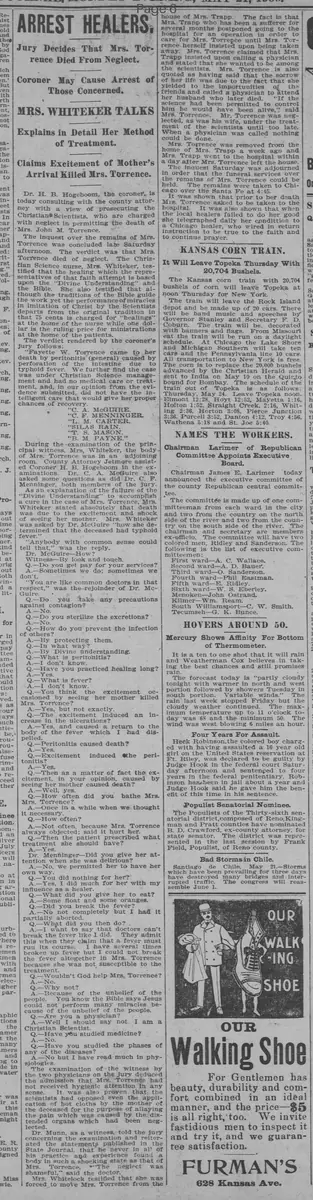
ARREST
HEALERS
Jury
Decides
That
Mrs. Torrence
Died
From
Neglect.
Coroner
May
Cause Arrest of
Those Concerned.
MRS. WHITEKER TALKS
Explains in Detail Her Method
of Treatment.
Claims Excitement of Mother's
Arrival Killed Mrs. Torrence.
Dr. H. B. Hogeboom, the coroner, is
today consulting with the county attorney
with a view of prosecuting the
Christian Scientists, who are charged
with neglect in permitting the death of
Mrs. John M. Torrence.
The inquest over the remains of Mrs.
Torrence was concluded late Saturday
afternoon. The verdict was that Mrs.
Torrence died of neglect. The Christian
Science nurse, Mrs. Whiteker, testified
that the healing which the representatives
of that faith attempt is based
upon the "Divine Understanding" and
the Bible. She also testified that although
the traditions of the Bible guide
the work yet the performance of miracles
in imitation of Christ by the Scientists
departs from the original tradition in
that 75 cents is charged for "healings"
at the home of the nurse while one dollar
is the ruling price for ministrations
at the home of the patients.
The verdict rendered by the coroner's
jury follows:
"Fayette W. Torrence came to her
death by peritonitis (general) caused by
perforation of the intestine due to
typhoid fever. We further find the case
was under Christian Science management
and had no medical care or treatment,
and, in our opinion from the evidence
submitted, did not have the intelligent
care that would give her proper
chances of recovery.
"C. A. McGUIRE.
"C. F. MENNINGER.
"L. M. CARTER.
"SILAS RAIN.
"T. S. MASON
"B. M. PAYNE."
During the examination of the principal
witness, Mrs. Whiteker, the body
of Mrs. Torrence was in an adjoining
room. County Attorney Jetmore assisted
Coroner H. B. Hogeboom in the examination.
Dr. C. A. McGuire also
asked some questions as did Dr. C. F.
Menninger, both members of the jury.
As an explanation of the failure of the
"Divine Understanding" to accomplish
a cure in the case of Mrs. Torrence, Mrs.
Whiteker stated absolutely that death
was due to the excitement and shock
of seeing her mother. Mrs. Whiteker
was asked by Dr. McGuire "how she determined
that the deceased had typhoid
fever."
"Anybody with common sense could
tell that," was the reply.
Dr. McGuire-How?
Witness-By look and touch
Q.-Do you get pay for your services?
A.-Sometimes we do; sometimes we
don't.
"You are like common doctors in that
respect,"
was the rejoinder of Dr. McGuire.
Q.-Do you take any precautions
against contagion?
A.-No.
Q.-Do you sterilize the excretions?
A.-No.
Q.-How do you prevent the infection
of others?
A.-By protecting them.
Q.-In what way?
A.-By Divine understanding.
Q.-What is peritonitis?
A.-I don't know.
Q.-Have you practiced healing long?
A.-Yes.
Q.-What is fever?
A.-I don't know.
Q.-You think the excitement occasioned
by seeing her mother killed
Mrs. Torrence?
A.-Yes, but not exactly.
Q.-The excitement induced an increase
in the ulcerations?
A.-Yes, and caused a return to the
body of the fever which I had dispelled.
Q.-Peritonitis caused death?
A.-Yes.
Q.-Excitement induced the peritonitis?
A.-Yes.
Q.-Then as a matter of fact the excitement,
in your opinion, caused by
seeing her mother caused death?
A.-Well, yes.
Q.-How often did you bathe Mrs.
Torrence?
A.-Once in a while when we thought
it necessary.
Q.-How often?
A.-Not often, because Mrs. Torrence
always objected; said it hurt her.
Q.-Then the patient prescribed what
treatment she should have?
A.-Yes.
Dr. Menninger-Did you give her attention
when she was delirious?
A.-No, we permitted her to have her
own way.
Q.-You did nothing for her?
A.-Yes, I did much for her with my
influence as a healer.
Q.-What did you give her to eat?
A.-Some float and some oranges.
Q.-Did you break the fever?
A.-No not completely but I had it
partially aborted.
Q.-What did you then do?
A.-I want to say that doctors can't
break the fever like I did. They admit
this when they claim that a fever must
run its course. I have several times
broken up fever but I could not break
the fever altogether in Mrs. Torrence
because she was not susceptible to the
treatment.
Q.-Wouldn't God help Mrs. Torrence?
A.-No.
Q.-Why not?
A.-Because of the unbelief of the
people. You know the Bible says Jesus
could not perform many miracles because
of the unbelief of the people.
Q.-Are you a physician?
A.-Well I should say not. I am a
Christian Scientist.
Q.-Have you studied medicine?
A.-No.
Q.-Have you studied the phases of
any of the diseases?
A.-No but I have read much in physiologies.
The examination of the witness by
the two physicians on the jury deduced
the admission that Mrs. Torrence had
not received hygienic attention in any
sense. It was also proven that the
scientists had opposed even the application
of hot cloths by the mother of
the deceased for the purpose of allaying
the pain which was caused by the distended
organs which had been neglected.
Dr. Munn, as a witness, told the jury
concerning the examination and reiterated
the statements published in the
State Journal, that he never in all of
his practice and experience found a
body in such a shocking state as that of
Mrs. Torrence.
"The neglect was shameful," said the doctor.
Mrs. Whitelock testified that she was
forced to move Mrs. Torrence from the
house of Mrs. Trapp. The fact is that
Mrs. Trapp who has been a sufferer for
several months postponed going to the
hospital for an operation in order to
care for Mrs. Torrence until Mrs. Torrence
herself insisted upon being taken
away. Mrs. Torrence claimed that Mrs.
Trapp insisted upon calling a physician
and stated that she wanted to be among
the scientists. Mrs. Torrence is also
quoted as having said that the sorrow
of her life was due to the fact that she
yielded to the importunities of the
friends and called a physician to attend
her husband who later died. "If the
science had been permitted to control
him he would have been alive," said
Mrs. Torrence. Mr. Torrence was neglected,
as was his wife, under the treatments
of the scientists until too late.
When a physician was called nothing
could be done.
Mrs. Torrence was removed from the
home of Mrs. Trapp a week ago and
Mrs. Trapp went to the hospital within
a day after Mrs. Torrence left the house.
The inquest Saturday was adjourned
in order that the funeral services over
the remains of Mrs. Torrence could be
held. The remains were taken to Chicago
over the Santa Fe at 4:45.
It was shown that prior to her death
Mrs. Torrence asked to be taken to the
hospital. It was also shown that when
the local healers failed to do her good
she telegraphed daily her condition to
a Chicago healer, who wired in return
instruction to be true to the faith and
to continue prayer.
HEALERS
Jury
Decides
That
Mrs. Torrence
Died
From
Neglect.
Coroner
May
Cause Arrest of
Those Concerned.
MRS. WHITEKER TALKS
Explains in Detail Her Method
of Treatment.
Claims Excitement of Mother's
Arrival Killed Mrs. Torrence.
Dr. H. B. Hogeboom, the coroner, is
today consulting with the county attorney
with a view of prosecuting the
Christian Scientists, who are charged
with neglect in permitting the death of
Mrs. John M. Torrence.
The inquest over the remains of Mrs.
Torrence was concluded late Saturday
afternoon. The verdict was that Mrs.
Torrence died of neglect. The Christian
Science nurse, Mrs. Whiteker, testified
that the healing which the representatives
of that faith attempt is based
upon the "Divine Understanding" and
the Bible. She also testified that although
the traditions of the Bible guide
the work yet the performance of miracles
in imitation of Christ by the Scientists
departs from the original tradition in
that 75 cents is charged for "healings"
at the home of the nurse while one dollar
is the ruling price for ministrations
at the home of the patients.
The verdict rendered by the coroner's
jury follows:
"Fayette W. Torrence came to her
death by peritonitis (general) caused by
perforation of the intestine due to
typhoid fever. We further find the case
was under Christian Science management
and had no medical care or treatment,
and, in our opinion from the evidence
submitted, did not have the intelligent
care that would give her proper
chances of recovery.
"C. A. McGUIRE.
"C. F. MENNINGER.
"L. M. CARTER.
"SILAS RAIN.
"T. S. MASON
"B. M. PAYNE."
During the examination of the principal
witness, Mrs. Whiteker, the body
of Mrs. Torrence was in an adjoining
room. County Attorney Jetmore assisted
Coroner H. B. Hogeboom in the examination.
Dr. C. A. McGuire also
asked some questions as did Dr. C. F.
Menninger, both members of the jury.
As an explanation of the failure of the
"Divine Understanding" to accomplish
a cure in the case of Mrs. Torrence, Mrs.
Whiteker stated absolutely that death
was due to the excitement and shock
of seeing her mother. Mrs. Whiteker
was asked by Dr. McGuire "how she determined
that the deceased had typhoid
fever."
"Anybody with common sense could
tell that," was the reply.
Dr. McGuire-How?
Witness-By look and touch
Q.-Do you get pay for your services?
A.-Sometimes we do; sometimes we
don't.
"You are like common doctors in that
respect,"
was the rejoinder of Dr. McGuire.
Q.-Do you take any precautions
against contagion?
A.-No.
Q.-Do you sterilize the excretions?
A.-No.
Q.-How do you prevent the infection
of others?
A.-By protecting them.
Q.-In what way?
A.-By Divine understanding.
Q.-What is peritonitis?
A.-I don't know.
Q.-Have you practiced healing long?
A.-Yes.
Q.-What is fever?
A.-I don't know.
Q.-You think the excitement occasioned
by seeing her mother killed
Mrs. Torrence?
A.-Yes, but not exactly.
Q.-The excitement induced an increase
in the ulcerations?
A.-Yes, and caused a return to the
body of the fever which I had dispelled.
Q.-Peritonitis caused death?
A.-Yes.
Q.-Excitement induced the peritonitis?
A.-Yes.
Q.-Then as a matter of fact the excitement,
in your opinion, caused by
seeing her mother caused death?
A.-Well, yes.
Q.-How often did you bathe Mrs.
Torrence?
A.-Once in a while when we thought
it necessary.
Q.-How often?
A.-Not often, because Mrs. Torrence
always objected; said it hurt her.
Q.-Then the patient prescribed what
treatment she should have?
A.-Yes.
Dr. Menninger-Did you give her attention
when she was delirious?
A.-No, we permitted her to have her
own way.
Q.-You did nothing for her?
A.-Yes, I did much for her with my
influence as a healer.
Q.-What did you give her to eat?
A.-Some float and some oranges.
Q.-Did you break the fever?
A.-No not completely but I had it
partially aborted.
Q.-What did you then do?
A.-I want to say that doctors can't
break the fever like I did. They admit
this when they claim that a fever must
run its course. I have several times
broken up fever but I could not break
the fever altogether in Mrs. Torrence
because she was not susceptible to the
treatment.
Q.-Wouldn't God help Mrs. Torrence?
A.-No.
Q.-Why not?
A.-Because of the unbelief of the
people. You know the Bible says Jesus
could not perform many miracles because
of the unbelief of the people.
Q.-Are you a physician?
A.-Well I should say not. I am a
Christian Scientist.
Q.-Have you studied medicine?
A.-No.
Q.-Have you studied the phases of
any of the diseases?
A.-No but I have read much in physiologies.
The examination of the witness by
the two physicians on the jury deduced
the admission that Mrs. Torrence had
not received hygienic attention in any
sense. It was also proven that the
scientists had opposed even the application
of hot cloths by the mother of
the deceased for the purpose of allaying
the pain which was caused by the distended
organs which had been neglected.
Dr. Munn, as a witness, told the jury
concerning the examination and reiterated
the statements published in the
State Journal, that he never in all of
his practice and experience found a
body in such a shocking state as that of
Mrs. Torrence.
"The neglect was shameful," said the doctor.
Mrs. Whitelock testified that she was
forced to move Mrs. Torrence from the
house of Mrs. Trapp. The fact is that
Mrs. Trapp who has been a sufferer for
several months postponed going to the
hospital for an operation in order to
care for Mrs. Torrence until Mrs. Torrence
herself insisted upon being taken
away. Mrs. Torrence claimed that Mrs.
Trapp insisted upon calling a physician
and stated that she wanted to be among
the scientists. Mrs. Torrence is also
quoted as having said that the sorrow
of her life was due to the fact that she
yielded to the importunities of the
friends and called a physician to attend
her husband who later died. "If the
science had been permitted to control
him he would have been alive," said
Mrs. Torrence. Mr. Torrence was neglected,
as was his wife, under the treatments
of the scientists until too late.
When a physician was called nothing
could be done.
Mrs. Torrence was removed from the
home of Mrs. Trapp a week ago and
Mrs. Trapp went to the hospital within
a day after Mrs. Torrence left the house.
The inquest Saturday was adjourned
in order that the funeral services over
the remains of Mrs. Torrence could be
held. The remains were taken to Chicago
over the Santa Fe at 4:45.
It was shown that prior to her death
Mrs. Torrence asked to be taken to the
hospital. It was also shown that when
the local healers failed to do her good
she telegraphed daily her condition to
a Chicago healer, who wired in return
instruction to be true to the faith and
to continue prayer.
What sub-type of article is it?
Medical Curiosity
Crime Story
Tragedy
What themes does it cover?
Misfortune
Crime Punishment
Moral Virtue
What keywords are associated?
Christian Science
Faith Healing
Medical Neglect
Inquest
Typhoid Fever
Peritonitis
Coroner Verdict
What entities or persons were involved?
Mrs. John M. Torrence
Mrs. Whiteker
Dr. H. B. Hogeboom
County Attorney Jetmore
Dr. C. A. Mcguire
Dr. C. F. Menninger
Mrs. Trapp
Mr. Torrence
Where did it happen?
Topeka (Implied), Chicago
Story Details
Key Persons
Mrs. John M. Torrence
Mrs. Whiteker
Dr. H. B. Hogeboom
County Attorney Jetmore
Dr. C. A. Mcguire
Dr. C. F. Menninger
Mrs. Trapp
Mr. Torrence
Location
Topeka (Implied), Chicago
Event Date
Late Saturday Afternoon
Story Details
Inquest reveals Mrs. Torrence died from untreated typhoid leading to peritonitis under Christian Science care; nurse Whiteker claims death due to excitement from mother's visit; jury rules neglect, prompting potential prosecution.