Thank you for visiting SNEWPapers!
Sign up free
Domestic News
July 27, 1812
Alexandria Daily Gazette, Commercial & Political
Alexandria, Virginia
What is this article about?
Continuation of a U.S. Senate speech by Mr. B. on June 16, arguing to postpone war declaration against Great Britain until October 31, citing economic losses, military unpreparedness, British domestic unrest, European conflicts, and unresolved issues with France.
Clipping
OCR Quality
98%
Excellent
Full Text
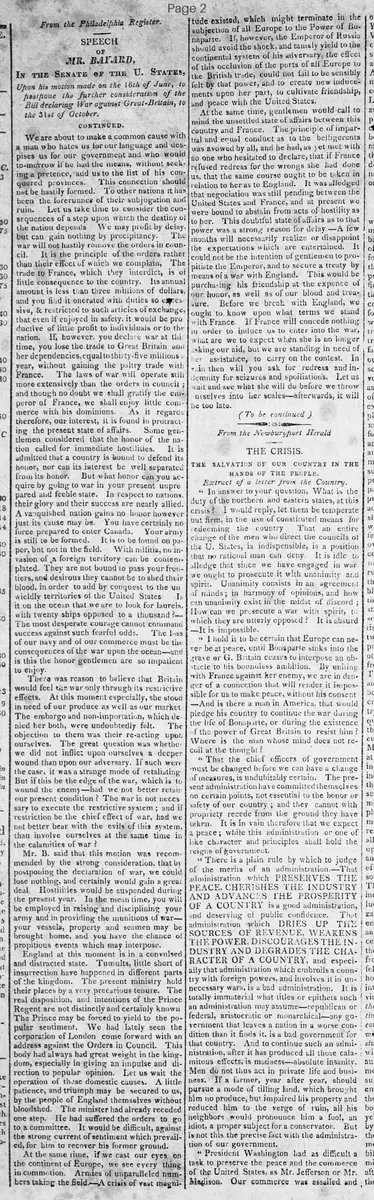
From the Philadelphia Register
SPEECH
REBAKIED
IN THE SENATE OF THE U. STATES,
Upon his motion made on the 16th of June, to
postpone the further consideration of the
Bill declaring War against Great-Britain, to
the 31st of October.
CONTINUED.
We are about to make a common cause with
a man who hates us for our language and despises us for our government and who would
to-morrow if he had the means, without seeking a pretence, add us to the list of his conquered provinces.
This connection should
not be hastily formed. To other nations it has
been the forerunner of their subjugation and
ruin. Let us take time to consider the consequences of a step upon which the destiny of
the nation depends. We may profit by delay.
but can gain nothing by precipitancy.
The
war will not hastily remove the orders in council. It is the principle of the orders rather
than their effect of which we complain. The
trade to France, which they interdict, is of
little consequence to the country. Its annual
amount is less than three millions of dollars.
and you find it onerated with duties so excessive, & restricted to such articles of exchange
that even if enjoyed in safety, it would be productive of little profit to individuals or to the
nation. If, however, you declare war at this
time, you lose the trade to Great Britain and
her dependencies, equal to thirty-five millions a
year, without gaining the paltry trade with
France. The laws of war will operate still
more extensively than the orders in council;
and though no doubt we shall gratify the emperor of France, we shall enjoy little commerce with his dominions. As it regards
therefore, our interest, it is found in protracting the present state of affairs. Some gentlemen considered that the honor of the nation called for immediate hostilities. It is
admitted that a country is bound to defend its
honor, nor can its interest be well separated
from its honor. But what honor can you acquire by going to war in your present unprepared and feeble state. In respect to nations,
their glory and their success are nearly allied.
A vanquished nation gains no honor however
just its cause may be. You have certainly no
force prepared to enter Canada. Your army
is still to be formed. It is to be found on paper, but not in the field. With militia, no invasion of a foreign territory can be contemplated. They are not bound to pass your frontiers, and desirous they cannot be to shed their
blood, in order to add by conquest to the unwieldy territories of the United States.
Is
it on the ocean that we are to look for laurels,
with twenty ships opposed to a thousand?-
The most desperate courage cannot command
success against such fearful odds. The loss
of our navy and of our commerce must be the
consequences of the war upon the ocean--and
is this the honor gentlemen are so impatient
to enjoy.
There was reason to believe that Britain
would feel the war only through its restrictive
effects. At this moment especially, she stood
in need of our produce as well as our market.
The embargo and non-importation, which denied her both, were undoubtedly felt.
The
objection to them was their re-acting upon
ourselves. The great question was whether
we did not inflict upon ourselves a deeper
wound than upon our adversary. If such were
the case, it was a strange mode of retaliating.
But if this be the edge of the war, which is to
wound the enemy--had we not better retain
our present condition? The war is not necessary to execute the restrictive system; and if
restriction be the chief effect of war, had we
not better bear with the evils of this system.
than involve ourselves at the same time in
the calamities of war?
Mr. B. said that this motion was recommended by the strong consideration, that by
postponing the declaration of war, we could
lose nothing, and certainly would gain a great
deal. Hostilities would be suspended during
the present year. In the mean time, you will
be employed in raising and disciplining your
army and in providing the munitions of war--
your vessels, property and seamen may be
brought home, and you have the chance of
propitious events which may interpose.
England at this moment is in a convulsed
and distracted state. Tumults, little short of
insurrection have happened in different parts
of the kingdom. The present ministry hold
their places by a very precarious tenure. The
real disposition, and intentions of the Prince
Regent are not distinctly and certainly known.
The Prince may be forced to yield to the popular sentiment. We had lately seen the
corporation of London come forward with an
address against the Orders in Council. This
body had always had great weight in the kingdom, especially in giving an impulse and direction to popular opinion. Let us wait the
operation of these domestic causes. A little
patience, and triumph may be secured to us,
by the people of England themselves without
bloodshed. The minister had already receded
one step. He had suffered the orders to go
to a committee. It would be difficult, against
the strong current of sentiment which prevailed, for him to recover his former ground.
At the same time, if we cast our eyes on
the continent of Europe, we see every thing
in commotion. Armies of unparalleled numbers taking the field.--A crisis of vast magnitude existed, which might terminate in the
subjection of all Europe to the Power of Bonaparte. If, however, the Emperor of Russia
should avoid the shock, and tamely yield to the
continental system of his adversary, the effect
of this occlusion of the ports of all Europe to
the British trade, could not fail to be sensibly
felt by that power, and to create new inducements upon her part, to cultivate friendship,
and peace with the United States.
At the same time, gentlemen would call to
mind the unsettled state of affairs between this
country and France. The principle of impartial and equal conduct as to the belligerents
was avowed by all, and he had, as yet met with
no one who hesitated to declare, that if France
refused redress for the wrongs she had done
us, that the same course ought to be taken in
relation to her as to England. It was alledged
that negociation was still pending between the
United States and France, and at present we
were bound to abstain from acts of hostility as
to her. This doubtful state of affairs as to that
power was a strong reason for delay.--A few
months will necessarily realize or disappoint
the expectations which are entertained. It
could not be the intention of gentlemen to propitiate the Emperor, and to secure a treaty by
means of a war with England. This would be
purchasing his friendship at the expence of
our honor, as well as of our blood and treasure. Before we break with England, we
ought to know upon what terms we stand
with France. If France will concede nothing
in order to induce us to enter into the war,
what are we to expect when she is no longer
asking our aid, but we are standing in need of
her assistance, to carry on the contest. In
what then will you ask for redress and indemnity for seizures and spoliations. Let us
wait and see what she will do before we throw
ourselves into her scales--afterwards, it will
be too late.
(To be continued)
SPEECH
REBAKIED
IN THE SENATE OF THE U. STATES,
Upon his motion made on the 16th of June, to
postpone the further consideration of the
Bill declaring War against Great-Britain, to
the 31st of October.
CONTINUED.
We are about to make a common cause with
a man who hates us for our language and despises us for our government and who would
to-morrow if he had the means, without seeking a pretence, add us to the list of his conquered provinces.
This connection should
not be hastily formed. To other nations it has
been the forerunner of their subjugation and
ruin. Let us take time to consider the consequences of a step upon which the destiny of
the nation depends. We may profit by delay.
but can gain nothing by precipitancy.
The
war will not hastily remove the orders in council. It is the principle of the orders rather
than their effect of which we complain. The
trade to France, which they interdict, is of
little consequence to the country. Its annual
amount is less than three millions of dollars.
and you find it onerated with duties so excessive, & restricted to such articles of exchange
that even if enjoyed in safety, it would be productive of little profit to individuals or to the
nation. If, however, you declare war at this
time, you lose the trade to Great Britain and
her dependencies, equal to thirty-five millions a
year, without gaining the paltry trade with
France. The laws of war will operate still
more extensively than the orders in council;
and though no doubt we shall gratify the emperor of France, we shall enjoy little commerce with his dominions. As it regards
therefore, our interest, it is found in protracting the present state of affairs. Some gentlemen considered that the honor of the nation called for immediate hostilities. It is
admitted that a country is bound to defend its
honor, nor can its interest be well separated
from its honor. But what honor can you acquire by going to war in your present unprepared and feeble state. In respect to nations,
their glory and their success are nearly allied.
A vanquished nation gains no honor however
just its cause may be. You have certainly no
force prepared to enter Canada. Your army
is still to be formed. It is to be found on paper, but not in the field. With militia, no invasion of a foreign territory can be contemplated. They are not bound to pass your frontiers, and desirous they cannot be to shed their
blood, in order to add by conquest to the unwieldy territories of the United States.
Is
it on the ocean that we are to look for laurels,
with twenty ships opposed to a thousand?-
The most desperate courage cannot command
success against such fearful odds. The loss
of our navy and of our commerce must be the
consequences of the war upon the ocean--and
is this the honor gentlemen are so impatient
to enjoy.
There was reason to believe that Britain
would feel the war only through its restrictive
effects. At this moment especially, she stood
in need of our produce as well as our market.
The embargo and non-importation, which denied her both, were undoubtedly felt.
The
objection to them was their re-acting upon
ourselves. The great question was whether
we did not inflict upon ourselves a deeper
wound than upon our adversary. If such were
the case, it was a strange mode of retaliating.
But if this be the edge of the war, which is to
wound the enemy--had we not better retain
our present condition? The war is not necessary to execute the restrictive system; and if
restriction be the chief effect of war, had we
not better bear with the evils of this system.
than involve ourselves at the same time in
the calamities of war?
Mr. B. said that this motion was recommended by the strong consideration, that by
postponing the declaration of war, we could
lose nothing, and certainly would gain a great
deal. Hostilities would be suspended during
the present year. In the mean time, you will
be employed in raising and disciplining your
army and in providing the munitions of war--
your vessels, property and seamen may be
brought home, and you have the chance of
propitious events which may interpose.
England at this moment is in a convulsed
and distracted state. Tumults, little short of
insurrection have happened in different parts
of the kingdom. The present ministry hold
their places by a very precarious tenure. The
real disposition, and intentions of the Prince
Regent are not distinctly and certainly known.
The Prince may be forced to yield to the popular sentiment. We had lately seen the
corporation of London come forward with an
address against the Orders in Council. This
body had always had great weight in the kingdom, especially in giving an impulse and direction to popular opinion. Let us wait the
operation of these domestic causes. A little
patience, and triumph may be secured to us,
by the people of England themselves without
bloodshed. The minister had already receded
one step. He had suffered the orders to go
to a committee. It would be difficult, against
the strong current of sentiment which prevailed, for him to recover his former ground.
At the same time, if we cast our eyes on
the continent of Europe, we see every thing
in commotion. Armies of unparalleled numbers taking the field.--A crisis of vast magnitude existed, which might terminate in the
subjection of all Europe to the Power of Bonaparte. If, however, the Emperor of Russia
should avoid the shock, and tamely yield to the
continental system of his adversary, the effect
of this occlusion of the ports of all Europe to
the British trade, could not fail to be sensibly
felt by that power, and to create new inducements upon her part, to cultivate friendship,
and peace with the United States.
At the same time, gentlemen would call to
mind the unsettled state of affairs between this
country and France. The principle of impartial and equal conduct as to the belligerents
was avowed by all, and he had, as yet met with
no one who hesitated to declare, that if France
refused redress for the wrongs she had done
us, that the same course ought to be taken in
relation to her as to England. It was alledged
that negociation was still pending between the
United States and France, and at present we
were bound to abstain from acts of hostility as
to her. This doubtful state of affairs as to that
power was a strong reason for delay.--A few
months will necessarily realize or disappoint
the expectations which are entertained. It
could not be the intention of gentlemen to propitiate the Emperor, and to secure a treaty by
means of a war with England. This would be
purchasing his friendship at the expence of
our honor, as well as of our blood and treasure. Before we break with England, we
ought to know upon what terms we stand
with France. If France will concede nothing
in order to induce us to enter into the war,
what are we to expect when she is no longer
asking our aid, but we are standing in need of
her assistance, to carry on the contest. In
what then will you ask for redress and indemnity for seizures and spoliations. Let us
wait and see what she will do before we throw
ourselves into her scales--afterwards, it will
be too late.
(To be continued)
What sub-type of article is it?
Politics
What keywords are associated?
Senate Speech
War Declaration
Great Britain
Postponement
Orders In Council
France Relations
What entities or persons were involved?
Mr. B.
Emperor Of France
Prince Regent
Where did it happen?
United States Senate
Domestic News Details
Primary Location
United States Senate
Event Date
16th Of June
Key Persons
Mr. B.
Emperor Of France
Prince Regent
Event Details
Mr. B. argues in the Senate for postponing the war bill against Great Britain to October 31, emphasizing risks of hasty action, economic impacts, military unreadiness, British internal issues, European dynamics, and need to resolve matters with France first.