Thank you for visiting SNEWPapers!
Sign up free
Phenix Gazette
Alexandria, Virginia
What is this article about?
In Rio de Janeiro, foreign Irish and German troops revolted against Brazilian forces on June 11 after a sentinel was harshly punished, capturing the Emperor's palace and forts amid pay disputes. Brazilian and allied naval marines countered; 500 rebels killed, others captured. Markets dull, bank cashier suicide amid unrest.
Clipping
OCR Quality
Full Text
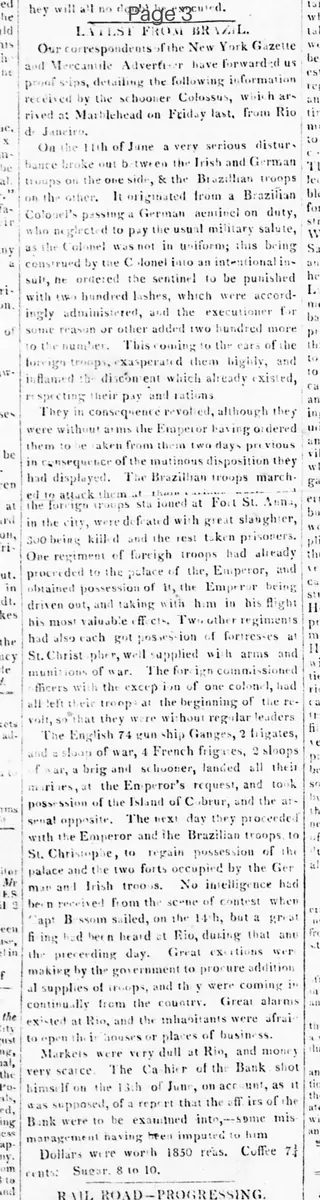
Our correspondents of the New York Gazette and Mercantile Advertiser have forwarded us proofs in, detailing the following information received by the schooner Colossus, which arrived at Marblehead on Friday last, from Rio de Janeiro,
On the 11th of June a very serious disturbance broke out between the Irish and German troops on the one side, & the Brazilian troops on the other. It originated from a Brazilian Colonel's passing a German sentinel on duty, who neglected to pay the usual military salute, as the Colonel was not in uniform; this being construed by the Colonel into an intentional insult, he ordered the sentinel to be punished with two hundred lashes, which were accordingly administered, and the executioner for some reason or other added two hundred more to the number. This coming to the ears of the foreign troops, exasperated them highly, and inflamed the discontent which already existed, respecting their pay and rations. They in consequence revolted, although they were without arms the Emperor having ordered them to be taken from them two days previous in consequence of the mutinous disposition they had displayed. The Brazilian troops marched to attack them at their quarters. The foreign troops stationed at Fort St. Anna, in the city, were defeated with great slaughter, 500 being killed and the rest taken prisoners. One regiment of foreign troops had already proceeded to the palace of the Emperor, and obtained possession of it, the Emperor being driven out, and taking with him in his flight his most valuable effects. Two other regiments had also each got possession of fortresses at St. Christopher, well supplied with arms and munitions of war. The foreign commissioned officers with that exception of one colonel, had all left their troops at the beginning of the revolt, so that they were without regular leaders. The English 74 gun ship Ganges, 2 frigates, and a sloop of war, 4 French frigates, 2 sloops of war, a brig and schooner, landed all their marines, at the Emperor's request, and took possession of the Island of Cobru, and the arsenal opposite. The next day they proceeded with the Emperor and the Brazilian troops, to St. Christophe, to regain possession of the palace and the two forts occupied by the German and Irish troops. No intelligence had been received from the scene of contest when Capt. Blossom sailed, on the 14th, but a great firing had been heard at Rio, during that and the preceding day. Great exertions were making by the government to procure additional supplies of troops, and they were coming in continually from the country. Great alarms existed at Rio, and the inhabitants were afraid to open their houses or places of business. Markets were very dull at Rio, and money very scarce. The Cashier of the Bank shot himself on the 13th of June, on account, as it was supposed, of a report that the affairs of the Bank were to be examined into,—some mismanagement having been imputed to him. Dollars were worth 1850 reals. Coffee 7 cents: Sugar, 8 to 10.
What sub-type of article is it?
What keywords are associated?
What entities or persons were involved?
Where did it happen?
Foreign News Details
Primary Location
Rio De Janeiro
Event Date
11th Of June
Key Persons
Outcome
500 foreign troops killed, rest taken prisoners; emperor driven out; foreign marines aiding to regain palace and forts; no final outcome reported as of 14th; bank cashier suicide; markets dull, money scarce
Event Details
Disturbance broke out on June 11 between Irish/German troops and Brazilian troops after a German sentinel was lashed 400 times for not saluting a Brazilian Colonel. Foreign troops, disarmed due to prior mutiny, revolted over pay/rations, captured Emperor's palace and forts at St. Christopher. Foreign officers mostly fled. English and French ships landed marines to support Emperor, taking Island of Cobru and arsenal, then moving to retake positions. Heavy firing heard; government rallying more troops. Alarms in Rio; bank cashier suicide on June 13 amid mismanagement reports. Markets dull: dollars at 1850 reals, coffee 7 cents, sugar 8-10.