Thank you for visiting SNEWPapers!
Sign up free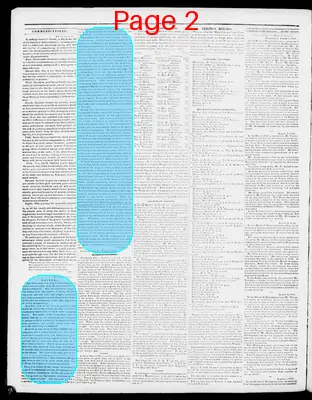
Letter to Editor
August 13, 1842
Richmond Palladium
Richmond, Wayne County, Indiana
What is this article about?
Mortimer criticizes the fashionable practice of tight lacing among women, arguing it causes severe health issues, deformities passed to offspring, and early deaths from consumption, urging society to oppose it like intemperance for the prosperity and happiness of mankind. From Jacksonburgh, Ia, August 1842.
Clipping
OCR Quality
98%
Excellent
Full Text
For the Palladium.
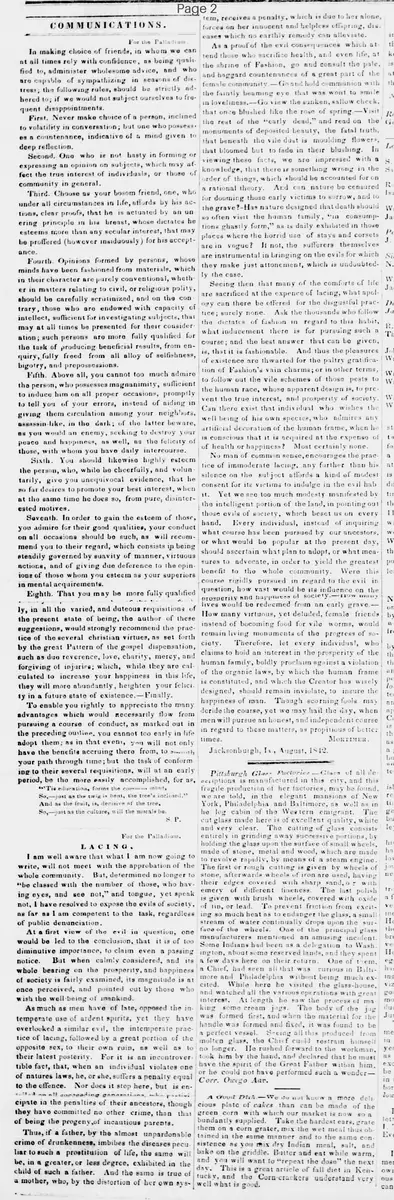
LACING.
I am well aware that what I am now going to write, will not meet with the approbation of the whole community. But, determined no longer to "be classed with the number of those, who having eyes, and see not," and tongue, yet speak not, I have resolved to expose the evils of society, as far as I am competent to the task, regardless of public denunciation.
At a first view of the evil in question, one would be led to the conclusion, that it is of too diminutive importance, to claim even a passing notice. But when calmly considered, and its whole bearing on the prosperity, and happiness of society is fairly examined, its magnitude is at once perceived, and pointed out by those who wish the well-being of mankind.
As much as men have of late, opposed the intemperate use of ardent spirits, yet they have overlooked a similar evil, the intemperate practice of lacing. followed by a great portion of the opposite sex, to their own ruin, as well as to their latest posterity. For it is an incontrovertible fact, that, when an individual violates one of nature's laws, he, or she, suffers a penalty equal to the offence. Nor does it stop here, but is entailed an all succeeding generations, who participate in the penalties of their ancestors, though they have committed no other crime, than that of being the progeny,of incautious parents.
Thus, if a father, by the almost unpardonable crime of drunkenness, imbibes the diseases peculiar to such a prostitution of life, the same will be, in a greater, or less degree, exhibited in the child of such a father. And the same is true of a mother, who, by the distortion of her own system, receives a penalty, which is due to her alone, forces on her innocent and helpless offspring, diseases which no earthly remedy can alleviate.
As a proof of the evil consequences which attend those who sacrifice health, and even life, at the shrine of Fashion, go and consult the pale, and haggard countenances of a great part of the female community.—Go and hold communion with the faintly beaming eye that was wont to smile in loveliness.—Go view the sunken, sallow cheek. that once blushed like the rose of spring.—Visit the rest of the "early dead," and read on the monuments of deposited beauty, the fatal truth, that beneath the vile dust is moulding flowers, that bloomed but to fade in their blushing. In viewing these facts, we are impressed with a knowledge, that there is something wrong in the order of things, which should be accounted for on a rational theory. And can nature be censured for dooming those early victims to sorrow, and to the grave?—Has nature designed that death should so often visit the human family, "in consumption's ghastly form," as is daily exhibited in those places where the horrid use of stays and corsets are in vogue? If not, the sufferers themselves are instrumental in bringing on the evils for which they make just atonement, which is undoubtedly the case.
Seeing then that many of the comforts of life are sacrificed at the expense of lacing, what apology can there be offered for the disgustful practice; surely none. Ask the thousands who follow the dictates of fashion in regard to this habit, what inducement there is for pursuing such a course; and the best answer that can be given, is, that it is fashionable. And thus the pleasures of existence are thwarted for the paltry gratification of Fashion's vain charms; or in other terms, to follow out the vile schemes of those pests to the human race, whose apparent design is, to prevent the true interest, and prosperity of society.
Can there exist that individual who wishes the well being of his own species, who admires any artificial decoration of the human frame, when he is conscious that it is acquired at the expense of health or happiness? Most certainly none.
No man of common sense, encourages the practice of immoderate lacing, any further than his silence on the subject affords a kind of modest consent for its victims to indulge in the evil habit. Yet we see too much modesty manifested by the intelligent portion of the land, in pointing out those evils of society, which beset us on every hand. Every individual, instead of inquiring what course has been pursued by our ancestors, or what would be popular at the present day, should ascertain what plan to adopt, or what measures to advocate, in order to yield the greatest benefit to the whole community. Were this course rigidly pursued in regard to the evil in question, how vast would be its influence on the prosperity and happiness of society.—how many lives would be redeemed from an early grave.— How many virtuous, yet deluded, female friends instead of becoming food for vile worms, would remain living monuments of the progress of society. Therefore, let every individual, who claims to hold an interest in the prosperity of the human family, boldly proclaim against a violation of the organic laws, by which the human frame is constituted, and which the Creator has wisely designed, should remain inviolate, to insure the happiness of man. Though scorning fools may deride the course, yet we may hail the day, when men will pursue an honest, and independent course in regard to these matters, as propitious of better times.
MORTIMER.
Jacksonburgh, Ia, August, 1842.
LACING.
I am well aware that what I am now going to write, will not meet with the approbation of the whole community. But, determined no longer to "be classed with the number of those, who having eyes, and see not," and tongue, yet speak not, I have resolved to expose the evils of society, as far as I am competent to the task, regardless of public denunciation.
At a first view of the evil in question, one would be led to the conclusion, that it is of too diminutive importance, to claim even a passing notice. But when calmly considered, and its whole bearing on the prosperity, and happiness of society is fairly examined, its magnitude is at once perceived, and pointed out by those who wish the well-being of mankind.
As much as men have of late, opposed the intemperate use of ardent spirits, yet they have overlooked a similar evil, the intemperate practice of lacing. followed by a great portion of the opposite sex, to their own ruin, as well as to their latest posterity. For it is an incontrovertible fact, that, when an individual violates one of nature's laws, he, or she, suffers a penalty equal to the offence. Nor does it stop here, but is entailed an all succeeding generations, who participate in the penalties of their ancestors, though they have committed no other crime, than that of being the progeny,of incautious parents.
Thus, if a father, by the almost unpardonable crime of drunkenness, imbibes the diseases peculiar to such a prostitution of life, the same will be, in a greater, or less degree, exhibited in the child of such a father. And the same is true of a mother, who, by the distortion of her own system, receives a penalty, which is due to her alone, forces on her innocent and helpless offspring, diseases which no earthly remedy can alleviate.
As a proof of the evil consequences which attend those who sacrifice health, and even life, at the shrine of Fashion, go and consult the pale, and haggard countenances of a great part of the female community.—Go and hold communion with the faintly beaming eye that was wont to smile in loveliness.—Go view the sunken, sallow cheek. that once blushed like the rose of spring.—Visit the rest of the "early dead," and read on the monuments of deposited beauty, the fatal truth, that beneath the vile dust is moulding flowers, that bloomed but to fade in their blushing. In viewing these facts, we are impressed with a knowledge, that there is something wrong in the order of things, which should be accounted for on a rational theory. And can nature be censured for dooming those early victims to sorrow, and to the grave?—Has nature designed that death should so often visit the human family, "in consumption's ghastly form," as is daily exhibited in those places where the horrid use of stays and corsets are in vogue? If not, the sufferers themselves are instrumental in bringing on the evils for which they make just atonement, which is undoubtedly the case.
Seeing then that many of the comforts of life are sacrificed at the expense of lacing, what apology can there be offered for the disgustful practice; surely none. Ask the thousands who follow the dictates of fashion in regard to this habit, what inducement there is for pursuing such a course; and the best answer that can be given, is, that it is fashionable. And thus the pleasures of existence are thwarted for the paltry gratification of Fashion's vain charms; or in other terms, to follow out the vile schemes of those pests to the human race, whose apparent design is, to prevent the true interest, and prosperity of society.
Can there exist that individual who wishes the well being of his own species, who admires any artificial decoration of the human frame, when he is conscious that it is acquired at the expense of health or happiness? Most certainly none.
No man of common sense, encourages the practice of immoderate lacing, any further than his silence on the subject affords a kind of modest consent for its victims to indulge in the evil habit. Yet we see too much modesty manifested by the intelligent portion of the land, in pointing out those evils of society, which beset us on every hand. Every individual, instead of inquiring what course has been pursued by our ancestors, or what would be popular at the present day, should ascertain what plan to adopt, or what measures to advocate, in order to yield the greatest benefit to the whole community. Were this course rigidly pursued in regard to the evil in question, how vast would be its influence on the prosperity and happiness of society.—how many lives would be redeemed from an early grave.— How many virtuous, yet deluded, female friends instead of becoming food for vile worms, would remain living monuments of the progress of society. Therefore, let every individual, who claims to hold an interest in the prosperity of the human family, boldly proclaim against a violation of the organic laws, by which the human frame is constituted, and which the Creator has wisely designed, should remain inviolate, to insure the happiness of man. Though scorning fools may deride the course, yet we may hail the day, when men will pursue an honest, and independent course in regard to these matters, as propitious of better times.
MORTIMER.
Jacksonburgh, Ia, August, 1842.
What sub-type of article is it?
Persuasive
Ethical Moral
Social Critique
What themes does it cover?
Health Medicine
Morality
Social Issues
What keywords are associated?
Tight Lacing
Women's Health
Corsets
Fashion Critique
Early Death
Consumption
Social Evil
Hereditary Disease
What entities or persons were involved?
Mortimer
For The Palladium
Letter to Editor Details
Author
Mortimer
Recipient
For The Palladium
Main Argument
the practice of tight lacing by women is a harmful social evil akin to intemperance, causing personal health ruin, hereditary diseases, and early deaths, and society must actively oppose it to promote human prosperity and happiness.
Notable Details
Analogy To Drunkenness And Intemperance
References To Pale Countenances And Early Deaths From Consumption
Critique Of Fashion As A 'Pest To The Human Race'
Biblical Allusion: 'Having Eyes, And See Not'