Thank you for visiting SNEWPapers!
Sign up free
Portage Sentinel
Ravenna, Portage County, Ohio
What is this article about?
Southern Press lauds W. M. Corry's speech urging US to actively support European republicanism against post-1848 betrayals of reforms, criticizing neutrality favoring oppression and calling for honest intervention to uphold promises and human rights, especially in Hungary.
Clipping
OCR Quality
Full Text
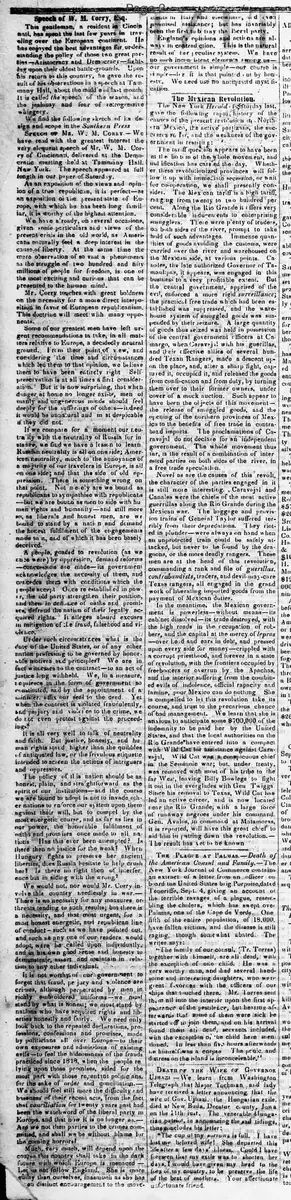
We find the following sketch of its design and scope in the Southern Press:
SPEECH OF MR. W. M. CORRY.—We have read with the greatest interest the very eloquent speech of Mr. W. M. Corry of Cincinnati, delivered at the Democratic meeting held at Tammany Hall, New York. The speech appeared at full length in our paper of Saturday.
As an exposition of the views and opinions of a true republican, it is perfect; and as an opposition to the present state of Europe with which he has been long familiar, it is worthy of the highest attention.
We have already, on several occasions, given some particulars and views of the present crisis in the old world, as Americans naturally feel a deep interest in the cause of liberty. At the same time the mere observation of so vast a phenomenon as the struggle of two hundred and fifty millions of people for freedom, is one of the most exciting and curious that can be presented to the human mind.
Mr. Corry touches with great boldness on the necessity of a more direct interposition in favor of European republicanism. This doctrine will meet with many opponents.
Some of our greatest men have left us great recommendations to take, in all matters relative to Europe, a decidedly neutral ground. From their point of view, and considering the time and circumstances which led them to that opinion, we believe them to have been entirely right. Self-preservation is at all times a vital consideration. But it is now surprising, that when danger at home no longer exists, men of manly and generous minds should feel deeply for the sufferings of others—indeed it would be unnatural and most despicable if they did not.
If we compare, for a moment, our neutrality with the neutrality of Russia for instance, we had we have a lesson to learn. Russian neutrality is all on one side; American neutrality, much to the annoyance of a majority of our travelers in Europe, is all on one side; and that the side of old oppression. There is something wrong on that point. Not merely are we bound as republicans to sympathize with republicans—but we are bound as men to side with human rights and humanity—and still more so, as liberals and honest men, are we bound to stand by a nation and demand the honest fulfilment of the engagements made to it, and of which it has been basely deceived.
A people, goaded to revolution (as we once were) by oppression, demand reforms—concessions are made—its government acknowledges the necessity of them, and concedes them with conditions which the people accept. Once re-established in power, the old party strengthen their position, and then—in defiance of oaths and promises—deprive the nation of their legally acquired rights. It alleges absurd excuses in mitigation of the fraud, falsehood and violence.
Under such circumstances what is the duty of the United States, or of any other nation professing to be governed by honorable motives and principles? We are in act witnesses to the contract—to an act of justice long withheld. We, in a measure, acquiesce in the form of government so constituted, and by the appointment of a minister, with our seal to the deed. Yet when the contract is violated fraudulently, and perjury and violence to the crime, we do not even protest against it! The proceedings!
It is all very well to talk of neutrality and faith. But justice, honesty, and human rights stand higher than the quibbles of antiquated law, or the ridiculous etiquette intended to screen the actions of intriguers and oppressors.
The policy of this nation should be as honest, plain, and straightforward as the spirit of our institutions—and the course we are bound to adopt is not to invade other nations to enforce our system upon them against their will, but to compel by the most energetic course, and as far as lies in our power, the honorable fulfilment of oaths and promises once made to all nations. Has this ever been attempted? Is there then no justice for the weak? When Hungary fights to preserve her ancient liberties, does Russia hesitate to help crush her? Is there no right then of interference but in siding with the wrong?
We would not, nor would Mr. Corry, involve this country heedlessly in war. There is no necessity for any measures or threats tending to such results; but there is a necessity, and that most urgent, of a most honest, energetic, and republican line of conduct—such as we have pointed out, and such as any one of our readers would adopt, were he called upon individually, and in his own good sense and honesty to demonstrate, assert, and maintain in relation to any other individual.
It is not worthy of our government to forget that fraud, perjury and violence are crimes, although perpetrated by men in high places. We must stand by what is honest; we must stand by nations who have acquired rights and liberties honestly and fairly. We need only look back to the repeated declarations, professions, confessions and promises, made by politicians all over Europe—to their own exposures and admissions—of existing evils to feel the hideousness of the frauds practiced since 1848, when the people relying upon those promises, sided on the most part with those reactionary politicians, for the sake of order and conciliation.
We should feel still more the difficulty and baseness of their recent acts, from the fact that conciliation for twenty years past had been the watchword of the liberal party in Europe, and that now it is no longer so.
Are we not then parties to the crimes committed, and shall we be without blame for the coming horrors!
Much, very much, will depend upon the course this country shall take in this dark future with which Europe is menaced. Let us not follow England. She is more guilty than ourselves, inasmuch as she has given distinct encouragement to the monarchs. England's military and elsewhere promised assistance; but has invariably been the first to betray the liberal party. England's opinions and actions are always in contradiction. This is the natural result of her peculiar system. We have no such inconsistent elements among us—our government is simple—our course is simple—it is that pointed out by honesty.
We need use no amplification.
What sub-type of article is it?
What keywords are associated?
Where did it happen?
Foreign News Details
Primary Location
Europe
Event Date
Since 1848
Event Details
The Southern Press praises Mr. W. M. Corry's eloquent speech delivered at a Democratic meeting in Tammany Hall, New York, which appeared in full in their Saturday paper. The speech expounds views of a true republican and opposes the current state in Europe. It boldly advocates for more direct US interposition in favor of European republicanism, criticizing passive neutrality that effectively sides with oppression. It references broken promises and deceptions post-1848 revolutions, where governments conceded reforms but later reneged using fraud, perjury, and violence. Examples include Hungary's fight for liberties crushed with Russian help. The commentary urges an honest, energetic, republican US policy to compel fulfillment of oaths and support human rights without heedless war, contrasting with England's contradictory actions.