Thank you for visiting SNEWPapers!
Sign up free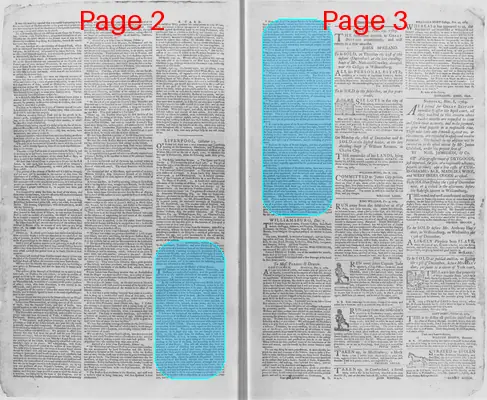
The Virginia Gazette
Richmond, Williamsburg, Richmond County, Virginia
What is this article about?
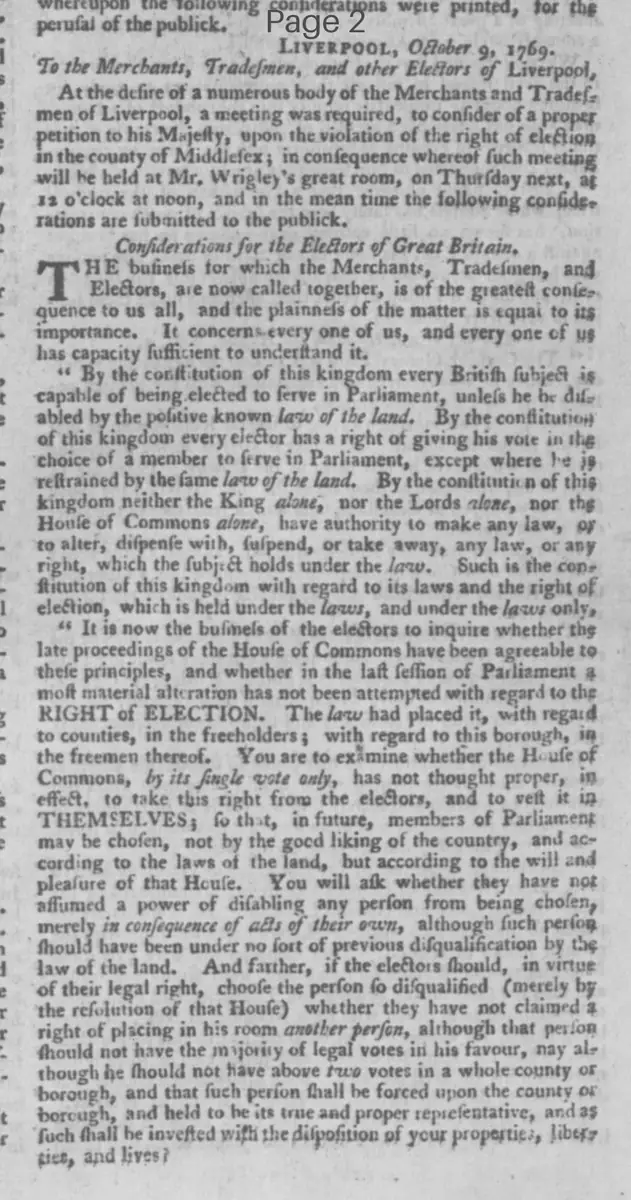
On October 9, 1769, in Liverpool, merchants and electors met to address the House of Commons' disqualification of the Middlesex election winner despite majority votes, approving a petition to the King for dissolution of Parliament to protect election rights. Sir William Meredith and Mr. Pennant supported the motion.
Merged-components note: Continuation of the article on Liverpool electors' considerations and petitioning across pages 2 and 3.
Clippings
1 of 2
OCR Quality
Full Text
To above all, it will be proper for you to be informed whether they have not actually carried this their claim into execution, by disqualifying the member lately chosen for the county of Middlesex, by force of their resolution only, by altering the return which had been made, agreeable to the majority of votes, and to the law of elections and returns; and finally, by appointing for the representative of Middlesex another person, not chosen by that county, 318 legal votes having been given in favour of the person whom the House had put under an arbitrary disqualification, and only 296 for the person whom they have thought proper, by their own authority, to elect.
"If the House of Commons shall possess a power of disqualifying any person, though chosen by a majority of legal votes, and of accepting another person upon any small number of votes, without any other rule than their own pleasure, it is evident that the election of members of Parliament must, in effect and substance, be in that House, and not in us, the electors of Great Britain. Words and names will be given to us in the place of solid privileges; we shall lose all share in making our own laws, and thereby be deprived of all our liberties at a single stroke.
"Whenever such an attempt is made, the wisdom of our constitution has not left us without a remedy. The King is by law invested with a power of dissolving as well as of calling Parliaments, and this power is not placed in the Crown in order to gratify private humour or mere inclination, but it is to be used for the benefit of the people, and in a gracious compliance with their just desires, whenever the representatives of the people shall appear to entertain a greater regard for their own power than for the rights of those who have chosen them; it is provided in order that the electors may have an opportunity, by a new election, of committing their affairs into hands more worthy of their trust.
"The right of the people to petition for such a dissolution has always existed, and it is not made, but is only confirmed by an act of Parliament, entitled An act declaring the rights and liberties of the subject, and settling the succession of the Crown. This act is one of the first fruits of the glorious Revolution, and it expressly declares: That it is the right of the subjects to petition the King, and all commitments and prosecutions for such petitioning are illegal; and to this right of petitioning the act has put no limitation whatsoever.
"It is not in the power of the House of Commons, even though it should be their inclination, to abridge this right, because it is a right granted not by their resolutions but by law; but that House, far from denying, have expressly admitted and authorized it, by declaring in their own journals, that it is the undoubted right of the people of England to petition or address the King for the calling, sitting, and dissolving of Parliament, and for redressing of grievances."
Such are the rights of British subjects, and this of petition is one of the remedies whenever any right is violated: and it is hoped that we shall never prove so degenerate from, and so ungrateful to, our ancestors, as not to transmit to posterity those privileges which had been handed down to us as perfect and as secure as we received them, and that we will not permit the invasion of those dear bought rights by any power in the world, and least of all by that power which we have expressly appointed for the preservation of our laws and liberties.
Yesterday, in pursuance of the above notice, there was a numerous meeting of the electors and inhabitants of this town, at the time and place appointed, and the business was conducted with the greatest regularity and decorum. After the reasons for calling the meeting had been declared, the members for the town were called upon to give their constituents an account of the proceedings in the House of Commons respecting the Middlesex election. Sir William Meredith then stood up, and delivered his sentiments with great perspicuity, freedom, and exactness, to the entire satisfaction of all who heard him, and concluded with declaring his readiness to comply with the request of his constituents to present the petition. Mr. Pennant spoke after him, much to the same purpose. Then a motion was made for a petition to his Majesty, to which all present assented, by holding up their hands. The copy of a petition was then produced, and read to the meeting, which, upon the question being put, was approved, nem. con. The petition was then engrossed, and signed by great numbers then present, and will be sent to different parts of the town, to be signed by the rest of the electors and inhabitants.
What sub-type of article is it?
What keywords are associated?
What entities or persons were involved?
Where did it happen?
Foreign News Details
Primary Location
Liverpool
Event Date
October 9, 1769
Key Persons
Outcome
petition to the king approved unanimously and signed by numerous electors; 318 votes for disqualified candidate vs. 296 for the imposed representative in middlesex.
Event Details
Merchants and electors of Liverpool met to consider petitioning the King against the House of Commons' disqualification of the Middlesex election winner by resolution alone, altering the return, and seating another with fewer votes. Meeting discussed constitutional rights, approved petition for Parliament's dissolution, with support from local MPs Sir William Meredith and Mr. Pennant.