Thank you for visiting SNEWPapers!
Sign up free
The Virginia Gazette
Richmond, Williamsburg, Richmond County, Virginia
What is this article about?
This letter, written by J.H. as the amanuensis of 'A Church of Englandman,' refutes Rev. S. Henley's arguments against an American Episcopate. It defends episcopacy using scripture, church history, and logic, accuses Henley of plagiarism, scurrility, and apostasy, and advocates for bishops to strengthen the colonial Church of England.
Merged-components note: These two components form a single continuous letter to the editor responding to Mr. S. Henley, spanning pages 1 and 2 with sequential reading order.
Clippings
1 of 2
OCR Quality
Full Text
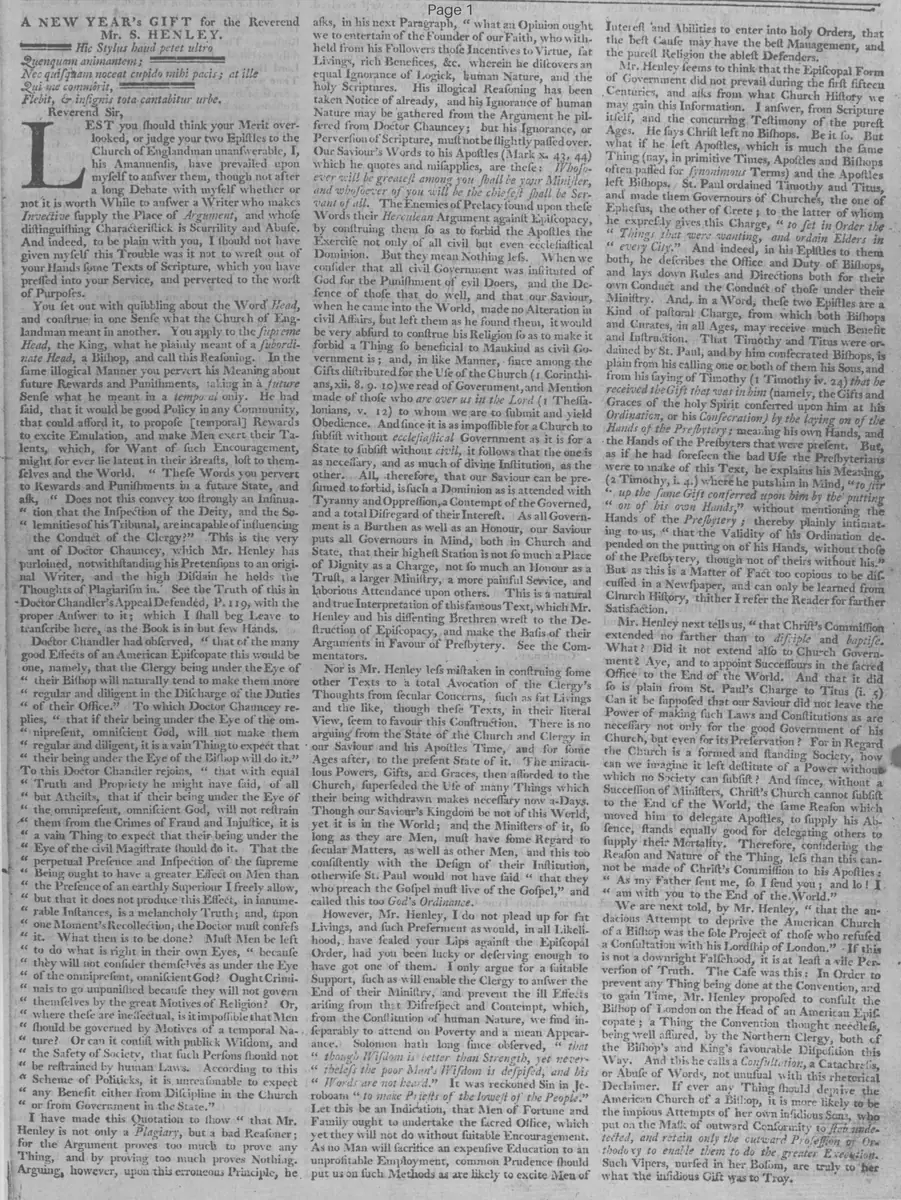
Mr. S. HENLEY.
Hic Stylus haud petet ultro
Quenguam animantem;
Nec quicquam noceat cupido mihi pacis; at ille
Qui me commorit,
Flebit, & ignis tota cantabitur urbe.
Reverend Sir,
Lest you should think your Merit overlooked,
or judge your two Epistles to the
Church of Englandman unanswerable, I,
his Amanuensis, have prevailed upon
myself to answer them, though not after
a long Debate with myself whether or
not it is worth While to answer a Writer who makes
Invective supply the Place of Argument, and whose
distinguishing Characteristic is Scurrility and Abuse.
And indeed, to be plain with you, I should not have
given myself this Trouble was it not to wrest out of
your Hands some Texts of Scripture, which you have
pressed into your Service, and perverted to the worst
of Purposes.
You set out with quibbling about the Word 'Head',
and construe in one Sense what the Church of Eng-
landman meant in another. You apply to the Supreme
Head, the King, what he plainly meant of a subordi-
nate Head, a Bishop, and call this Reasoning. In the
same illogical Manner you pervert his Meaning about
future Rewards and Punishments, taking in a future
Sense what he meant in a temporal only. He had
said, that it would be good Policy in any Community,
that could afford it, to propose [temporal] Rewards
to excite Emulation, and make Men exert their Ta-
lents, which, for Want of such Encouragement,
might for ever lie latent in their Breasts, lost to them-
themselves and the World. "These Words you pervert
to Rewards and Punishments in a future State, and
ask, "Does not this convey too strongly an Intima-
"tion that the Inspection of the Deity, and the So-
"lemnities of his Tribunal, are incapable of influencing
the Conduct of the Clergy?" This is the very
Want of Doctor Chauncey, which Mr. Henley has
purloined, notwithstanding his Pretensions to an origi-
nal Writer, and the high Disdain he holds the
Thoughts of Plagiarism in.' See the Truth of this in
-Doctor Chandler's Appeal Defended, P. 119, with the
proper Answer to it; which I shall beg Leave to
transcribe here, as the Book is in but few Hands.
Doctor Chandler had observed, "that of the many
good Effects of an American Episcopate this would be
one, namely, that the Clergy being under the Eye of
"their Bishop will naturally tend to make them more
"regular and diligent in the Discharge of the Duties
"of their Office." To which Doctor Chauncey re-
plies, "that if their being under the Eye of the om-
"nipresent, omniscient God, will not make them
"regular and diligent, it is a vain Thing to expect that
"their being under the Eye of the Bishop will do it."
To this Doctor Chandler rejoins, "that with equal
"Truth and Propriety he might have said, of all
"but Atheists, that if their being under the Eye of
"the omnipresent, omniscient God, will not restrain
"them from the Crimes of Fraud and Injustice, it is
"a vain Thing to expect that their being under the
"Eye of the civil Magistrate should do it. That the
perpetual Presence and Inspection of the Supreme
Being ought to have a greater Effect on Men than
"the Presence of an earthly Superior I freely allow,
"but that it does not produce this Effect, in innume-
"rable Instances, is a melancholy Truth; and, upon
"one Moment's Recollection, the Doctor must confess
"it. What then is to be done? Must Men be left
"to do what is right in their own Eyes," because
"they will not consider themselves as under the Eye
"of the omnipresent, omniscient God? Ought Crimi-
"nals to go unpunished because they will not govern
"themselves by the great Motives of Religion? Or,
"where these are ineffectual, is it impossible that Men
"should be governed by Motives of a temporal Na-
"ture? Or can it consist with publick Wisdom, and
"the Safety of Society, that such Persons should not
"be restrained by human Laws. According to this
"a Scheme of Politicks, it is unreasonable to expect
"any Benefit either from Discipline in the Church
"or from Government in the State."
I have made this Quotation to show "that Mr.
Henley is not only a Plagiary, but a bad Reasoner;
for the Argument proves too much to prove any
Thing, and by proving too much proves Nothing.
Arguing, however, upon this erroneous Principle, he
asks, in his next Paragraph, "what an Opinion ought
we to entertain of the Founder of our Faith, who with-
held from his Followers those Incentives to Virtue, fat
Livings, rich Benefices, &c." wherein he discovers an
equal Ignorance of Logick, Human Nature, and the
holy Scriptures. His illogical Reasoning has been
taken Notice of already, and his Ignorance of human
Nature may be gathered from the Argument he pil-
fered from Doctor Chauncey; but his Ignorance, or
Perversion of Scripture, must not be lightly passed over.
Our Saviour's Words to his Apostles (Mark x. 43. 44)
which he quotes and misapplies, are these: Whoso-
ever will be greatest among you shall be your Minister,
and whosoever of you will be the chiefest shall be Ser-
vant of all. The Enemies of Prelacy found upon these
Words their Herculean Argument against Episcopacy,
by construing them so as to forbid the Apostles the
Exercise not only of all civil but even ecclesiastical
Dominion. But they mean Nothing less. When we
consider that all civil Government was instituted of
God for the Punishment of evil Doers, and the De-
fence of those that do well, and that our Saviour,
when he came into the World, made no Alteration in
civil Affairs, but left them as he found them, it would
be very absurd to construe his Religion so as to make it
forbid a Thing so beneficial to Mankind as civil Go-
vernment is; and, in like Manner, since among the
Gifts distributed for the Use of the Church (1 Corinthi-
ans, xii. 8. 9. 10) we read of Government, and Mention
made of those who are over us in the Lord (I Thea-
lonians, v. 12) to whom we are to submit and yield
Obedience. And since it is as impossible for a Church to
subsist without ecclesiastical Government as it is for a
State to subsist without civil, it follows that the one is
as necessary, and as much of divine Institution, as the
other. All, therefore, that our Saviour can be pre-
sumed to forbid, is such a Dominion as is attended with
Tyranny and Oppression, a Contempt of the Governed,
and a total Disregard of their Interest. As all Govern-
ment is a Burthen as well as an Honour, our Saviour
puts all Governours in Mind, both in Church and
State, that their highest Station is not so much a Place
of Dignity as a Charge, not so much an Honour as a
Trust, a larger Ministry, a more painful Service, and
laborious Attendance upon others. This is a natural
and true Interpretation of this famous Text, which Mr.
Henley and his dissenting Brethren wrest to the De-
struction of Episcopacy, and make the Basis of their
Arguments in Favour of Presbytery. See the Com-
mentators.
Nor is Mr. Henley less mistaken in construing some
other Texts to a total Avocation of the Clergy's
Thoughts from secular Concerns, such as fat Livings
and the like, though these Texts, in their literal
View, seem to favour this Construction. There is no
arguing from the State of the Church and Clergy in
our Saviour and his Apostles Time, and for some
Ages after, to the present State of it. The miracu-
lous Powers, Gifts, and Graces, then afforded to the
Church, superseded the Use of many Things which
their being withdrawn makes necessary now a-Days.
Though our Saviour's Kingdom be not of this World;
yet it is in the World; and the Ministers of it, so
long as they are Men, must have some Regard to
secular Matters, as well as other Men, and this too
consistently with the Design of their Institution,
otherwise St. Paul would not have said "that they
who preach the Gospel must live of the Gospel," and
called this too God's Ordinance.
However, Mr. Henley, I do not plead up for fat
Livings, and such Preferment as would, in all Likeli-
hood, have sealed your Lips against the Episcopal
Order, had you been lucky or deserving enough to
have got one of them. I only argue for a suitable
Support, such as will enable the Clergy to answer the
End of their Ministry, and prevent the ill Effects
arising from that Disrespect and Contempt, which,
from the Constitution of human Nature, we find in-
separably to attend on Poverty and a mean Appcar-
ance. Solomon hath long since observed, "that
"though Wisdom is better than Strength, yet never-
"theless the poor Man's Wisdom is despised, and his
"Words are not heard." It was reckoned Sin in Je-
roboam "to make Priests of the lowest of the People."
Let this be an Indication, that Men of Fortune and
Family ought to undertake the sacred Office, which
yet they will not do without suitable Encouragement.
As no Man will sacrifice an expensive Education to an
unprofitable Employment, common Prudence should
put us on such Methods as are likely to excite Men of
Interest and Abilities to enter into holy Orders, that
the best Cause may have the best Management, and
the purest Religion the ablest Defenders.
Mr. Henley seems to think that the Episcopal Form
of Government did not prevail during the first fifteen
Centuries, and asks from what Church History we
may gain this Information. I answer, from Scripture
itself, and the concurring Testimony of the purest
Ages. He says Christ left no Bishops. Be it so. But
what if he left Apostles, which is much the same
Thing (nay, in primitive Times, Apostles and Bishops
often passed for synonymous Terms) and the Apostles
left Bishops. St. Paul ordained Timothy and Titus,
and made them Governours of Churches, the one of
Ephesus, the other of Crete; to the latter of whom
he expressly gives this Charge, "to set in Order the
"Things that were wanting, and ordain Elders in
"every City." And indeed, in his Epistles to them
both, he describes the Office and Duty of Bishops,
and lays down Rules and Directions both for their
own Conduct and the Conduct of those under their
Ministry. And, in a Word, these two Epistles are a
Kind of pastoral Charge, from which both Bishops
and Curates, in all Ages, may receive much Benefit
and Instruction. That Timothy and Titus were or-
dained by St. Paul, and by him consecrated Bishops, is
plain from his calling one or both of them his Sons, and
from his saying of Timothy (1 Timothy iv. 14) that he
received the Gift that was in him (namely, the Gifts and
Graces of the holy Spirit conferred upon him at his
Ordination, or his Consecration) by the laying on of the
Hands of the Presbytery; meaning his own Hands, and
the Hands of the Presbyters that were present. But,
as if he had foreseen the bad Use the Presbyterians
were to make of this Text, he explains his Meaning,
(2 Timothy, i. 6.) where he puts him in Mind, "to stir
up the same Gift conferred upon him by the putting
"on of his own Hands," without mentioning the
Hands of the Presbytery; thereby plainly intimat-
ing to us, that the Validity of his Ordination de-
pended on the putting on of his Hands, without those
of the Presbytery, though not of theirs without his."
But as this is a Matter of Fact too copious to be dis-
cussed in a Newspaper, and can only be learned from
Church History, thither I refer the Reader for farther
Satisfaction.
Mr. Henley next tells us, "that Christ's Commission
extended no farther than to disciple and baptize.
What? Did it not extend also to Church Govern-
ment? Aye, and to appoint Successors in the sacred
Office to the End of the World. And that it did
so is plain from St. Paul's Charge to Titus (i. 5)
Can it be supposed that our Saviour did not leave the
Power of making such Laws and Constitutions as are
necessary not only for the good Government of his
Church, but even for its Preservation? For in Regard
the Church is a formed and standing Society, how
can we imagine it left destitute of a Power without
which no Society can subsist? And since, without a
Succession of Ministers, Christ's Church cannot subsist
to the End of the World, the same Reason which
moved him to delegate Apostles, to supply his Ab-
sence, stands equally good for delegating others to
supply their Mortality. Therefore, considering the
Reason and Nature of the Thing, less than this can-
not be made of Christ's Commission to his Apostles :
"As my Father sent me, so I send you; and lo! I
"am with you to the End of the World."
We are next told, by Mr. Henley, "that the au-
dacious Attempt to deprive the American Church
of a Bishop was the sole Project of those who refused
a Consultation with his Lordship of London." . If this
is not a downright Falsehood, it is at least a vile Per-
version of Truth. The Case was this : In Order to
prevent any Thing being done at the Convention, and
to gain Time, Mr. Henley proposed to consult the
Bishop of London on the Head of an American Epi-
scopate; a Thing the Convention thought needless.
being well assured, by the Northern Clergy, both of
the Bishop's and King's favourable Disposition this
Way. And this he calls a Consultation, a Catachresis,
or Abuse of Words, not unusual with this rhetorical
Declaimer. If ever any Thing should deprive the
American Church of a Bishop, it is more likely to be
the impious Attempts of her own insidious Sons, who
put on the Mask of outward Conformity to tab un de-
tected, and retain only the outward Profession of Or-
thodoxy to enable them to do the greater Execution.
Such Vipers, nursed in her Bosom, are truly to her
what the insidious Gift was to Troy.
Mr. Henley is very unlucky in mentioning Judas's Fidelity to his Master, between whose Character and his own there is so striking a Resemblance; the one having betrayed his Master, the other his Cause. The Church of Englandman is not used to give or receive such hard Words as abandoned Villain, and it pains him to think that any One deserves them. However, let me observe that no One deserves them more than that Man does, who, being bred up in violent dissenting Principles, comes over to the Church for the Sake of the Loaves and the Fishes, and afterwards betrays her, and that under the aggravating Circumstances of acting contrary to his Ordination Vows and Promises, and even his Oath of canonical Obedience. Mr. Henley cannot be at a Loss to make the Application.
Mr. Henley next asks, what gives the Clergy a Right to petition for a Bishop in Opposition to the Sense of the People? The Answer is, because they want a Head for themselves only, and not for the Laity. The Clergy meant no Harm to any Mortal upon Earth; much less to put a Slight upon the Legislature, with whom it is both their Duty and Interest to live in Amity; and they were sorry for Nothing than that the Commissary did not call them together, when the Assembly was sitting, that they might have had an Opportunity at least of soliciting their Concurrence, though such a Step might have implied a Doubt of their Right to petition without it. But, surely, Mr. Henley knows that all free born Subjects have a Right to approach the Throne in an humble Petition for the Redress of Grievances; and the Grievance (the Redress of which is now Solicitude) is such a One as the Christian World cannot afford a Parallel, a national Church without Rulers and Teachers! Nor do I believe that the People of Virginia are so averse to an American Episcopate as the Enemies of Episcopacy would have us believe. They, indeed, have done all in their Power to prejudice and inflame them against One; but Truth is great, and will prevail. And relying on that divine Promise made by Christ to his Church (Matthew, xvi. 18) we trust that it will not be in the Power of the Devil and all his Agents to prevent the Publication of the Gospel, where it is not known, in this new World, nor its being taught in greater Purity and Perfection where it is known; nor an American Episcopate, as the most effectual Means for accomplishing these great and desirable Ends.
When we originally came from our Mother Country we brought with us all the Rights and Privileges of British Subjects, religious as well as civil; the free Enjoyment of which was promised us by Charter, and the publick Faith given us for Security: And why these solemn Engagements should be broken through now, to deprive the Church of a natural Right, I can see no Reason nor Justice. We want the full Enjoyment of religious Liberty; we want to be upon a Footing with other Denominations of Christians, and to aim at a Toleration at least, if not an Establishment. We never can be a regular Church, we never can arrive at any Degree of Perfection, we never can be the Church of England, without a Bishop; nay we cannot answer the End of our Ministry, nor be of that Service to Religion, so well without proper Rulers and Teachers as with them. There is Nothing more visionary than to imagine that a Bishop in England can do the Duty of a Bishop here. If in England Suffragans were appointed, where the Diocese was judged too large for the Inspection and Superintendence of one Bishop, how much stronger a Claim has the American Church to a Bishop, where the Diocese extends over both Sides of the Globe? In a Word, view the Matter in what Light you will, it will bear the strictest Scrutiny, the most severe Examination: nay, the more it is searched and examined into the more reasonable, and even necessary, it appears to every thinking and unprejudiced Mind. Every reasonable Objection against it has been removed, and backed with Reasons unanswered and unanswerable.
I wish we could as easily remove the insurmountable Obstacle of Mens Passions and Prejudices; but these we must leave to Time, which will bring all Things to Light, and to that God who has the Hearts of all Men in his Hands, and can turn and dispose them as it seemeth best to his godly Wisdom.
Mr. Henley's second Epistle to the Church of Englandman is so full of Scurrility and Abuse that it would be abusing the Patience of the Publick to answer it. He aims at Wit, in Spite of Nature, and affects a Display of his Learning sometimes, at the Expense of common Sense. Like Lord Shaftesbury, but without his Talent, he tries to turn every Thing into Ridicule, as if such Buffoonery was the Touchstone of Truth. But, after all his apish Imitation of that noble Lord's Manner of writing, he is no more than a Lump of Lead hanging at his backside. Where is the Sense, the Truth, or the Justice, in saying an American Episcopate would bastardize the Church of England as at present established? If by the Church of England he means the American Church of England, it is bastardized already, being without its lawful nursing Fathers, the Bishops, and must for ever remain in a State of Bastardy, until it is restored and put under the Care of its lawful Parents; a Thing the Clergy are now endeavouring to do, that it may be treated not like Bastards, but like Sons.
Where is the Wit or Humour in comparing the Episcopate contended for to a Hobbyhorse, a Mountebank, &c. I can see no Wit or Humour in it, but a great Deal of Profaneness and Impiety; and the Comparison would have come better from a Monkey than a Man.
We want, and do aim at, an Episcopate here more perfect, if possible, than in England. We would have One purely primitive, with Jurisdiction only over the Clergy, and not clogged with civil Powers of any Kind. And as this will be more agreeable to the Laity, we hope it will be more serviceable to Religion. And who can be so unjust, so irreligious, so unchristian, as to oppose it!
After emitting the Gall of your Heart, through the Channel of your Pen, at the Church of Englandman, you could not conclude without a Fling at the whole Virginia Clergy, by calling him their Partisan, and saying that what he had written would not disparage him in the Eyes of the Brotherhood. Herein you exemplify the Odium theologicum in yourself, though unhappily you make the envenomed Dart you aimed at others rebound upon yourself. What the Church of Englandman wrote was with a Design to do Service to Religion, and therefore was well received both by Clergy and Laity, and indeed found Fault with by none but yourself, whose Censure he counts Fame. Your Apostasy, indeed, was occasionally animadverted upon: but you flatter yourself too much if you think it was solely aimed at you.
As to your Censures of the Virginia Clergy, and your Opponents in this Controversy, particularly the Countryman, who appears to be as much a better Man than you are, as he indisputably is a better Writer, neither they nor the Church of Englandman need mind them, considering they come from an envious, dissatisfied Man, and well known to be a constant Snarler at Virtue and Merit, in whomsoever they are found, and suffers his licentious Tongue, if not his Pen, to run out against all Orders and Degrees of Men, from the King down to a Constable.
So prevalent is the Odium theologicum in yourself, that you separate from your Brethren of the Clergy to join, or rather to head, the Cry of the Mob among the Laity, thereby to curry Favour and make yourself popular. But let me tell you, those you make your Court to have too much Sense not to see through this flimsy Veil, and will act like him of whom the Poet says,
Cui male si palpere, recalcitrat undique tutus.
You find Fault with your Opponents for not putting their Names to their Publications. In this, I think, they are right; because it is the best Way to have Matters fairly discussed. When a Person puts his Name to a Piece, some Affection of the Reader, proceeding from a good or bad Opinion of the Writer, mixes itself with our Reason, and too often biasseth the Judgment: but when no Name is put to it, the Merits of the Cause are only regarded, and the Writer has Justice done him. For this Reason, I would have you do so too; for without being your magnus Apollo, I will venture to prognosticate, that, for the future, whatever Piece has the Signature of S. Henley subscribed to it will be but little regarded, if thought deserving of a Reading.
Lastly, with all your Sagacity, you have not been able to find out the Reason why the Author of that Piece signed himself A Church of Englandman. It is because he really is what he pretends to be, which you are not. This is a Fact the Publick may believe, when it is asserted by
The Church of Englandman's Amanuensis, J. H.
What sub-type of article is it?
What themes does it cover?
What keywords are associated?
What entities or persons were involved?
Letter to Editor Details
Author
The Church Of Englandman's Amanuensis, J. H.
Recipient
Reverend Mr. S. Henley
Main Argument
the letter defends the necessity of an american episcopate for the church of england in the colonies, refuting rev. s. henley's scriptural misinterpretations, accusations of plagiarism from dr. chauncey, and arguments against bishops, while asserting the clergy's right to petition for religious governance aligned with british privileges.
Notable Details