Thank you for visiting SNEWPapers!
Sign up free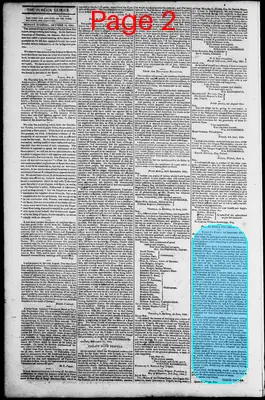
Letter to Editor
October 14, 1805
Norfolk Gazette And Publick Ledger
Norfolk, Virginia
What is this article about?
Joseph Cooper describes an improved method for preparing flax, learned from a German servant, involving partial water retting followed by ground exposure to produce softer, whiter linen. He notes similar practices in Ireland and Russia, urging American farmers to trial it for better domestic manufacture.
Clipping
OCR Quality
98%
Excellent
Full Text
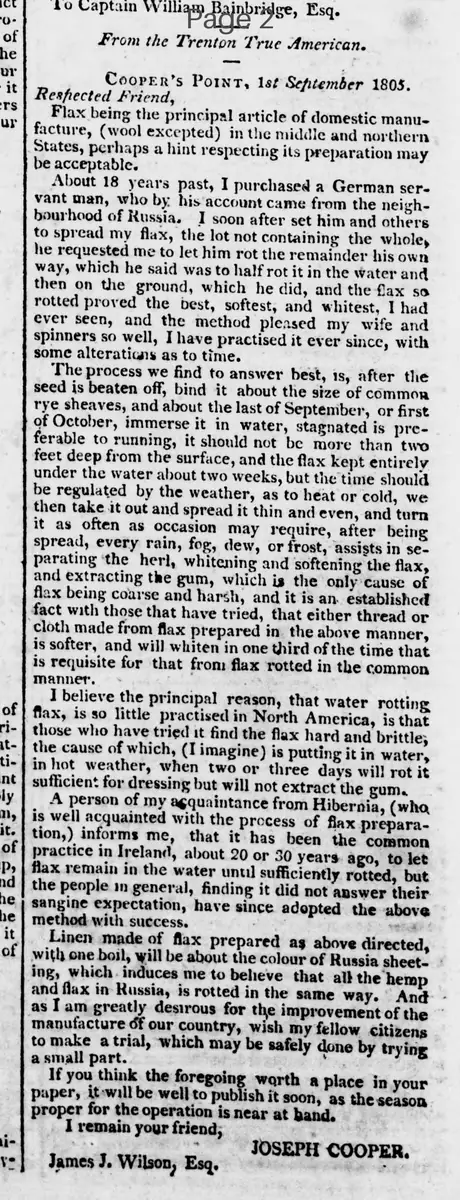
From the Trenton True American.
Cooper's Point, 1st September 1805.
Respected Friend,
Flax being the principal article of domestic manufacture, (wool excepted) in the middle and northern States, perhaps a hint respecting its preparation may be acceptable.
About 18 years past, I purchased a German servant man, who by his account came from the neighbourhood of Russia. I soon after set him and others to spread my flax, the lot not containing the whole, he requested me to let him rot the remainder his own way, which he said was to half rot it in the water and then on the ground, which he did, and the flax so rotted proved the best, softest, and whitest, I had ever seen, and the method pleased my wife and spinners so well, I have practised it ever since, with some alterations as to time.
The process we find to answer best, is, after the seed is beaten off, bind it about the size of common rye sheaves, and about the last of September, or first of October, immerse it in water, stagnated is preferable to running, it should not be more than two feet deep from the surface, and the flax kept entirely under the water about two weeks, but the time should be regulated by the weather, as to heat or cold, we then take it out and spread it thin and even, and turn it as often as occasion may require, after being spread, every rain, fog, dew, or frost, assists in separating the hurle, whitening and softening the flax, and extracting the gum, which is the only cause of flax being coarse and harsh, and it is an established fact with those that have tried, that either thread or cloth made from flax prepared in the above manner, is softer, and will whiten in one third of the time that is requisite for that from flax rotted in the common manner.
I believe the principal reason, that water rotting flax, is so little practised in North America, is that those who have tried it find the flax hard and brittle; the cause of which, (I imagine) is putting it in water, in hot weather, when two or three days will rot it sufficient for dressing but will not extract the gum.
A person of my acquaintance from Hibernia, (who is well acquainted with the process of flax preparation,) informs me, that it has been the common practice in Ireland, about 20 or 30 years ago, to let flax remain in the water until sufficiently rotted, but the people in general, finding it did not answer their sanguine expectation, have since adopted the above method with success.
Linen made of flax prepared as above directed, with one boil, will be about the colour of Russia sheeting, which induces me to believe that all the hemp and flax in Russia, is rotted in the same way. And as I am greatly desirous for the improvement of the manufacture of our country, wish my fellow citizens to make a trial, which may be safely done by trying a small part.
If you think the foregoing worth a place in your paper, it will be well to publish it soon, as the season proper for the operation is near at hand.
I remain your friend;
JOSEPH COOPER.
James J. Wilson, Esq.
Cooper's Point, 1st September 1805.
Respected Friend,
Flax being the principal article of domestic manufacture, (wool excepted) in the middle and northern States, perhaps a hint respecting its preparation may be acceptable.
About 18 years past, I purchased a German servant man, who by his account came from the neighbourhood of Russia. I soon after set him and others to spread my flax, the lot not containing the whole, he requested me to let him rot the remainder his own way, which he said was to half rot it in the water and then on the ground, which he did, and the flax so rotted proved the best, softest, and whitest, I had ever seen, and the method pleased my wife and spinners so well, I have practised it ever since, with some alterations as to time.
The process we find to answer best, is, after the seed is beaten off, bind it about the size of common rye sheaves, and about the last of September, or first of October, immerse it in water, stagnated is preferable to running, it should not be more than two feet deep from the surface, and the flax kept entirely under the water about two weeks, but the time should be regulated by the weather, as to heat or cold, we then take it out and spread it thin and even, and turn it as often as occasion may require, after being spread, every rain, fog, dew, or frost, assists in separating the hurle, whitening and softening the flax, and extracting the gum, which is the only cause of flax being coarse and harsh, and it is an established fact with those that have tried, that either thread or cloth made from flax prepared in the above manner, is softer, and will whiten in one third of the time that is requisite for that from flax rotted in the common manner.
I believe the principal reason, that water rotting flax, is so little practised in North America, is that those who have tried it find the flax hard and brittle; the cause of which, (I imagine) is putting it in water, in hot weather, when two or three days will rot it sufficient for dressing but will not extract the gum.
A person of my acquaintance from Hibernia, (who is well acquainted with the process of flax preparation,) informs me, that it has been the common practice in Ireland, about 20 or 30 years ago, to let flax remain in the water until sufficiently rotted, but the people in general, finding it did not answer their sanguine expectation, have since adopted the above method with success.
Linen made of flax prepared as above directed, with one boil, will be about the colour of Russia sheeting, which induces me to believe that all the hemp and flax in Russia, is rotted in the same way. And as I am greatly desirous for the improvement of the manufacture of our country, wish my fellow citizens to make a trial, which may be safely done by trying a small part.
If you think the foregoing worth a place in your paper, it will be well to publish it soon, as the season proper for the operation is near at hand.
I remain your friend;
JOSEPH COOPER.
James J. Wilson, Esq.
What sub-type of article is it?
Informative
What themes does it cover?
Agriculture
What keywords are associated?
Flax Preparation
Water Retting
Ground Retting
Linen Manufacture
Domestic Agriculture
Russia Method
Ireland Practice
What entities or persons were involved?
Joseph Cooper
James J. Wilson, Esq.
Letter to Editor Details
Author
Joseph Cooper
Recipient
James J. Wilson, Esq.
Main Argument
an improved flax preparation method—partial water retting followed by ground exposure—produces softer, whiter linen more efficiently than common practices, and should be trialed by american farmers to enhance domestic manufacture.
Notable Details
Learned From German Servant Near Russia
Similar To Irish Method Adopted 20 30 Years Ago
Results In Color Like Russia Sheeting After One Boil