Thank you for visiting SNEWPapers!
Sign up free
The Virginia Gazette
Richmond, Williamsburg, Richmond County, Virginia
What is this article about?
General Washington's letter to Congress details the successful surprise attack on Hessian forces at Trenton on December 26, 1776, capturing 918 prisoners and artillery with minimal American losses, despite ice hindering river crossings by supporting forces.
Merged-components note: Continuation of the report on the Battle of Trenton from General Washington, including the return of prisoners; the second part flows directly from the first.
Clippings
1 of 2
OCR Quality
Full Text
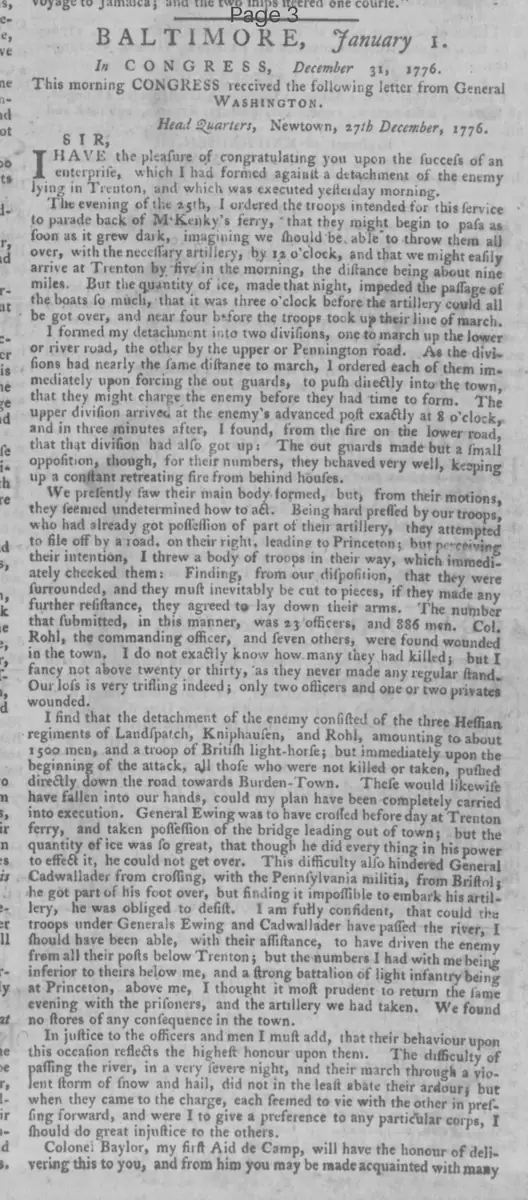
In CONGRESS, December 31, 1776.
This morning CONGRESS received the following letter from General WASHINGTON.
Head Quarters, Newtown, 27th December, 1776.
SIR,
I HAVE the pleasure of congratulating you upon the success of an enterprise, which I had formed against a detachment of the enemy lying in Trenton, and which was executed yesterday morning.
The evening of the 25th, I ordered the troops intended for this service to parade back of McKonkey's ferry, that they might begin to pass as soon as it grew dark, imagining we should be able to throw them all over, with the necessary artillery, by 12 o'clock, and that we might easily arrive at Trenton by five in the morning, the distance being about nine miles. But the quantity of ice, made that night, impeded the passage of the boats so much, that it was three o'clock before the artillery could all be got over, and near four before the troops took up their line of march.
I formed my detachment into two divisions, one to march up the lower or river road, the other by the upper or Pennington road. As the divisions had nearly the same distance to march, I ordered each of them immediately upon forcing the out guards, to push directly into the town, that they might charge the enemy before they had time to form. The upper division arrived at the enemy's advanced post exactly at 8 o'clock, and in three minutes after, I found, from the fire on the lower road, that that division had also got up: The out guards made but a small opposition, though, for their numbers, they behaved very well, keeping up a constant retreating fire from behind houses.
We presently saw their main body formed, but, from their motions, they seemed undetermined how to act. Being hard pressed by our troops, who had already got possession of part of their artillery, they attempted to file off by a road, on their right, leading to Princeton; but perceiving their intention, I threw a body of troops in their way, which immediately checked them: Finding, from our disposition, that they were surrounded, and they must inevitably be cut to pieces, if they made any further resistance, they agreed to lay down their arms. The number that submitted, in this manner, was 23 officers, and 886 men. Col. Rahl, the commanding officer, and seven others, were found wounded in the town, I do not exactly know how many they had killed; but I fancy not above twenty or thirty, as they never made any regular stand.
Our loss is very trifling indeed; only two officers and one or two privates wounded.
I find that the detachment of the enemy consisted of the three Hessian regiments of Knyphausen, Landpatch, and Rohl, amounting to about 1500 men, and a troop of British light-horse; but immediately upon the beginning of the attack, all those who were not killed or taken, pushed directly down the road towards Burdentown. These would likewise have fallen into our hands, could my plan have been completely carried into execution. General Ewing was to have crossed before day at Trenton ferry, and taken possession of the bridge leading out of town; but the quantity of ice was so great, that though he did every thing in his power to effect it, he could not get over. This difficulty also hindered General Cadwallader from crossing, with the Pennsylvania militia, from Bristol; he got part of his foot over, but finding it impossible to embark his artillery, he was obliged to desist. I am fully confident, that could the troops under Generals Ewing and Cadwallader have passed the river, I should have been able, with their assistance, to have driven the enemy from all their posts below Trenton; but the numbers I had with me being inferior to theirs below me, and a strong battalion of light infantry being at Princeton, above me, I thought it most prudent to return the same evening with the prisoners, and the artillery we had taken. We found no stores of any consequence in the town.
In justice to the officers and men I must add, that their behaviour upon this occasion reflects the highest honour upon them. The difficulty of passing the river, in a very severe night, and their march through a violent storm of snow and hail, did not in the least abate their ardour; but when they came to the charge, each seemed to vie with the other in pressing forward, and were I to give a preference to any particular corps, I should do great injustice to the others.
Colonel Baylor, my first Aid de Camp, will have the honour of delivering this to you, and from him you may be made acquainted with many circumstances, which I have not time to mention.
other particulars; his spirited behaviour, upon every occasion, requires me to recommend him to your particular notice.
I have the honour to be, with great respect,
Sir, your most humble servant,
G. WASHINGTON.
Enclosed I have sent you a particular list of the prisoners, artillery, and other stores.
RETURN of prisoners taken at Trenton, the 26th of December, 1776, by the army under the command of his Excellency General Washington.
Regiment of LANDSPATCH.
1 Lieutenant Colonel, 1 Major, 1 Captain, 3 Lieutenants, 4 Ensigns, 38 serjeants, 6 drummers, 5 musicians, 9 officers servants, 206 rank and file.
Regiment of KNIPHAUSEN.
1 Major, 2 Captains, 2 Lieutenants, 3 Ensigns, 25 serjeants, 6 drummers, 6 officers servants, 258 rank and file.
Regiment of ROHL.
1 Colonel, 1 Lieutenant Colonel, 1 Major, 1 Captain, 2 Lieutenants, 5 Ensigns, 2 surgeons mates, 25 serjeants, 8 drummers, 4 musicians, 9 officers servants, 244 rank and file.
Regiment of ARTILLERY.
1 Lieutenant, 4 serjeants, 1 officer's servant, 32 rank and file.
Total,-1 Colonel, 2 Lieutenant Colonels, 3 Majors, 4 Captains, 8 Lieutenants, 12 Ensigns, 2 surgeons, 92 serjeants, 20 drummers, 9 musicians, 25 officers servants, 740 rank and file. 918 prisoners.
6 double-fortified brass three pounders, with carriages complete, ammunition waggons, as many muskets, bayonets, cartouch boxes, and swords, as there are prisoners, 12 drums, and 4 colours.
Published by order of Congress.
CHARLES THOMSON, Sec'ry.
What sub-type of article is it?
What themes does it cover?
What keywords are associated?
What entities or persons were involved?
Where did it happen?
Story Details
Key Persons
Location
Trenton
Event Date
December 26, 1776
Story Details
Washington's forces crossed the Delaware River despite ice and storm, surprised Hessian troops at Trenton, captured 918 prisoners including Col. Rahl (wounded), six artillery pieces, and stores, with only minor American casualties; supporting crossings by Ewing and Cadwallader failed due to ice.