Thank you for visiting SNEWPapers!
Sign up free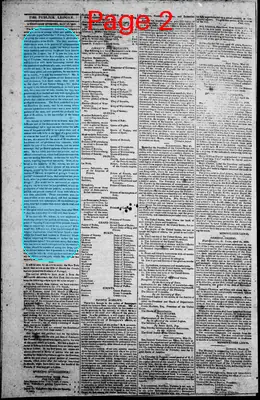
Editorial
May 17, 1809
Norfolk Gazette And Publick Ledger
Norfolk, Virginia
What is this article about?
An editorial criticizes former President John Adams for publishing essays in the Boston Patriot, portraying him as vain, passionate, and unfit for leadership. It defends his honesty but pities his recent excesses due to his son's political exclusion, and dismisses concerns over his revelations about Federalists.
Clipping
OCR Quality
96%
Excellent
Full Text
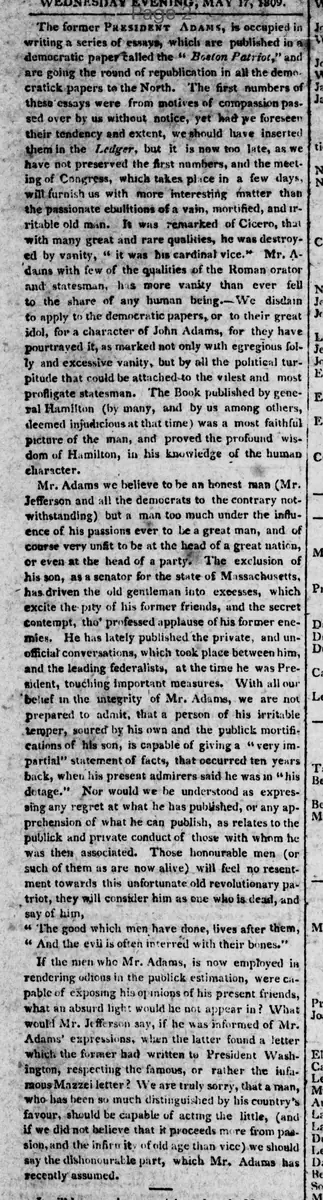
The former President Adams, is occupied in writing a series of essays, which are published in a democratic paper called the "Boston Patriot," and are going the round of republication in all the democratic papers to the North. The first numbers of these essays were from motives of compassion passed over by us without notice, yet had we foreseen their tendency and extent, we should have inserted them in the Ledger, but it is now too late, as we have not preserved the first numbers, and the meeting of Congress, which takes place in a few days, will furnish us with more interesting matter than the passionate ebulitions of a vain, mortified, and irritable old man. It was remarked of Cicero, that with many great and rare qualities, he was destroyed by vanity, "it was his cardinal vice." Mr. Adams with few of the qualities of the Roman orator and statesman, has more vanity than ever fell to the share of any human being. We disdain to apply to the democratic papers, or to their great idol, for a character of John Adams, for they have pourtrayed it, as marked not only with egregious folly and excessive vanity, but by all the political turpitude that could be attached to the vilest and most profligate statesman. The Book published by general Hamilton (by many, and by us among others, deemed injudicious at that time) was a most faithful picture of the man, and proved the profound wisdom of Hamilton, in his knowledge of the human character. Mr. Adams we believe to be an honest man (Mr. Jefferson and all the democrats to the contrary notwithstanding) but a man too much under the influence of his passions ever to be a great man, and of course very unfit to be at the head of a great nation, or even at the head of a party. The exclusion of his son, as a senator for the state of Massachusetts, has driven the old gentleman into excesses, which excite the pity of his former friends, and the secret contempt, tho' professed applause of his former enemies. He has lately published the private, and unofficial conversations, which took place between him, and the leading federalists, at the time he was President, touching important measures. With all our belief in the integrity of Mr. Adams, we are not prepared to admit, that a person of his irritable temper, soured by his own and the publick mortifications of his son, is capable of giving a "very impartial" statement of facts, that occurred ten years back, when his present admirers said he was in "his dotage." Nor would we be understood as expressing any regret at what he has published, or any apprehension of what he can publish, as relates to the publick and private conduct of those with whom he was then associated. Those honourable men (or such of them as are now alive) will feel no resentment towards this unfortunate old revolutionary patriot, they will consider him as one who is dead, and say of him,
"The good which men have done, lives after them,
And the evil is often interred with their bones."
If the men who Mr. Adams, is now employed in rendering odious in the publick estimation, were capable of exposing his opinions of his present friends, what an absurd light would he not appear in? What would Mr. Jefferson say, if he was informed of Mr. Adams' expressions, when the latter found a letter which the former had written to President Washington, respecting the famous, or rather the infamous Mazzei letter? We are truly sorry, that a man, who has been so much distinguished by his country's favour, should be capable of acting the little, (and if we did not believe that it proceeds more from passion, and the infirmity of old age than vice) we should say the dishonourable part, which Mr. Adams has recently assumed.
"The good which men have done, lives after them,
And the evil is often interred with their bones."
If the men who Mr. Adams, is now employed in rendering odious in the publick estimation, were capable of exposing his opinions of his present friends, what an absurd light would he not appear in? What would Mr. Jefferson say, if he was informed of Mr. Adams' expressions, when the latter found a letter which the former had written to President Washington, respecting the famous, or rather the infamous Mazzei letter? We are truly sorry, that a man, who has been so much distinguished by his country's favour, should be capable of acting the little, (and if we did not believe that it proceeds more from passion, and the infirmity of old age than vice) we should say the dishonourable part, which Mr. Adams has recently assumed.
What sub-type of article is it?
Partisan Politics
What keywords are associated?
John Adams
Boston Patriot
Political Vanity
Federalists
Democratic Papers
Hamilton Book
Mazzei Letter
What entities or persons were involved?
John Adams
Alexander Hamilton
Thomas Jefferson
George Washington
Federalists
Democrats
Boston Patriot
Editorial Details
Primary Topic
Criticism Of John Adams' Essays And Political Conduct
Stance / Tone
Critical And Pitying Of John Adams' Vanity And Excesses
Key Figures
John Adams
Alexander Hamilton
Thomas Jefferson
George Washington
Federalists
Democrats
Boston Patriot
Key Arguments
Adams' Essays In The Boston Patriot Are Passionate Outbursts Of A Vain Old Man
Adams Possesses Excessive Vanity, More Than Cicero
Hamilton's Book Accurately Portrayed Adams' Character
Adams Is Honest But Too Passionate To Be A Great Leader
His Son's Exclusion From Senate Has Driven Him To Excesses
His Published Conversations Are Not Impartial Due To His Temper
No Regret Over His Publications As Honorable Federalists Will Forgive Him
Adams' Actions Stem From Passion And Old Age Infirmity