Thank you for visiting SNEWPapers!
Sign up free
Atlanta Daily World
Atlanta, Fulton County, Georgia
What is this article about?
In a sensational Atlanta trial, John Lovejoy is convicted of fornication after a 1928-1930 affair with Leona Murphy, who bore his child. Court hears love letters and testimony; defense uses racist slurs. Sentencing pending under Georgia law.
Merged-components note: Continuation of trial story from page 1 to page 2.
Clippings
1 of 2
OCR Quality
Full Text
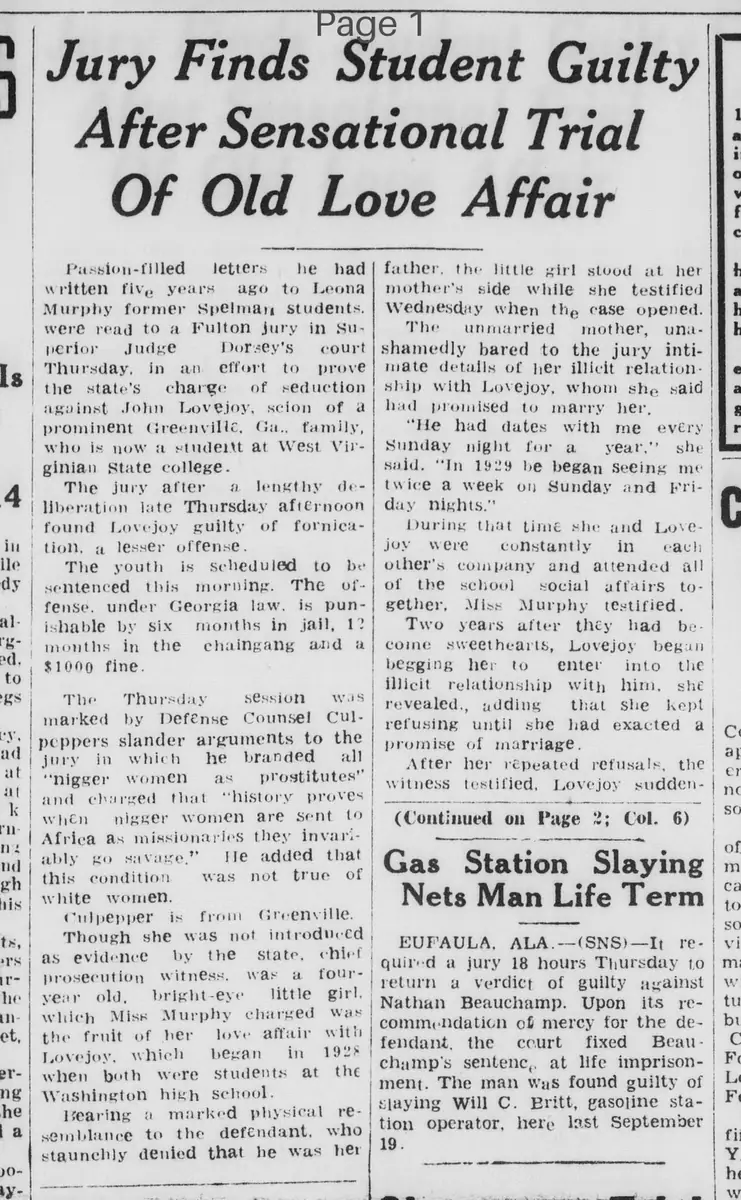
Passion-filled letters he had written five years ago to Leona Murphy, former Spelman student, were read to a Fulton jury in Superior Judge Dorsey's court Thursday, in an effort to prove the state's charge of seduction against John Lovejoy, scion of a prominent Greenville, Ga., family, who is now a student at West Virginia State college.
The jury after a lengthy deliberation late Thursday afternoon found Lovejoy guilty of fornication, a lesser offense.
The youth is scheduled to be sentenced this morning. The offense, under Georgia law, is punishable by six months in jail, 12 months in the chaingang and a $1000 fine.
The Thursday session was marked by Defense Counsel Culpepper's slander arguments to the jury in which he branded all "nigger women as prostitutes" and charged that "history proves when nigger women are sent to Africa as missionaries they invariably go savage." He added that this condition was not true of white women.
Culpepper is from Greenville.
Though she was not introduced as evidence by the state, chief prosecution witness, was a four-year old, bright-eyed little girl, which Miss Murphy charged was the fruit of her love affair with Lovejoy, which began in 1928 when both were students at the Washington high school.
Bearing a marked physical resemblance to the defendant, who staunchly denied that he was her father, the little girl stood at her mother's side while she testified Wednesday when the case opened.
The unmarried mother, unashamedly bared to the jury intimate details of her illicit relationship with Lovejoy, whom she said had promised to marry her.
"He had dates with me every Sunday night for a year," she said. "In 1929 he began seeing me twice a week on Sunday and Friday nights."
During that time she and Lovejoy were constantly in each other's company and attended all of the school social affairs together, Miss Murphy testified.
Two years after they had become sweethearts, Lovejoy began begging her to enter into the illicit relationship with him, she revealed, adding that she kept refusing until she had exacted a promise of marriage.
After her repeated refusals, the witness testified, Lovejoy suddenly
(Continued on Page 1, Col. 6)
Jury Finds
(Continued from Page 1)
ly stopped calling on her and stayed away a month. He then returned and after apologizing for his conduct, began visiting her again.
Shortly afterward, she said, she made a mutual agreement, with the defendant that they would get married after both had finished school. After the agreement had been made, Lovejoy again began his pleas for her consent to the relationship and finally on Easter Sunday, 1930, she said she "accomodated" him because she "loved him."
Her mother was at work at the time, and both she and Lovejoy were alone at her home, 58 Chestnut street, northwest, she said. She first learned that she was about to become a mother in March, 1931, she revealed. The child was born in November of the same year, but Lovejoy in the meantime had ceased calling in June.
Mrs. Clara Hilliard, mother of the girl, told the jury that her daughter had never gone with any other boy but Lovejoy, and that she had started seeing with him without her mother's consent.
Asked on cross examination why she objected to Lovejoy's interest in her daughter, Mrs. Hilliard said, that she "just never approved of girls of that age keeping company with boys."
Several other witnesses were placed on the stand by the state to testify that they had overheard Lovejoy state his intentions to marry Miss Murphy.
Lovejoy in his unsworn statement reviewed his early life, spoke at length on his plans to become a doctor, then lightly touched on Miss Murphy's contention that he was her sweetheart five years ago.
"I went with her some, but not much and so did several others," he explained.
Miss Ethel Lovejoy, a sister to the defendant, who is a school-teacher at Greenville, took the stand and told of a conversation she had had with the girl's mother. The mother at that time, according to the sister, was not certain just who was the father of her daughter's baby.
The state in rebuttal introduced a package of letters written to Miss Murphy by the defendant during their school-day love affair.
The letters, portions of which were read to the jury, were written in endearing terms. In one Lovejoy wrote that he "wished I had a talking picture of you, so that you would be with me all the time." In another the defendant wrote, "I dream that you are in my arms and when I wake up you are there." The love notes were closed with such phrases as "I'll love you always," "you'll always be mine," etc.
Defense counsel Culpepper in closing his argument to the jury asserted that the jury could not treat this case "as if it were white people involved." He then went on to state his opinion as to the immorality prevailing "generally" among Negroes especially among "nigger women."
Making the losing argument for the State, Assistant Solicitor Smith cautioned the jurors that "you are not dealing with the Negro race as a whole, but with two people, this boy and this girl."
"The Negro race is not on trial," he declared.
Attorney A. T. Walden assisted in the prosecution of the case.
What sub-type of article is it?
What themes does it cover?
What keywords are associated?
What entities or persons were involved?
Where did it happen?
Story Details
Key Persons
Location
Fulton Superior Court, Atlanta, Georgia
Event Date
Thursday, 1933 (Trial); Affair Began 1928
Story Details
John Lovejoy, a student, is tried for seduction after a love affair with former Spelman student Leona Murphy, resulting in a child. Passionate letters from 1928 are read in court. Defense makes racist arguments. Jury finds him guilty of lesser charge of fornication. Murphy testifies to promises of marriage and intimate details.