Thank you for visiting SNEWPapers!
Sign up free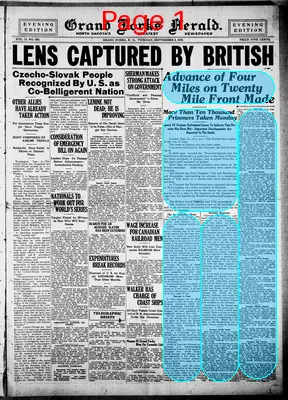
Grand Forks Herald
Grand Forks, Grand Forks County, North Dakota
What is this article about?
British forces under Field Marshal Haig captured Lens, Queant, and other towns, advancing up to four miles on a twenty-mile front, taking over 10,000 German prisoners amid a forced German retreat on the Western Front in France.
Merged-components note: Merged section title/headline with the following war news story for coherent logical unit.
Clipping
OCR Quality
Full Text
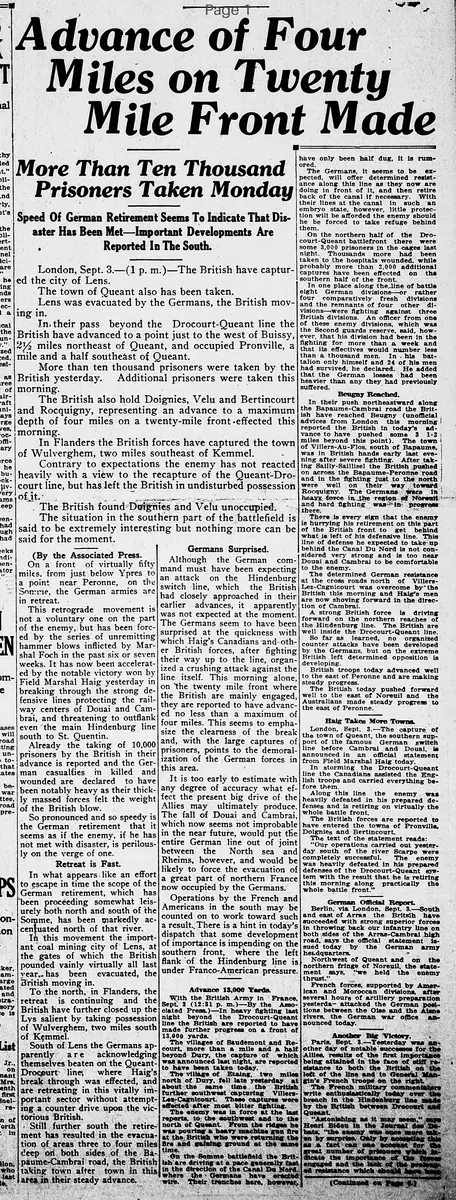
More Than Ten Thousand Prisoners Taken Monday
Speed Of German Retirement Seems To Indicate That Disaster Has Been Met Important Developments Are Reported In The South.
London, Sept. 3.-(1 p. m.) --The British have captured the city of Lens.
The town of Queant also has been taken.
Lens was evacuated by the Germans, the British moving in.
In their pass beyond the Drocourt-Queant line the British have advanced to a point just to the west of Buissy, 2½ miles northeast of Queant, and occupied Pronville, a mile and a half southeast of Queant.
More than ten thousand prisoners were taken by the British yesterday. Additional prisoners were taken this morning.
The British also hold Doignies, Velu and Bertincourt and Rocquigny, representing an advance to a maximum depth of four miles on a twenty-mile front-effected this morning.
In Flanders the British forces have captured the town of Wulverghem, two miles southeast of Kemmel
Contrary to expectations the enemy has not reacted heavily with a view to the recapture of the Queant-Drocourt line, but has left the British in undisturbed possession of it.
The British found Doignies and Velu unoccupied.
The situation in the southern part of the battlefield is said to be extremely interesting but nothing more can be said for the moment.
(By the Associated Press.)
On a front of virtually fifty miles, from just below Ypres to a point near Peronne, on the Somme, the German armies are in retreat.
This retrograde movement is not a voluntary one on the part of the enemy, but has been forced by the series of unremitting hammer blows inflicted by Marshal Foch in the past six or seven weeks. It has now been accelerated by the notable victory won by Field Marshal Haig yesterday in breaking through the strong defensive lines protecting the railway centers of Douai and Cambrai, and threatening to outflank even the main Hindenburg line south to St. Quentin.
Already the taking of 10,000 prisoners by the British in their advance is reported and the German casualties in killed and wounded are declared to have been notably heavy as their thickly massed forces felt the weight of the British blow.
So pronounced and so speedy is the German retirement that it seems as if the enemy, if he has not met with disaster, is perilously on the verge of one.
Retreat is Fast.
In what appears like an effort to escape in time the scope of the German retirement, which has been proceeding somewhat leisurely both north and south of the Somme, has been markedly accentuated north of that river.
In this movement the important coal mining city of Lens, at the gates of which the British pounded vainly virtually all last year--has been evacuated, the British moving in.
To the north, in Flanders, the retreat is continuing and the British have further closed up the Lys salient by taking possession of Wulverghem, two miles south of Kemmel.
South of Lens the Germans apparently are acknowledging themselves beaten on the Queant-Drocourt line, where Haig's break through was effected, and are retreating in this vitally important sector without attempting a counter drive upon the victorious British.
Still further south the retirement has resulted in the evacuation of areas three to four miles deep on both sides of the Bapaume Cambrai road, the British taking town after town in this area in their steady advance.
Although the German command must have been expecting an attack on the Hindenburg switch line, which the British had closely approached in their earlier advances, it apparently was not expected at the moment.
The Germans seem to have been surprised at the quickness with which Haig's Canadians and other British forces, after fighting their way up to the line, organized a crushing attack against the line itself. This morning alone, on the twenty mile front where the British are mainly engaged, they are reported to have advanced no less than a maximum of four miles. This seems to emphasize the clearness of the break and, with the large captures of prisoners, points to the demoralization of the German forces in this area.
It is too early to estimate with any degree of accuracy what effect the present big drive of the Allies may ultimately produce. The fall of Douai and Cambrai, which now seems not improbable in the near future, would put the entire German line out of joint between the North sea and Rheims, however, and would be likely to force the evacuation of a great part of northern France now occupied by the Germans.
Operations by the French and Americans in the south may be counted on to work toward such a result. There is a hint in today's dispatch that some development of importance is impending on the southern front, where the left flank of the Hindenburg line is under Franco-American pressure.
Advance 13,000 Yards.
With the British Army in France, Sept. 3 (12:31 p. m.)--By the Associated Press.)--In heavy fighting last night beyond the Drocourt-Queant line the British are reported to have made further progress on a front of 13,000 yards.
The villages of Saudemont and Rocourt, more than a mile and a half beyond Dury, the capture of which was announced last night, are reported to have been taken today.
The village of Etaing, two miles north of Dury, fell late yesterday at about the same time the British further southwest capturing Villers-Les-Cagnicourt. These captures were effected after most bitter fighting.
The enemy was in force at the last reports, to the southwest and to the north of Queant From the ridge he was pouring a heavy machine gun fire at the British who were returning the fire and gaining ground at the same time.
On the Somme battlefield the British are driving at a pace, generally last in the direction of the Canal Du Nord Where the Germans have only been half dug, it is rumored.
The Germans, it seems to be expected, will offer determined resistance along this line as they now are doing in front of it, and then retire back of the canal if necessary. With their lines at the canal in such an embryo state, however, little protection will be afforded the enemy should he be forced to take refuge behind them.
On the northern half of the Drocourt-Queant battlefront there were some 3,000 prisoners in the cages last night. Thousands more had been taken to the hospitals wounded, while probably more than 2,000 additional captures have been effected on the southern half of the front.
In one place along the line of battle eight German divisions or rather four comparatively fresh divisions and the remnants of four other divisions--were fighting against three British divisions. An officer from one of these enemy divisions, which was the Second guards reserve, said, however, that his division had been in the fighting for more than a week and that its effectives would number less than a thousand men. In his battalion only himself and 24 of his men had survived, he declared. He added that the German losses had been heavier than any they had previously suffered.
Beugny Reached
In their push northeastward along the Bapaume-Cambrai road the British have reached Beugny (unofficial advices from London this morning reported the British in today's advance to have pushed some 3½ miles beyond this point). The town of Villers-Au-Flos, south of Bapaume, was in British hands early last evening after severe fighting. After taking Sailly-Saillisel the British pushed on across the Bapaume-Peronne road and in the fighting just to the north were well on their way toward Rocquigny. The Germans were in heavy force in the region of Noreuil and hard fighting was in progress there.
There is every sign that the enemy is hurrying his retirement on this part of the British front to get behind what is left of his defensive line. This line of defense he expected to take up behind the Canal Du Nord is not considered very strong and is too near Douai and Cambrai to be comfortable to the enemy.
The determined German resistance at the cross roads north of Villers-Lez-Cagnicourt was overcome by the British this morning and Haig's men are now shoving forward in the direction of Cambrai.
A strong British force is driving forward on the northern reaches of the Hindenburg line. The British are well inside the Drocourt-Queant line.
So far as learned, no organized counter attacks have been developed by the Germans, but on the extreme British left determined opposition is developing.
British troops today advanced well to the east of Peronne and are making steady progress.
The British today pushed forward well to the east of Noreuil and the Australians made steady progress to the east of Peronne.
Haig Takes More Towns.
London, Sept. 3.--The capture of the town of Queant, the southern support of the famous German switch line before Cambrai and Douai, is announced in an official statement from Field Marshal Haig today.
In storming the Drocourt-Queant line the Canadians assisted the English troops and carried everything before them.
Along this line the enemy was heavily defeated in his prepared defenses and is retiring on virtually the whole battle front.
The British forces are reported to have entered the towns of Pronville, Doignies and Bertincourt.
The text of the statement reads:
"Our operations carried out yesterday south of the river Scarpe were completely successful.
The enemy was heavily defeated in his prepared defenses of the Drocourt-Queant system with the result that he is retiring this morning along practically the whole battle front."
German Official Report.
Berlin, via London, Sept. 3.-South and east of Arras the British have succeeded with strong superior forces in throwing back our infantry line on both sides of the Arras-Cambrai high road, says the official statement issued today by the German army headquarters.
Northwest of Queant and on the northern fringe of Noreuil, the statement says, "we held the enemy thrust."
French forces, supported by American and Moroccan divisions, after several hours of artillery preparation yesterday attacked the German positions between the Oise and the Aisne rivers, the German war office announced today.
Another Big Victory
Paris, Sept. 3.-Yesterday other day of notable successes for Allies, results of the first import being attained in the face of stiffs resistance to both the British on left of the line and to General Mangin's French troops on the right
The French military comment writes enthusiastically today over breach in the Hindenburg line by the British between Drocourt Queant
Astonishing as it may seem Henri Bidou in the Journal de Genies once more by surprise
Snumberaorp HooBcJ Yetheemoor tmo of 17* t04 and:the.laek-ofita p resistance, which,ahoyy
What sub-type of article is it?
What keywords are associated?
What entities or persons were involved?
Where did it happen?
Foreign News Details
Primary Location
Lens, France
Event Date
Sept. 3
Key Persons
Outcome
more than ten thousand prisoners taken by the british; german casualties in killed and wounded notably heavy; british captured lens, queant, wulverghem, pronville, doignies, bertincourt, rocquigny, saudemont, rocourt, etaing, villers-les-cagnicourt, beugny, villers-au-flos, sailly-saillisel; german retreat on fifty-mile front
Event Details
British forces advanced four miles on a twenty-mile front beyond the Drocourt-Queant line, capturing multiple towns including Lens and Queant evacuated by Germans; in Flanders, captured Wulverghem; German retirement forced by Allied blows, no heavy counterattacks; French and Americans pressuring southern front; heavy fighting with British progress toward Canal du Nord and Cambrai