Thank you for visiting SNEWPapers!
Sign up free
Alexandria Daily Gazette, Commercial & Political
Alexandria, Virginia
What is this article about?
In dispatches from Washington dated August 7 and 10, 1809, British envoy David Erskine defends his negotiations with the US to Secretary Canning, explaining deviations from instructions to foster better relations, referencing the Chesapeake affair and US assurances, and acknowledges his replacement by Mr. Jackson.
Clipping
OCR Quality
Full Text
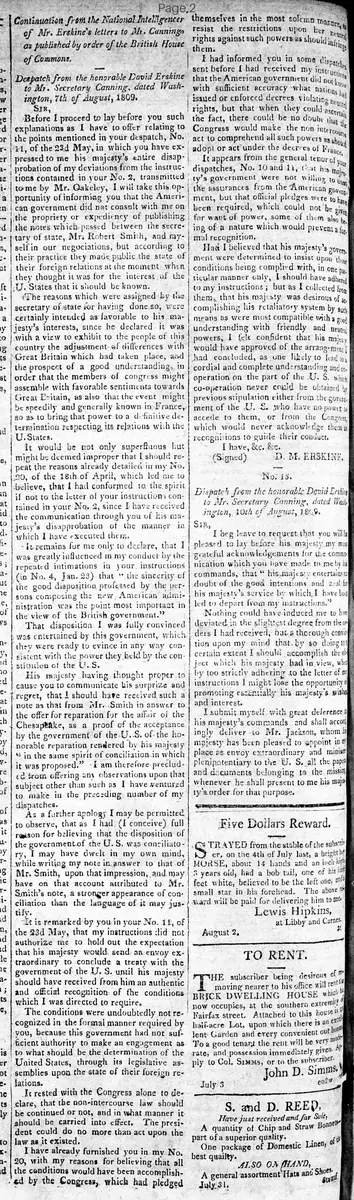
Despatch from the honorable David Erskine to Mr. Secretary Canning, dated Washington, 7th of August, 1809.
SIR,
Before I proceed to lay before you such explanations as I have to offer relating to the points mentioned in your despatch, No. 11, of the 23d May, in which you have expressed to me his majesty's entire disapprobation of my deviations from the instructions contained in your No. 2, transmitted to me by Mr. Oakeley, I will take this opportunity of informing you that the American government did not consult with me on the propriety or expediency of publishing the notes which passed between the secretary of state, Mr. Robert Smith, and myself in our negociations, but according to their practice they made public the state of their foreign relations at the moment when they thought it was for the interest of the U. States that it should be known. The reasons which were assigned by the secretary of state for having done so, were certainly intended as favorable to his majesty's interests, since he declared it was with a view to exhibit to the people of this country the adjustment of differences with Great Britain which had taken place, and the prospect of a good understanding, in order that the members of congress might assemble with favorable sentiments towards Great Britain, as also that the event might be speedily and generally known in France, so as to bring that power to a definitive determination respecting its relations with the U. States. It would be not only superfluous but might be deemed improper that I should repeat the reasons already detailed in my No. 20, of the 18th. of April, which led me to believe, that I had conformed to the spirit if not to the letter of your instructions contained in your No. 2. since I have received the communication through you of his majesty's disapprobation of the manner in which I have executed them. —it remains for me only to declare, that I was greatly influenced in my conduct by the repeated intimations in your instructions (in No. 4, Jan. 23) that "the sincerity of the good disposition professed by the persons composing the new, American administration was the point most important in the view of the British government." That disposition I was fully convinced was entertained by this government, which they were ready to evince in any way consistent with the power they held by the constitution of the U. S. His majesty having thought proper to cause you to communicate his surprize and regret, that I should have received such a note as that from Mr. Smith in answer to the offer for reparation for the affair of the Chesapeake, as a proof of the acceptance by the government of the U. S. of the honorable reparation rendered by his majesty "in the same spirit of conciliation in which it was proposed." —I am therefore precluded from offering any observations upon that subject other than such as I have ventured to make in the preceding number of my dispatches. As a further apology I may be permitted to observe, that as I had (I conceive) full reason for believing that the disposition of the government of the U. S. was conciliatory, I may have dwelt in my own mind, while writing my note in answer to that of Mr. Smith, upon that impression, and may have on that account attributed to Mr. Smith's note, a stronger appearance of conciliation than the language of it may justify. "It is remarked by you in your No. 11. of the 23d May, that my instructions did not authorize me to hold out the expectation that his majesty would send an envoy extraordinary to conclude a treaty with the government of the U. S. until his majesty should have received from him an authentic and official recognition of the conditions which I was directed to require. The conditions were undoubtedly not recognized in the formal manner required by you, because this government had not sufficient authority to make an engagement as to what should be the determination of the United States, through its legislative assemblies upon the state of their foreign relations. It rested with the Congress alone to declare, that the non-intercourse law should be continued or not, and in what manner it should be carried into effect. The president could do no more than act upon the law as it existed. I have already furnished you in my No. 20, with my reasons for believing that all the conditions would have been accomplished by the Congress, which had pledged themselves in the most solemn manner, to resist free trade with them. I had informed you in some dispatches sent before I had received my instructions that the American government did not know with what nations the act to comprehend all such powers as should adopt or act under the decrees of France. It appears from the general tenor you dispatches No. 10 and 11 that his majesty's government were not willing to put the assurances from the American government, but that official pledges were to have been required, which could not be given for want of power, some of them also being of a nature which would prevent a formal recognition. Had I believed that his majesty's government were determined to insist upon those conditions being complied with, in one particular manner only, I should have adhered to my instructions; but as I collected from them, that his majesty was desirous of accomplishing his retaliatory system by such means as were most compatible with a good understanding with friendly and neutral powers, I felt confident that his majesty would have approved of the arrangement I had concluded, as one likely to lead to a cordial and complete understanding and co-operation on the part of the U. S. which co-operation never could be obtained by previous stipulation either from the government of the U. S. who have no power to accede to them, or from the Congress which would never acknowledge them as recognitions to guide their conduct. I have, &c. &c.
(Signed)
D. M. ERSKINE,
No. 15.
Dispatch from the honorable David Erskine to Mr. Secretary Canning, dated Washington, 10th of August, 1809.
SIR,
I beg leave to request that you will be pleased to lay before his majesty my most grateful acknowledgements for the communication which you have made to me by his commands, that "his majesty entertains no doubt of the good intentions and zeal for his majesty's service by which I have been led to depart from my instructions." Nothing could have induced me to have deviated in the slightest degree from the orders I had received, but a thorough conviction upon my mind that by so doing to a certain extent I should accomplish the object which his majesty had in view, whereby too strictly adhering to the letter of my instructions I might lose the opportunity of promoting essentially his majesty's wishes and interest. I submit myself, with great deference to his majesty's commands and shall accordingly deliver to Mr. Jackson, whom his majesty has been pleased to appoint in my place as envoy extraordinary and minister plenipotentiary to the U. S. all the papers and documents belonging to the mission whenever he shall present to me his majesty's order for that purpose.
What sub-type of article is it?
What keywords are associated?
What entities or persons were involved?
Where did it happen?
Foreign News Details
Primary Location
Washington
Event Date
7th Of August, 1809 And 10th Of August, 1809
Key Persons
Outcome
erskine defends his actions and deviations from instructions; acknowledges replacement by mr. jackson as envoy.
Event Details
David Erskine explains to Secretary Canning his reasons for deviating from instructions in negotiations with the US government, emphasizing conciliatory dispositions and limitations of US authority; references Chesapeake reparation and publication of notes; in a follow-up, expresses gratitude for recognition of his good intentions and submits to replacement.