Thank you for visiting SNEWPapers!
Sign up free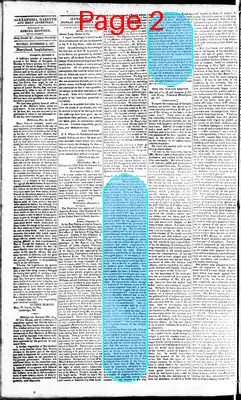
Alexandria Gazette & Daily Advertiser
Alexandria, Virginia
What is this article about?
Private correspondence from Paris on September 14 describes delivering American minerals to Professor Haüy, praises his character and work, notes low religious observance despite royal favor, church defacement from the revolution, and anti-English sentiment affecting Americans.
Clipping
OCR Quality
Full Text
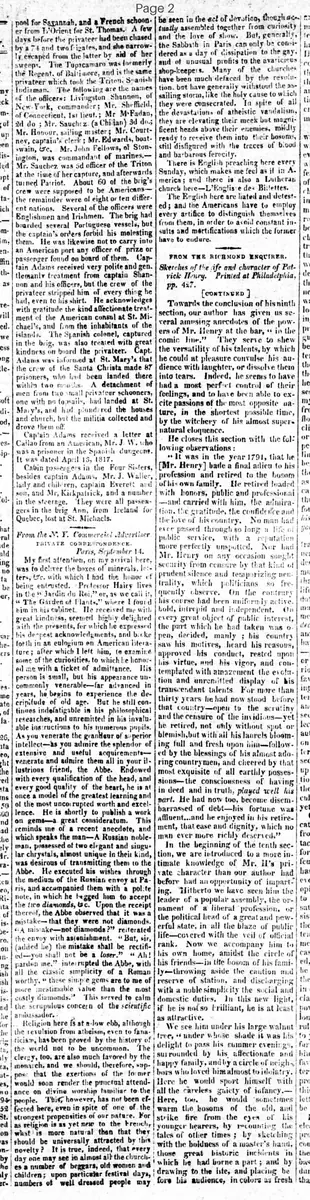
PRIVATE CORRESPONDENCE.
Paris, September 14.
My first attention, on my arrival here, was to deliver the boxes of minerals, letters, &c. with which I had the honor of being entrusted. Professor Haüy lives in the "Jardin du Roi," or, as we call it, "The Garden of Plants," where I found him in his cabinet. He received me with great kindness, seemed highly delighted with the presents, for which he expressed his deepest acknowledgments, and broke forth in an eulogium on American literature; after which I left him, to examine some of the curiosities, to which he honored me with a ticket of admittance. His person is small, but his appearance uncommonly venerable--far advanced in years, he begins to experience the decrepitude of old age. But he still continues indefatigable in his philosophical researches, and unremitted in his invaluable instructions to his numerous pupils. As you venerate the grandeur of superior intellect--as you admire the splendor of extensive and useful acquirements--venerate and admire them all in your illustrious friend, the Abbé. Endowed with every qualification of the head, and every good quality of the heart, he is at once a model of the greatest learning and of the most uncorrupted worth and excellence. He is shortly to publish a work on gems--a great desideratum. This reminds me of a recent anecdote, and which speaks the man--A Russian nobleman, possessed of two elegant and singular crystals, almost unique in their kind, was desirous of transmitting them to the Abbé. He executed his wishes through the medium of the Russian envoy at Paris, and accompanied them with a polite note, in which he begged him to accept the two diamonds, &c. Upon the receipt thereof, the Abbé observed that it was a mistake--that they were not diamonds. "Mistake--not diamonds?" reiterated the envoy with astonishment. "But, sir, (added he) the mistake shall be rectified--you shall not be a loser." "Ah! pardon me," interrupted the Abbé, with all the classic simplicity of a Roman worthy, "these simple gems are to me of more inestimable value than the most costly diamonds." This served to calm the scrupulous concern of the scientific ambassador.
Religion here is at a low ebb, although the revulsion from atheism, even to fanaticism, has been proved by the history of the world not to be uncommon. The clergy, too, are also much favored by the monarch, and we should, therefore, suppose that the exertions of the former would soon render the punctual attendance on divine worship familiar to the people. This, however, has not been effected here, even in spite of one of the strongest propensities of our nature. For as religion is as yet new to the French, what is more natural than that they should be universally attracted by this novelty? It is true, indeed, that every day one may see in almost all the churches a number of beggars, old women and children; upon particular festival days, numbers of well dressed people may be seen in the act of devotion, though actually assembled together from curiosity and the love of show. But, generally, the Sabbath in Paris can only be considered as a day of dissipation to the gay, and of unusual profits to the avaricious shop-keepers. Many of the churches have been much defaced by the revolution, but have generally withstood the assailing storm, like the holy cause to which they were consecrated. In spite of all the devastations of atheistic vandalism, they are elevating their meek but magnificent heads above their enemies, mildly ready to receive them into their bosoms, still disfigured with the traces of blood and barbarous ferocity.
There is English preaching here every Sunday, which makes me feel as in America; and there is also a Lutheran church here--L'Eglise des Billettes.
The English here are hated and detested; and the Americans have to employ every artifice to distinguish themselves from them, in order to avoid constant insults and mortifications which the former have to endure.
What sub-type of article is it?
What keywords are associated?
What entities or persons were involved?
Where did it happen?
Foreign News Details
Primary Location
Paris
Event Date
September 14
Key Persons
Event Details
The correspondent delivered boxes of minerals and letters to Professor Haüy at the Jardin du Roi, who received them kindly and praised American literature. Haüy is described as venerable, learned, and virtuous, soon to publish on gems, with an anecdote of his humility regarding Russian crystals mistaken for diamonds. Religion in Paris is at a low ebb despite royal favor to clergy; churches see few attendees except beggars, women, children, and curious crowds on festivals; Sabbath is a day of dissipation. Churches defaced by the revolution but enduring. English preaching and Lutheran church noted. English are hated, Americans must distinguish themselves to avoid insults.