Thank you for visiting SNEWPapers!
Sign up free
Letter to Editor
March 27, 1919
The Bossier Banner
Benton, Bellevue, Bossier County, Louisiana
What is this article about?
Sergeant William Manry, son of Hon. and Mrs. J. T. Manry of Plain Dealing, writes from France to friends in Bossier Parish, sharing WWI experiences including a humorous anecdote, the joyful armistice celebration on November 11, 1918, a torpedo attack on the Moldavia, and Big Bertha shells.
Clipping
OCR Quality
98%
Excellent
Full Text
A Line to Old Friends.
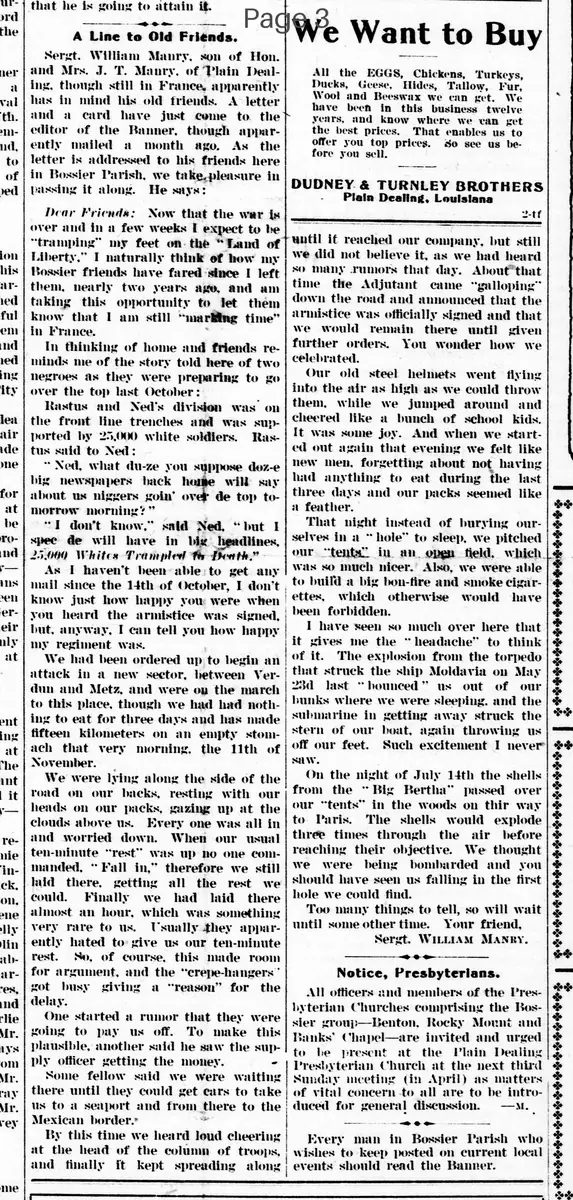
Sergt. William Manry, son of Hon. and Mrs. J. T. Manry, of Plain Dealing, though still in France, apparently has in mind his old friends. A letter and a card have just come to the editor of the Banner, though apparently mailed a month ago. As the letter is addressed to his friends here in Bossier Parish, we take pleasure in passing it along. He says:
Dear Friends: Now that the war is over and in a few weeks I expect to be "tramping" my feet on the "Land of Liberty," I naturally think of how my Bossier friends have fared since I left them, nearly two years ago, and am taking this opportunity to let them know that I am still "marching time" in France.
In thinking of home and friends reminds me of the story told here of two negroes as they were preparing to go over the top last October:
Rastus and Ned's division was on the front line trenches and was supported by 25,000 white soldiers. Rastus said to Ned:
"Ned, what du-ze you suppose doz-e big newspapers back home will say about us niggers goin' over de top tomorrow morning?"
"I don't know," said Ned, "but I spee de will have in big headlines, 25,000 Whites Trampled to Death."
As I haven't been able to get any mail since the 14th of October, I don't know just how happy you were when you heard the armistice was signed, but, anyway, I can tell you how happy my regiment was.
We had been ordered up to begin an attack in a new sector, between Verdun and Metz, and were on the march to this place, though we had had nothing to eat for three days and had made fifteen kilometers on an empty stomach that very morning, the 11th of November.
We were lying along the side of the road on our backs, resting with our heads on our packs, gazing up at the clouds above us. Every one was all in and worried down. When our usual ten-minute "rest" was up no one commanded, "Fall in," therefore we still laid there, getting all the rest we could. Finally we had laid there almost an hour, which was something very rare to us. Usually they apparently hated to give us our ten-minute rest. So, of course, this made room for argument, and the "crepe-hangers" got busy giving a "reason" for the delay.
One started a rumor that they were going to pay us off. To make this plausible, another said he saw the supply officer getting the money.
Some fellow said we were waiting there until they could get cars to take us to a seaport and from there to the Mexican border.
By this time we heard loud cheering at the head of the column of troops, and finally it kept spreading along until it reached our company, but still we did not believe it, as we had heard so many rumors that day. About that time the Adjutant came "galloping" down the road and announced that the armistice was officially signed and that we would remain there until given further orders. You wonder how we celebrated.
Our old steel helmets went flying into the air as high as we could throw them, while we jumped around and cheered like a bunch of school kids. It was some joy. And when we started out again that evening we felt like new men, forgetting about not having had anything to eat during the last three days and our packs seemed like a feather.
That night instead of burying ourselves in a "hole" to sleep, we pitched our tents in an open field, which was so much nicer. Also, we were able to build a big bon-fire and smoke cigarettes, which otherwise would have been forbidden.
I have seen so much over here that it gives me the "headache" to think of it. The explosion from the torpedo that struck the ship Moldavia on May 23d last "bounced us out of our bunks where we were sleeping, and the submarine in getting away struck the stern of our boat, again throwing us off our feet. Such excitement I never saw.
On the night of July 14th the shells from the "Big Bertha" passed over our "tents" in the woods on their way to Paris. The shells would explode three times through the air before reaching their objective. We thought we were being bombarded and you should have seen us falling in the first hole we could find.
Too many things to tell, so will wait until some other time. Your friend,
Sergt. WILLIAM MANRY.
Sergt. William Manry, son of Hon. and Mrs. J. T. Manry, of Plain Dealing, though still in France, apparently has in mind his old friends. A letter and a card have just come to the editor of the Banner, though apparently mailed a month ago. As the letter is addressed to his friends here in Bossier Parish, we take pleasure in passing it along. He says:
Dear Friends: Now that the war is over and in a few weeks I expect to be "tramping" my feet on the "Land of Liberty," I naturally think of how my Bossier friends have fared since I left them, nearly two years ago, and am taking this opportunity to let them know that I am still "marching time" in France.
In thinking of home and friends reminds me of the story told here of two negroes as they were preparing to go over the top last October:
Rastus and Ned's division was on the front line trenches and was supported by 25,000 white soldiers. Rastus said to Ned:
"Ned, what du-ze you suppose doz-e big newspapers back home will say about us niggers goin' over de top tomorrow morning?"
"I don't know," said Ned, "but I spee de will have in big headlines, 25,000 Whites Trampled to Death."
As I haven't been able to get any mail since the 14th of October, I don't know just how happy you were when you heard the armistice was signed, but, anyway, I can tell you how happy my regiment was.
We had been ordered up to begin an attack in a new sector, between Verdun and Metz, and were on the march to this place, though we had had nothing to eat for three days and had made fifteen kilometers on an empty stomach that very morning, the 11th of November.
We were lying along the side of the road on our backs, resting with our heads on our packs, gazing up at the clouds above us. Every one was all in and worried down. When our usual ten-minute "rest" was up no one commanded, "Fall in," therefore we still laid there, getting all the rest we could. Finally we had laid there almost an hour, which was something very rare to us. Usually they apparently hated to give us our ten-minute rest. So, of course, this made room for argument, and the "crepe-hangers" got busy giving a "reason" for the delay.
One started a rumor that they were going to pay us off. To make this plausible, another said he saw the supply officer getting the money.
Some fellow said we were waiting there until they could get cars to take us to a seaport and from there to the Mexican border.
By this time we heard loud cheering at the head of the column of troops, and finally it kept spreading along until it reached our company, but still we did not believe it, as we had heard so many rumors that day. About that time the Adjutant came "galloping" down the road and announced that the armistice was officially signed and that we would remain there until given further orders. You wonder how we celebrated.
Our old steel helmets went flying into the air as high as we could throw them, while we jumped around and cheered like a bunch of school kids. It was some joy. And when we started out again that evening we felt like new men, forgetting about not having had anything to eat during the last three days and our packs seemed like a feather.
That night instead of burying ourselves in a "hole" to sleep, we pitched our tents in an open field, which was so much nicer. Also, we were able to build a big bon-fire and smoke cigarettes, which otherwise would have been forbidden.
I have seen so much over here that it gives me the "headache" to think of it. The explosion from the torpedo that struck the ship Moldavia on May 23d last "bounced us out of our bunks where we were sleeping, and the submarine in getting away struck the stern of our boat, again throwing us off our feet. Such excitement I never saw.
On the night of July 14th the shells from the "Big Bertha" passed over our "tents" in the woods on their way to Paris. The shells would explode three times through the air before reaching their objective. We thought we were being bombarded and you should have seen us falling in the first hole we could find.
Too many things to tell, so will wait until some other time. Your friend,
Sergt. WILLIAM MANRY.
What sub-type of article is it?
Reflective
Historical
Emotional
What themes does it cover?
Military War
What keywords are associated?
World War I
Armistice
France
Bossier Parish
Soldier Experiences
Military Life
Ver Dun
Metz
What entities or persons were involved?
Sergt. William Manry
Dear Friends
Letter to Editor Details
Author
Sergt. William Manry
Recipient
Dear Friends
Main Argument
shares personal experiences from serving in france during wwi, including the joy of the armistice and various wartime incidents, while expressing thoughts of home and friends in bossier parish.
Notable Details
Humorous Anecdote About Two Negro Soldiers
Description Of Armistice Celebration On November 11, 1918
Torpedo Attack On Ship Moldavia On May 23
Big Bertha Shells Passing Over On July 14