Thank you for visiting SNEWPapers!
Sign up free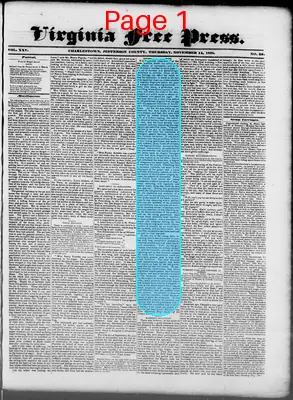
Story
November 15, 1832
Virginia Free Press
Charles Town, Jefferson County, West Virginia
What is this article about?
In a Virginia tavern, a plainly dressed old gentleman, revealed as Chief Justice John Marshall, delivers an eloquent and unanswerable defense of Christianity in a debate with young lawyers, astonishing all present.
Clipping

OCR Quality
98%
Excellent
Full Text
INTERESTING ANECDOTE.
It is frequently remarked, that the most laudable deeds are achieved in the shades of retirement; and to its truth history testifies in every page.—An act of heroism and philanthropy, performed in solitude, where no undue feelings can affect the mind, or bias the character, is worth to the eye of an impartial observer, a whole volumes of exploits displayed before the gaze of a stupid and admiring multitude.—Some time since, a gentleman was travelling in one of the counties of Virginia, and about the close of the day, stopped at a public house to obtain refreshment and spend the night. He had been there but a short time before an old gentleman alighted from his gig with the apparent intention of becoming a fellow guest with him at the same house. As the old man drove up, he observed that both shafts of his gig were broken, and that they were held together by withes formed from the bark of a hickory sapling. Our traveller observed further, that he was plainly clad, that his knee buckles were loosened, and that something like negligence pervaded his dress. Conceiving him to be one of the honest yeomanry of our land, the courtesies of strangers passed between them, and they entered the tavern. It was about the same time that an addition of three or four young gentlemen was made to their number, most, if not all of them, of the legal profession. As soon as they became conveniently accommodated, the conversation was turned by one of the latter upon an elegant harangue which had been displayed at the bar. It was replied to by the other, that he had witnessed the same day, a degree of eloquence no doubt equal, but that it was from the pulpit. Something like a sarcastic rejoinder was made to the eloquence of the pulpit: and a warm and able altercation ensued, in which the merits of the Christian religion became the subject of discussion. From six o'clock until eleven the young champions wielded the sword of argument, adducing with ingenuity and ability every thing that could be said pro. and con. During this protracted period, the old gentleman listened with all the meekness and modesty of a child, as if he was adding new information to the stores of his mind; or perhaps he was observing with a philosophic eye the faculties of the youthful mind, and how new energies are evolved by repeated action; or perhaps, with patriotic emotion, he was reflecting upon the future destinies of his country, and on the rising generation, upon whom those destinies must devolve: or most probably, with a sentiment of moral and religious feeling, he was collecting an argument which, characteristic of himself, no art would be able to elude, and no force resist. Our traveller remained a spectator and took no part in what was said.
At last, one of the young men, remarking that it was impossible to combat with long established prejudices, wheeled around and with some familiarity exclaimed, 'Well, my old gentleman, what think you of these things?' If, said the traveller, a streak of vivid lightning had at that moment crossed the room, their amazement could not have been greater than it was with what followed. The most eloquent and unanswerable appeal was made for nearly an hour by the old gentleman that he had ever heard. So perfect was his recollection, that every argument urged against the Christian religion, was met in the order in which it was advanced. Hume's sophistry on the subject of miracles, was, if possible, more perfectly answered than it had already been done by Campbell.—And in the whole lecture there was so much simplicity, and energy, pathos and sublimity, that not another word was uttered. An attempt to describe it, said the traveller, would be an attempt to paint the sunbeams. It was immediately a matter of curiosity and inquiry who the old gentleman was.—The traveller concluded him to be the preacher, from whom the pulpit eloquence had been heard. But no, it was John Marshall, Chief Justice of the United States.
It is frequently remarked, that the most laudable deeds are achieved in the shades of retirement; and to its truth history testifies in every page.—An act of heroism and philanthropy, performed in solitude, where no undue feelings can affect the mind, or bias the character, is worth to the eye of an impartial observer, a whole volumes of exploits displayed before the gaze of a stupid and admiring multitude.—Some time since, a gentleman was travelling in one of the counties of Virginia, and about the close of the day, stopped at a public house to obtain refreshment and spend the night. He had been there but a short time before an old gentleman alighted from his gig with the apparent intention of becoming a fellow guest with him at the same house. As the old man drove up, he observed that both shafts of his gig were broken, and that they were held together by withes formed from the bark of a hickory sapling. Our traveller observed further, that he was plainly clad, that his knee buckles were loosened, and that something like negligence pervaded his dress. Conceiving him to be one of the honest yeomanry of our land, the courtesies of strangers passed between them, and they entered the tavern. It was about the same time that an addition of three or four young gentlemen was made to their number, most, if not all of them, of the legal profession. As soon as they became conveniently accommodated, the conversation was turned by one of the latter upon an elegant harangue which had been displayed at the bar. It was replied to by the other, that he had witnessed the same day, a degree of eloquence no doubt equal, but that it was from the pulpit. Something like a sarcastic rejoinder was made to the eloquence of the pulpit: and a warm and able altercation ensued, in which the merits of the Christian religion became the subject of discussion. From six o'clock until eleven the young champions wielded the sword of argument, adducing with ingenuity and ability every thing that could be said pro. and con. During this protracted period, the old gentleman listened with all the meekness and modesty of a child, as if he was adding new information to the stores of his mind; or perhaps he was observing with a philosophic eye the faculties of the youthful mind, and how new energies are evolved by repeated action; or perhaps, with patriotic emotion, he was reflecting upon the future destinies of his country, and on the rising generation, upon whom those destinies must devolve: or most probably, with a sentiment of moral and religious feeling, he was collecting an argument which, characteristic of himself, no art would be able to elude, and no force resist. Our traveller remained a spectator and took no part in what was said.
At last, one of the young men, remarking that it was impossible to combat with long established prejudices, wheeled around and with some familiarity exclaimed, 'Well, my old gentleman, what think you of these things?' If, said the traveller, a streak of vivid lightning had at that moment crossed the room, their amazement could not have been greater than it was with what followed. The most eloquent and unanswerable appeal was made for nearly an hour by the old gentleman that he had ever heard. So perfect was his recollection, that every argument urged against the Christian religion, was met in the order in which it was advanced. Hume's sophistry on the subject of miracles, was, if possible, more perfectly answered than it had already been done by Campbell.—And in the whole lecture there was so much simplicity, and energy, pathos and sublimity, that not another word was uttered. An attempt to describe it, said the traveller, would be an attempt to paint the sunbeams. It was immediately a matter of curiosity and inquiry who the old gentleman was.—The traveller concluded him to be the preacher, from whom the pulpit eloquence had been heard. But no, it was John Marshall, Chief Justice of the United States.
What sub-type of article is it?
Biography
Heroic Act
What themes does it cover?
Moral Virtue
Bravery Heroism
What keywords are associated?
John Marshall
Christian Debate
Virginia Tavern
Eloquent Defense
Hume Miracles
Chief Justice
What entities or persons were involved?
John Marshall
Old Gentleman
Young Gentlemen
Traveller
Where did it happen?
One Of The Counties Of Virginia, Public House
Story Details
Key Persons
John Marshall
Old Gentleman
Young Gentlemen
Traveller
Location
One Of The Counties Of Virginia, Public House
Event Date
Some Time Since
Story Details
A traveler in Virginia stops at a tavern where young lawyers debate Christianity; an unassuming old gentleman, John Marshall, Chief Justice, listens then delivers a masterful, hour-long defense refuting all arguments, including Hume's on miracles, silencing the room.