Thank you for visiting SNEWPapers!
Sign up free
Editorial
November 20, 1835
Richmond Enquirer
Richmond, Richmond County, Virginia
What is this article about?
An editorial derides the failed attempt by abolitionists to hold a convention in Utica on the 21st ult., where they dispersed peacefully after citizen warnings. It mocks their exaggerated peril claims and criticizes supportive media lies, especially by editor Noah of the N.Y. Evening Star, aimed at discrediting the Van Buren party.
Clipping
OCR Quality
95%
Excellent
Full Text
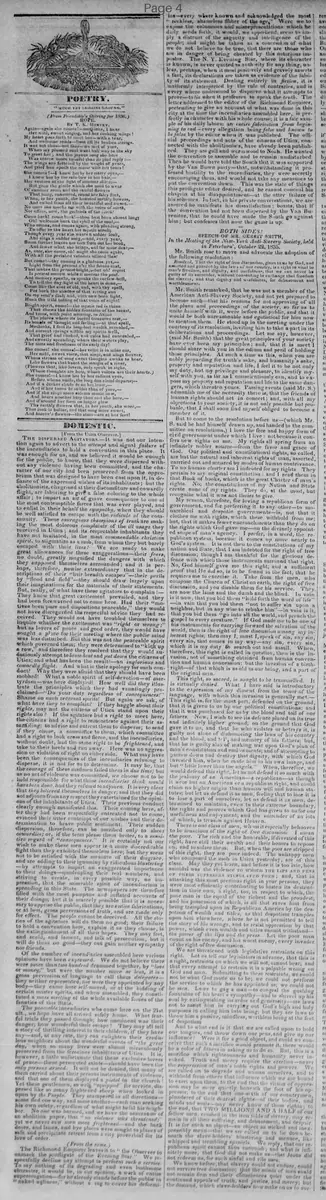
The Dispersed Agitators.—It was not our intention again to advert to the attempt and signal failure of the incendiaries to hold a convention in this place. It was enough for us, and we believed it would be enough for the public, to know, that they were dispersed without any violence having been committed, and the character of our city had been preserved from the opprobrium that was designed to have been cast upon it, in defiance of the expressed wishes of its inhabitants: but the abolitionists, chagrined at their discomfiture and cowardly flight, are laboring to give a false coloring to the whole affair; to impart an air of grave consequence to one of the most contemptible farces that was ever played, and to enlist in their behalf the sympathy, when they should be well satisfied to escape with the ridicule of the community. These courageous champions of truth are making the most dolorous complaints of the ill usage they received in Utica; and its respectable inhabitants they have not hesitated, in the most commendable christian spirit, to stigmatize as a mob, from whom they but barely escaped with their lives! We are ready to make great allowances for these exaggerations—their fears, no doubt, greatly magnified the dangers with which they supposed themselves surrounded; and it is perhaps, therefore, nowise extraordinary that in the descriptions of their "hair breadth escapes"—their perils by "flood and field"—they should draw largely upon their imaginations for the materials of their statements.
But, really, of what have these agitators to complain!—They knew that great excitement prevailed, and they had been forewarned not to come here. Had their "motives been pure and dispositions peaceable," they would not have disregarded the respectful advice they had received. They would not have troubled themselves to inquire whether the excitement was "right or wrong; but as lovers of peace and good order, they would have sought a place for their meeting where the public mind was less disturbed. But this was not the peaceable spirit which governed them; they were determined to "kick up a row," and therefore they resolved that they would audaciously attempt to brow-beat and put down the citizens of Utica: and what has been the result?—an inglorious and cowardly flight. And what is their apology for such conduct? Why they were afraid that they should have been mobbed! What a noble spirit of self-devotion—of martyrdom—was here displayed! How well did they illustrate the principles which they had vauntingly proclaimed—“Do your duty regardless of consequences!"
Shame on such recreant spirits! But again we ask, of what have they to complain? If they haggle about their rights, may not the citizens of Utica stand upon their rights also? If the agitators had a right to meet here, the citizens had a right to remonstrate against their assembling; to advise and entreat them to disperse; to send if they chose, a committee to them, which committee had a right to look cross and fierce, and the incendiaries, without doubt, had the same right to be frightened, and take to their heels and run away. Here was no aggression or violation of right on either side. What may have been the consequences of the incendiaries refusing to disperse, it is not for us to determine. It may be, that the courage of these madmen failed them in due time; but as no act of violence was committed, we choose not to be held responsible for what these incendiaries think would have been done, had they refused to adjourn. It is very clear that they believed themselves in danger; and that they did not adjourn from any respect they entertained for the opinions of the inhabitants of Utica. Their previous conduct clearly enough manifested this. Their coming here, after they had been respectfully entreated not to come, evinced their utter contempt of our wishes and their determination to brave public sentiment. Their sudden dispersion, therefore, can be ascribed only to sheer cowardice; or, if the term please them better, to a sensible regard of "consequences." It is certainly not our wish to make these men appear in a more discreditable light than they exhibited themselves here; but they seem not to be satisfied with the measure of their disgrace, and are adding to their ignominy by ridiculous blustering—by attempts to impart an exaggerated importance to their doings—quadrupling their real numbers, and striving to create, in every possible way, an impression, that the miserable spirit of incendiarism is spreading in this State. The newspapers are therefore filled with the most pompous and inflated accounts of their doings; but it is scarcely possible that it is necessary to apprise the public, that they are entire fabrications, or at best, gross perversions of truth, and are made only for effect. The people cannot be deceived. All the stories of the agitators will do them no good; their failure to hold a convention here, explain it as they choose, is the extinguishment of all their hopes. They may fret, and scold, and lament, and talk of persecution, but it will do them no good—they can gain neither sympathy nor friends.
Of the number of incendiaries assembled here various opinions have been expressed. We do not believe there were more than two hundred drummed together, by "love or money;" but were the number more or less, it is a gross perversion of language to call them delegates—they neither represented, nor were they appointed by any body—they came here self moved, or at the bidding of certain master spirits, and when assembled, they constituted a mass meeting of the whole available forces of the fanatics of this State.
The peaceable incendiaries who came here on the 21st ult., we hope have all arrived safely home. What fearful trials they passed through; how imminent was their danger; how wonderful their escape! They may all tell a story of thrilling interest to their children, if they have any—and, at any rate, they can enlighten their credulous neighbors about the wonderful events of "the great day," when so many lives were almost miraculously preserved from the ferocious inhabitants of Utica. It is, however, a little unfortunate that these exclusive lovers of peace—these persecuted saints—should have been the only persons armed. It will not be denied, that many of them carried about their persons instruments of violence, and that one of them displayed a pistol in the church. Yet these gentlemen, so well "equipped" for service, dispersed like so many frightened sheep when looked in upon by the People. They scampered in all directions—some fled one way, and some another—each man seeking his own safety, regardless of what might befall his neighbor. No one was harmed, and we have the assurance of an abolition paper, that "no violence was threatened;" yet we never saw men more frightened—and the back doors, and lanes, and bye places were sought as places of safe and precipitate retreat from a city proverbial for its love of order.
(From the same)
The Richmond Enquirer leaves it to "the Observer to unmask the profligate of the Evening Star." We respectfully decline any attempt to perform such a service. To say nothing of its degrading and even loathsome character, it would be, in our opinion, a work of entire supererogation—for he already stands before the public in "naked ugliness," without a rag to cover his deformities—every where known and acknowledged the most "reckless, shameless fibber of the age." Were we to expose the calumnies and misrepresentations which he daily sends forth, it would, we apprehend, seem to imply a distrust of the sagacity and intelligence of the people; and might be taken as a concession of what we do not believe to be true, that there are those who are in danger of being cheated by this notorious impostor. The N. Y. Evening Star, where its character is known, is never quoted as authority for any thing, unless, perhaps, when it most positively and gravely asserts a fact, its declarations are taken as evidence of the falsity of its statement. Dealing entirely in fiction, it is uniformly interpreted by the rule of contraries, and is every where understood to disprove what it attempts to prove—to lie when it professes to speak the truth. The letter addressed to the editor of the Richmond Enquirer, pretending to give an account of what was done in this city at the time the incendiaries assembled here, is perfectly in character with his whole course; it is a fair sample of his daily labors: an entire fabrication from beginning to end—every allegation being false and known to be false by the editor when it was published. The official proceedings and acts of the citizens of Utica, connected with the abolitionists, have already been published. They are gall and wormwood to Noah. He wanted the convention to assemble and to remain undisturbed. Then he would have told the South that it was supported by the Van Buren party—that, notwithstanding it professed hostility to the incendiaries, they were secretly encouraging them, and would not take any measures to put the convention down. This was the state of things this profligate editor desired, and he cannot conceal his chagrin at his disappointment—at the utter failure of his schemes. In fact, in his private conversations, we are assured he manifests his dissatisfaction; boasts, that if the convention had not been dispersed by the Van Burenites, that he could have made the South go against him; but confesses that now the game is up.
But, really, of what have these agitators to complain!—They knew that great excitement prevailed, and they had been forewarned not to come here. Had their "motives been pure and dispositions peaceable," they would not have disregarded the respectful advice they had received. They would not have troubled themselves to inquire whether the excitement was "right or wrong; but as lovers of peace and good order, they would have sought a place for their meeting where the public mind was less disturbed. But this was not the peaceable spirit which governed them; they were determined to "kick up a row," and therefore they resolved that they would audaciously attempt to brow-beat and put down the citizens of Utica: and what has been the result?—an inglorious and cowardly flight. And what is their apology for such conduct? Why they were afraid that they should have been mobbed! What a noble spirit of self-devotion—of martyrdom—was here displayed! How well did they illustrate the principles which they had vauntingly proclaimed—“Do your duty regardless of consequences!"
Shame on such recreant spirits! But again we ask, of what have they to complain? If they haggle about their rights, may not the citizens of Utica stand upon their rights also? If the agitators had a right to meet here, the citizens had a right to remonstrate against their assembling; to advise and entreat them to disperse; to send if they chose, a committee to them, which committee had a right to look cross and fierce, and the incendiaries, without doubt, had the same right to be frightened, and take to their heels and run away. Here was no aggression or violation of right on either side. What may have been the consequences of the incendiaries refusing to disperse, it is not for us to determine. It may be, that the courage of these madmen failed them in due time; but as no act of violence was committed, we choose not to be held responsible for what these incendiaries think would have been done, had they refused to adjourn. It is very clear that they believed themselves in danger; and that they did not adjourn from any respect they entertained for the opinions of the inhabitants of Utica. Their previous conduct clearly enough manifested this. Their coming here, after they had been respectfully entreated not to come, evinced their utter contempt of our wishes and their determination to brave public sentiment. Their sudden dispersion, therefore, can be ascribed only to sheer cowardice; or, if the term please them better, to a sensible regard of "consequences." It is certainly not our wish to make these men appear in a more discreditable light than they exhibited themselves here; but they seem not to be satisfied with the measure of their disgrace, and are adding to their ignominy by ridiculous blustering—by attempts to impart an exaggerated importance to their doings—quadrupling their real numbers, and striving to create, in every possible way, an impression, that the miserable spirit of incendiarism is spreading in this State. The newspapers are therefore filled with the most pompous and inflated accounts of their doings; but it is scarcely possible that it is necessary to apprise the public, that they are entire fabrications, or at best, gross perversions of truth, and are made only for effect. The people cannot be deceived. All the stories of the agitators will do them no good; their failure to hold a convention here, explain it as they choose, is the extinguishment of all their hopes. They may fret, and scold, and lament, and talk of persecution, but it will do them no good—they can gain neither sympathy nor friends.
Of the number of incendiaries assembled here various opinions have been expressed. We do not believe there were more than two hundred drummed together, by "love or money;" but were the number more or less, it is a gross perversion of language to call them delegates—they neither represented, nor were they appointed by any body—they came here self moved, or at the bidding of certain master spirits, and when assembled, they constituted a mass meeting of the whole available forces of the fanatics of this State.
The peaceable incendiaries who came here on the 21st ult., we hope have all arrived safely home. What fearful trials they passed through; how imminent was their danger; how wonderful their escape! They may all tell a story of thrilling interest to their children, if they have any—and, at any rate, they can enlighten their credulous neighbors about the wonderful events of "the great day," when so many lives were almost miraculously preserved from the ferocious inhabitants of Utica. It is, however, a little unfortunate that these exclusive lovers of peace—these persecuted saints—should have been the only persons armed. It will not be denied, that many of them carried about their persons instruments of violence, and that one of them displayed a pistol in the church. Yet these gentlemen, so well "equipped" for service, dispersed like so many frightened sheep when looked in upon by the People. They scampered in all directions—some fled one way, and some another—each man seeking his own safety, regardless of what might befall his neighbor. No one was harmed, and we have the assurance of an abolition paper, that "no violence was threatened;" yet we never saw men more frightened—and the back doors, and lanes, and bye places were sought as places of safe and precipitate retreat from a city proverbial for its love of order.
(From the same)
The Richmond Enquirer leaves it to "the Observer to unmask the profligate of the Evening Star." We respectfully decline any attempt to perform such a service. To say nothing of its degrading and even loathsome character, it would be, in our opinion, a work of entire supererogation—for he already stands before the public in "naked ugliness," without a rag to cover his deformities—every where known and acknowledged the most "reckless, shameless fibber of the age." Were we to expose the calumnies and misrepresentations which he daily sends forth, it would, we apprehend, seem to imply a distrust of the sagacity and intelligence of the people; and might be taken as a concession of what we do not believe to be true, that there are those who are in danger of being cheated by this notorious impostor. The N. Y. Evening Star, where its character is known, is never quoted as authority for any thing, unless, perhaps, when it most positively and gravely asserts a fact, its declarations are taken as evidence of the falsity of its statement. Dealing entirely in fiction, it is uniformly interpreted by the rule of contraries, and is every where understood to disprove what it attempts to prove—to lie when it professes to speak the truth. The letter addressed to the editor of the Richmond Enquirer, pretending to give an account of what was done in this city at the time the incendiaries assembled here, is perfectly in character with his whole course; it is a fair sample of his daily labors: an entire fabrication from beginning to end—every allegation being false and known to be false by the editor when it was published. The official proceedings and acts of the citizens of Utica, connected with the abolitionists, have already been published. They are gall and wormwood to Noah. He wanted the convention to assemble and to remain undisturbed. Then he would have told the South that it was supported by the Van Buren party—that, notwithstanding it professed hostility to the incendiaries, they were secretly encouraging them, and would not take any measures to put the convention down. This was the state of things this profligate editor desired, and he cannot conceal his chagrin at his disappointment—at the utter failure of his schemes. In fact, in his private conversations, we are assured he manifests his dissatisfaction; boasts, that if the convention had not been dispersed by the Van Burenites, that he could have made the South go against him; but confesses that now the game is up.
What sub-type of article is it?
Slavery Abolition
Partisan Politics
What keywords are associated?
Abolitionist Convention
Utica Dispersal
Anti Abolition
Media Fabrication
Agitators Cowardice
Van Buren Party
What entities or persons were involved?
Abolitionists
Citizens Of Utica
Richmond Enquirer
N.Y. Evening Star
Noah
Editorial Details
Primary Topic
Defense Of Dispersal Of Abolitionist Convention In Utica
Stance / Tone
Strongly Anti Abolitionist And Mocking
Key Figures
Abolitionists
Citizens Of Utica
Richmond Enquirer
N.Y. Evening Star
Noah
Key Arguments
Abolitionists Were Forewarned Of Excitement And Advised Not To Hold Convention In Utica But Proceeded Anyway
They Dispersed Cowardly Without Violence After Citizens Remonstrated
Their Complaints Of Mob Danger Are Exaggerations Born Of Fear
Media Accounts By Agitators And Noah Are Fabrications To Gain Sympathy
The Assembly Was A Mass Meeting Of Fanatics, Not True Delegates
Criticizes Noah's Desire For Undisturbed Convention To Discredit Van Buren Party