Thank you for visiting SNEWPapers!
Sign up free
Editorial
November 11, 1812
Alexandria Gazette, Commercial And Political
Alexandria, Virginia
What is this article about?
This editorial defends the use of British licenses for American trade with Spain and Portugal during wartime, arguing it is a profitable mutual concession rather than dishonorable, and warns of economic harm from prohibition, urging Congress to consider it carefully.
Clipping
OCR Quality
95%
Excellent
Full Text
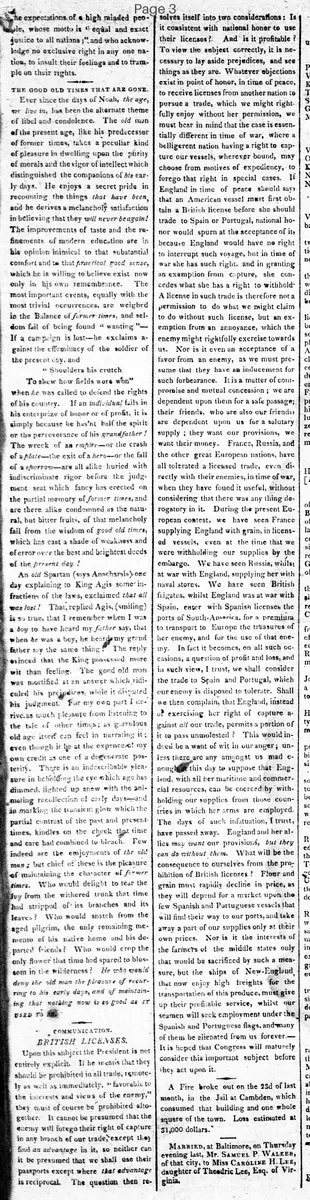
COMMUNICATION.
BRITISH LICENSES
Upon this subject the President is not entirely explicit. If he means that they should be prohibited in all trade, remotely as well as immediately, "favorable to the interests and views of the enemy," they must of course be prohibited altogether. It cannot be presumed that the enemy will forego their right of capture in any branch of our trade, except they find an advantage in it, so neither can it be presumed that we shall use their passports except where that advantage is reciprocal. The question then resolves itself into two considerations: Is it consistent with national honor to use their licenses? And is it profitable?
To view the subject correctly, it is necessary to lay aside prejudices, and see things as they are. Whatever objections exist in point of honor, in time of peace, to receive licenses from another nation to pursue a trade, which we might rightfully enjoy without her permission, we must bear in mind that the case is essentially different in time of war. where a belligerent nation having a right to capture our vessels, wherever bound, may choose from motives of expediency, to forego that right in special cases. If England in time of peace should say that an American vessel must first obtain a British license before she should trade to Spain or Portugal, national honor would spurn at the acceptance of it because England would have no right to interrupt such voyage, but in time of war she has such right. and in granting an exemption from capture, she concedes what she has a right to withhold. A license in such trade is therefore not a permission to do what we might claim to do without such license, but an exemption from an annoyance, which the enemy might rightfully exercise towards us. Nor is it even an acceptance of a favor from an enemy, as we must presume that they have an inducement for such forbearance. It is a matter of compromise and mutual concession; we are dependent upon them for a safe passage; their friends, who are also our friends are dependent upon us for a salutary supply; they want our provisions, we want their money. France, Russia, and the other great European nations, have all tolerated a licensed trade, even directly with their enemies, in time of war. when they have found it useful, without considering that there was any thing derogatory in it. During the present European contest, we have seen France supplying England with grain, in licensed vessels, even at the time that we were withholding our supplies by the embargo. We have seen Russia, whilst at war with England, supplying her with naval stores. We have seen British frigates. whilst England was at war with Spain, enter with Spanish licenses the ports of South-America, for a premium to transport to Europe the treasures of her enemy, and for the use of that enemy. In fact it becomes, on all such occasions, a question of profit and loss, and in such view, I trust. we shall consider the trade to Spain and Portugal, which our enemy is disposed to tolerate. Shall we then complain, that England, instead of exercising her right of capture against all our trade, permits a portion of it to pass unmolested? This would indeed be a want of wit in our anger; unless there are any amongst us mad enough this day to suppose that England, with all her maritime and commercial resources, can be coerced by withholding our supplies from those countries in which her arms are employed. The days of such infatuation, I trust, have passed away, England and her allies may want our provisions, but they can do without them. What will be the consequence to ourselves from the prohibition of British licenses? Flour and grain must rapidly decline in price, as they will depend for a market upon the few Spanish and Portuguese vessels that will find their way to our ports, and take away a part of our supplies only at their own prices. Nor is it the interests of the farmers of the middle states only that would be sacrificed by such a measure, but the ships of New-England that now enjoy high freights for the transportation of this produce, must give up their profitable service, whilst our seamen will seek employment under the Spanish and Portuguese flags, and many of them be alienated from us forever. It is hoped that Congress will maturely consider this important subject before they act upon it.
BRITISH LICENSES
Upon this subject the President is not entirely explicit. If he means that they should be prohibited in all trade, remotely as well as immediately, "favorable to the interests and views of the enemy," they must of course be prohibited altogether. It cannot be presumed that the enemy will forego their right of capture in any branch of our trade, except they find an advantage in it, so neither can it be presumed that we shall use their passports except where that advantage is reciprocal. The question then resolves itself into two considerations: Is it consistent with national honor to use their licenses? And is it profitable?
To view the subject correctly, it is necessary to lay aside prejudices, and see things as they are. Whatever objections exist in point of honor, in time of peace, to receive licenses from another nation to pursue a trade, which we might rightfully enjoy without her permission, we must bear in mind that the case is essentially different in time of war. where a belligerent nation having a right to capture our vessels, wherever bound, may choose from motives of expediency, to forego that right in special cases. If England in time of peace should say that an American vessel must first obtain a British license before she should trade to Spain or Portugal, national honor would spurn at the acceptance of it because England would have no right to interrupt such voyage, but in time of war she has such right. and in granting an exemption from capture, she concedes what she has a right to withhold. A license in such trade is therefore not a permission to do what we might claim to do without such license, but an exemption from an annoyance, which the enemy might rightfully exercise towards us. Nor is it even an acceptance of a favor from an enemy, as we must presume that they have an inducement for such forbearance. It is a matter of compromise and mutual concession; we are dependent upon them for a safe passage; their friends, who are also our friends are dependent upon us for a salutary supply; they want our provisions, we want their money. France, Russia, and the other great European nations, have all tolerated a licensed trade, even directly with their enemies, in time of war. when they have found it useful, without considering that there was any thing derogatory in it. During the present European contest, we have seen France supplying England with grain, in licensed vessels, even at the time that we were withholding our supplies by the embargo. We have seen Russia, whilst at war with England, supplying her with naval stores. We have seen British frigates. whilst England was at war with Spain, enter with Spanish licenses the ports of South-America, for a premium to transport to Europe the treasures of her enemy, and for the use of that enemy. In fact it becomes, on all such occasions, a question of profit and loss, and in such view, I trust. we shall consider the trade to Spain and Portugal, which our enemy is disposed to tolerate. Shall we then complain, that England, instead of exercising her right of capture against all our trade, permits a portion of it to pass unmolested? This would indeed be a want of wit in our anger; unless there are any amongst us mad enough this day to suppose that England, with all her maritime and commercial resources, can be coerced by withholding our supplies from those countries in which her arms are employed. The days of such infatuation, I trust, have passed away, England and her allies may want our provisions, but they can do without them. What will be the consequence to ourselves from the prohibition of British licenses? Flour and grain must rapidly decline in price, as they will depend for a market upon the few Spanish and Portuguese vessels that will find their way to our ports, and take away a part of our supplies only at their own prices. Nor is it the interests of the farmers of the middle states only that would be sacrificed by such a measure, but the ships of New-England that now enjoy high freights for the transportation of this produce, must give up their profitable service, whilst our seamen will seek employment under the Spanish and Portuguese flags, and many of them be alienated from us forever. It is hoped that Congress will maturely consider this important subject before they act upon it.
What sub-type of article is it?
Economic Policy
Foreign Affairs
War Or Peace
What keywords are associated?
British Licenses
Wartime Trade
Neutral Commerce
Economic Consequences
National Honor
Congressional Action
What entities or persons were involved?
President
England
France
Russia
Spain
Portugal
Congress
Editorial Details
Primary Topic
Use Of British Licenses In Wartime Trade To Spain And Portugal
Stance / Tone
Supportive Of Licensed Trade As Honorable And Profitable
Key Figures
President
England
France
Russia
Spain
Portugal
Congress
Key Arguments
Licenses Are A Mutual Concession In Wartime, Not Dishonorable Permission
Other Nations Like France And Russia Have Used Licensed Trade With Enemies When Useful
Prohibiting Licenses Would Harm American Farmers, Shippers, And Seamen Economically
England Cannot Be Coerced By Withholding Supplies
Trade Question Is One Of Profit And Loss