Thank you for visiting SNEWPapers!
Sign up free
Editorial
February 24, 1790
Gazette Of The United States
New York, New York County, New York
What is this article about?
In 'The Republican No. III,' the author argues that government is a practical art reliant on experience rather than abstract theory, critiquing utopian schemes by Plato, More, and especially Locke's failed Carolina constitution, while praising figures like Chesterfield and Cicero for their experiential insights.
Clipping
OCR Quality
95%
Excellent
Full Text
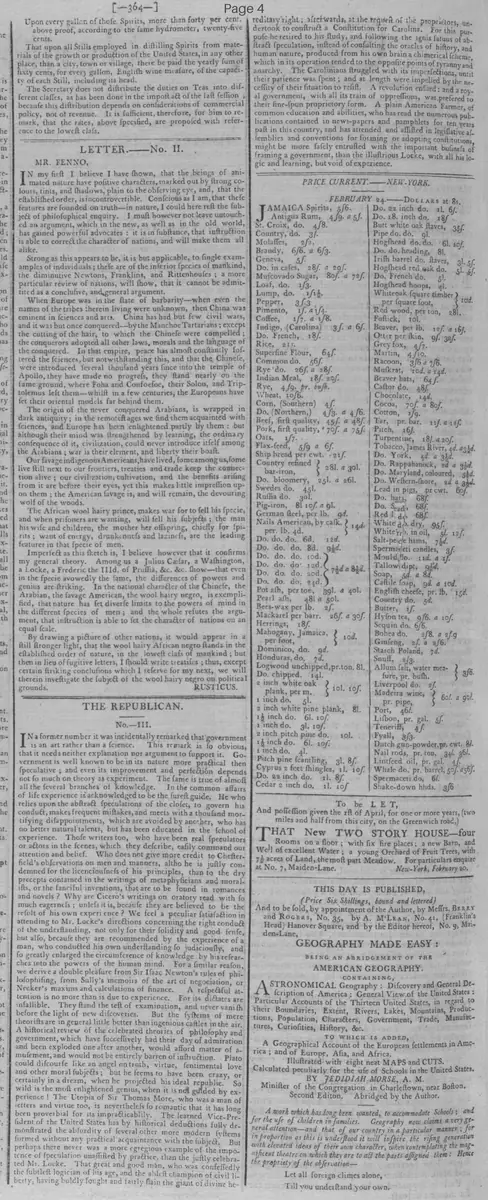
THE REPUBLICAN
No. III.
In a former number it was incidentally remarked that government
is an art rather than a science. This remark is so obvious,
that it needs neither explanation nor argument to support it. Government is well known to be in its nature more practical than
speculative; and even its improvement and perfection depends
not so much on theory as experiment. The same is true of almost
all the several branches of knowledge. In the common affairs
of life experience is acknowledged to be the surest guide. He who
relies upon the abstract speculations of the closet, to govern his
conduct, makes frequent mistakes, and meets with a thousand mor-
tifying disappointments, which are avoided by another, who has
no better natural talents, but has been educated in the school of
experience. Those writers too, who have been real speculators
or actors in the scenes, which they describe, easily command our
attention and belief. Who does not give more credit to Chester-
field's observations on men and manners, altho he is justly con-
demned for the licentiousness of his principles, than to the dry
precepts contained in the writings of metaphysicians and moral-
ists, or the fanciful inventions, that are to be found in romances
and novels? Why are Cicero's writings on oratory read with so
much eagerness; unless it is, because they are believed to be the
result of his own experience? We feel a peculiar satisfaction in
attending to Mr. Locke's directions concerning the right conduct
of the understanding, not only for their solidity and good sense,
but also, because they are recommended by the experience of a
man, who conducted his own understanding so judiciously, and
so greatly enlarged the circumference of knowledge by his reser-
ches into the powers of the human mind. For a similar reason,
we derive a double pleasure from Sir Isaac Newton's rules of phi-
losophising, from Sully's memoirs of the art of negociation, or
Necker's maxims and calculations of finance. A respectful at-
tention is no more than is due to experience. For its dictates are
infallible. They stand the test of examination, and never vanish
before the light of new discoveries. But the systems of mere
theorists are in general little better than ingenious castles in the air.
A historical review of the celebrated theories of philosophy and
government, which have successively had their day of admiration
and been exploded one after another, would afford matter of a-
musement, and would not be entirely barren of instruction. Plato
could discourse like an angel on truth, virtue, sentimental love
and other moral subjects; but he seems to have been crazy, or
certainly in a dream, when he projected his ideal republic. So
wild is the most enlightened genius, when it is not guided by ex-
perience! The Utopia of Sir Thomas More, who was a man of
letters and virtue too, is nevertheless so romantic that it has long
been proverbial for its impracticability. The learned Vice-Presi-
dent of the United States has by historical deductions fully de-
monstrated the absurdity of several other more modern systems
formed without any practical acquaintance with the subject. But
perhaps there never was a more egregious example of the impo-
tence of speculation unassisted by practice, than the justly cele-
brated Mr. Locke. That great and good man, who was confessedly
the subtlest logician of his age, and the ablest champion of civil li-
berty, having boldly fought and fairly slain the giant of divine he-
reditary right; afterwards, at the request of the proprietors, un-
dertook to construct a Constitution for Carolina. For this pur-
pose he retired to his study, and following the ignis fatuus of ab-
stract speculation, instead of consulting the oracles of history, and
human nature, produced from his own brain a chimerical scheme,
which in its operation tended to the opposite points of tyranny and
anarchy. The Carolinians struggled with its imperfections, until
their patience was spent; and at length were impelled by the ne-
cessity of their situation to resist. A revolution ensued: and a roy-
al government, with all its train of oppressions, was preferred to
their fine-spun proprietory form. A plain American Farmer, of
common education and abilities, who has read the numerous pub-
lications contained in news-papers and pamphlets for ten years
past in this country, and has attended and assisted in legislative as-
semblies and conventions for forming or adopting constitutions.
might be more safely entrusted with the important business of
framing a government, than the illustrious Locke, with all his lo-
gic and learning, but void of experience.
No. III.
In a former number it was incidentally remarked that government
is an art rather than a science. This remark is so obvious,
that it needs neither explanation nor argument to support it. Government is well known to be in its nature more practical than
speculative; and even its improvement and perfection depends
not so much on theory as experiment. The same is true of almost
all the several branches of knowledge. In the common affairs
of life experience is acknowledged to be the surest guide. He who
relies upon the abstract speculations of the closet, to govern his
conduct, makes frequent mistakes, and meets with a thousand mor-
tifying disappointments, which are avoided by another, who has
no better natural talents, but has been educated in the school of
experience. Those writers too, who have been real speculators
or actors in the scenes, which they describe, easily command our
attention and belief. Who does not give more credit to Chester-
field's observations on men and manners, altho he is justly con-
demned for the licentiousness of his principles, than to the dry
precepts contained in the writings of metaphysicians and moral-
ists, or the fanciful inventions, that are to be found in romances
and novels? Why are Cicero's writings on oratory read with so
much eagerness; unless it is, because they are believed to be the
result of his own experience? We feel a peculiar satisfaction in
attending to Mr. Locke's directions concerning the right conduct
of the understanding, not only for their solidity and good sense,
but also, because they are recommended by the experience of a
man, who conducted his own understanding so judiciously, and
so greatly enlarged the circumference of knowledge by his reser-
ches into the powers of the human mind. For a similar reason,
we derive a double pleasure from Sir Isaac Newton's rules of phi-
losophising, from Sully's memoirs of the art of negociation, or
Necker's maxims and calculations of finance. A respectful at-
tention is no more than is due to experience. For its dictates are
infallible. They stand the test of examination, and never vanish
before the light of new discoveries. But the systems of mere
theorists are in general little better than ingenious castles in the air.
A historical review of the celebrated theories of philosophy and
government, which have successively had their day of admiration
and been exploded one after another, would afford matter of a-
musement, and would not be entirely barren of instruction. Plato
could discourse like an angel on truth, virtue, sentimental love
and other moral subjects; but he seems to have been crazy, or
certainly in a dream, when he projected his ideal republic. So
wild is the most enlightened genius, when it is not guided by ex-
perience! The Utopia of Sir Thomas More, who was a man of
letters and virtue too, is nevertheless so romantic that it has long
been proverbial for its impracticability. The learned Vice-Presi-
dent of the United States has by historical deductions fully de-
monstrated the absurdity of several other more modern systems
formed without any practical acquaintance with the subject. But
perhaps there never was a more egregious example of the impo-
tence of speculation unassisted by practice, than the justly cele-
brated Mr. Locke. That great and good man, who was confessedly
the subtlest logician of his age, and the ablest champion of civil li-
berty, having boldly fought and fairly slain the giant of divine he-
reditary right; afterwards, at the request of the proprietors, un-
dertook to construct a Constitution for Carolina. For this pur-
pose he retired to his study, and following the ignis fatuus of ab-
stract speculation, instead of consulting the oracles of history, and
human nature, produced from his own brain a chimerical scheme,
which in its operation tended to the opposite points of tyranny and
anarchy. The Carolinians struggled with its imperfections, until
their patience was spent; and at length were impelled by the ne-
cessity of their situation to resist. A revolution ensued: and a roy-
al government, with all its train of oppressions, was preferred to
their fine-spun proprietory form. A plain American Farmer, of
common education and abilities, who has read the numerous pub-
lications contained in news-papers and pamphlets for ten years
past in this country, and has attended and assisted in legislative as-
semblies and conventions for forming or adopting constitutions.
might be more safely entrusted with the important business of
framing a government, than the illustrious Locke, with all his lo-
gic and learning, but void of experience.
What sub-type of article is it?
Constitutional
What keywords are associated?
Government Art
Practical Experience
Abstract Theory
John Locke
Carolina Constitution
Utopian Schemes
Political Philosophy
What entities or persons were involved?
John Locke
Plato
Sir Thomas More
Cicero
Chesterfield
Sir Isaac Newton
Sully
Necker
Vice President Of The United States
Editorial Details
Primary Topic
Government As Practical Art Guided By Experience Over Abstract Theory
Stance / Tone
Advocating Experiential Knowledge In Governance And Critiquing Theoretical Speculation
Key Figures
John Locke
Plato
Sir Thomas More
Cicero
Chesterfield
Sir Isaac Newton
Sully
Necker
Vice President Of The United States
Key Arguments
Government Is An Art Rather Than A Science, Depending On Experiment Over Theory
Experience Is The Surest Guide In Life And Knowledge, Avoiding Mistakes Of Abstract Speculation
Writings Based On Personal Experience, Like Chesterfield's And Cicero's, Command More Credit Than Theoretical Works
Theorists' Systems Are Often Impractical Castles In The Air, As Seen In Plato's Republic And More's Utopia
Locke's Carolina Constitution Exemplifies Failure Of Speculation Without Practice, Leading To Revolution
A Plain American Farmer With Practical Experience Is Better Suited To Frame Governments Than Learned Theorists Like Locke