Thank you for visiting SNEWPapers!
Sign up free
Story
November 3, 1831
Constitutional Whig
Richmond, Virginia
What is this article about?
Daniel Webster's opinion, read at a Boston meeting, critiques imprisonment for debt as outdated, proposing reforms for fair asset disclosure, equal creditor distribution, and debtor discharge to promote justice and societal good.
Clipping
OCR Quality
95%
Excellent
Full Text
We give below the lucid remarks of Mr. Webster on this interesting question, as read from a paper sent by him to the recent meeting at Faneuil Hall, Boston, in reply to an invitation to be present on the occasion. The importance of the subject itself, and the probability of its coming under the consideration of the National Legislature, during the approaching Congress, will sufficiently recommend Mr. Webster's observations to the attention of our readers.--U. S. Telegraph.
Opinion of Daniel Webster on the subject of Imprisonment for Debt.
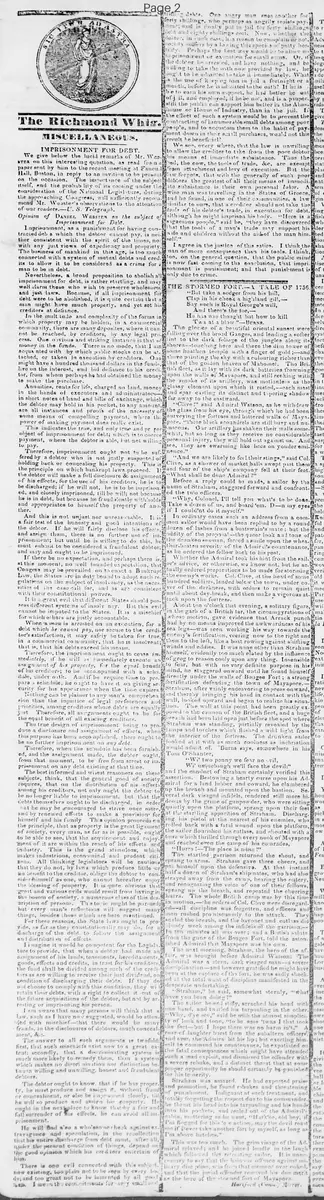
Imprisonment, as a punishment for having contracted debts which the debtor cannot pay, is neither consistent with the spirit of the times, nor with any just views of expediency and propriety. The business of mankind in this age, is too much connected with a system of mutual debts and credits to allow it to be considered as a crime for a man to be in debt. Nevertheless, a broad proposition to abolish all imprisonment for debt, is rather startling, and may well alarm those who wish to preserve wholesome and just laws. Because, if all imprisonment for debt were to be abolished, it is quite certain that a man might have much property, and yet set his creditors at defiance. In the multitude and complexity of the forms in which property may be holden, in a commercial community, there are many deposites, where it can not be reached, by creditors, by any legal process. One obvious and striking instance is that of money in the funds. There is no mode, that I am acquainted with by which public stocks can be attached, or taken in execution by creditors. One might have a hundred thousand dollars in the funds, live on the interest, and bid defiance to his creditor, from whom perhaps he had obtained the money to make the purchase. Annuities, rents for life, charged on land, money in the hands of executors and administrators-- in short notes of hand and bills of exchange, which the debtor may hold in his pocket, to any amount are all instances and proofs of the necessity of some means of compelling payment, where the power of making payment does really exist. This indicates the true, and only true and proper object of imprisonment for debt; which is to coerce payment, where the debtor is able, but not willing to pay. Therefore, imprisonment ought not to be suffered by a debtor who is not justly suspected of holding back or concealing his property. This is the principle on which bankrupt laws proceed. If the debtor will make a full disclosure & assignment of his effects, for the use of his creditors, he is to be discharged; if he will not, he is to be imprisoned, and closely imprisoned, till he will; not because he is in debt, but because he fraudulently withholds and appropriates to himself the property of another. And this is not unjust nor unreasonable. It is a fair test of the honesty and good intentions of the debtor. If he will fairly disclose his effects and assign them, there is no further use of imprisonment; but until he is willing to do this, he must submit to be considered a fraudulent debtor: and may and ought to be imprisoned. If there be no expectation, and perhaps there is at this moment, no well founded expectation, that Congress may be prevailed on to enact a Bankruptcy Law, the States are in duty bound to adopt such regulations on the subject of insolvency, as the necessities of the case call for, and as are consistent with their constitutional powers. It is a great evil that different States should possess different systems of insolvency. But this evil cannot be imputed to the States. It is a mischief for which others are justly accountable. When a man is arrested on an execution, for a debt which he cannot pay, nor secure to the creditor's satisfaction, it may safely be taken for true in a commercial community, that he is insolvent that is, that his debts exceed his means. Therefore, the imprisonment ought to cease immediately, if he will immediately execute an assignment of his property, for the equal benefit of his creditors; to be accompanied with a schedule, under oath. And if he require time to prepare a schedule, he ought to have it on giving security for his appearance when the time expires. Nothing can be plainer to any man's comprehension than the injustice of legal preferences and priorities, among creditors whose debts are equally just Therefore, all assignments ought to be for the equal benefit of all existing creditors. The true design of imprisonment being to produce a disclosure and assignment of effects, when this purpose has been accomplished, there ought to be no further imprisonment on any debt. Therefore, when the schedule has been furnished, and the assignment made, the debtor ought, from that moment, to be free from arrest or imprisonment on any debt existing at that time. The best informed and wisest reasoners on these subjects, think, that the general good of society requires, that on the distribution of his effects among his creditors, not only ought the debtor to be no longer liable to imprisonment, but that the debts themselves ought to be discharged, in order that he may be encouraged to strive once more and by renewed efforts to make a provision for himself and his family This opinion proceeds on the principle, that as property is the great ligament of society, every man, as far as is possible, ought to be able to see, that the acquisition and enjoyment of it are within the reach of his efforts and industry. This is the grand stimulus, which makes industrious, economical and prudent citizens. All thinking legislators will be cautious that they do not, by laws which produce little or no benefit to the creditor, oblige the debtor to consider himself as one, who cannot hereafter enjoy the blessing of property. It is quite obvious that great and various evils would result from having in the bosom of society, a numerous class of this description of persons. This topic might be pursued: but every man's reflections will suggest many things, besides those which are here mentioned. For these reasons, the State laws ought to provide, as far as they constitutionally may do, for a discharge of the debt, to follow the assignment and distribution of effects. I imagine it would be competent for the Legislature to provide, that when a debtor had made an assignment of his lands, tenements, hereditaments, goods, effects and credits, in trust for his creditors the fund shall be divided among such of those creditors as are willing to receive their just dividend, on condition of discharging their debts. If they do not choose to comply with this condition, they will retain their debts, with a right to collect it out of the future acquisitions of the debtor, but not by arresting or imprisoning his person. I am aware that many persons will think that a law such as I have now suggested, would be attended with mischief-that there would be many frauds, in the disclosures of debtors, much concealment, &c. The answer to all such arguments is twofold first, that such mischiefs exist now to a great extent: secondly, that a discriminating system is much more likely to remedy them, than a system which makes no discrimination nor distinction between willing and unwilling, honest and fraudulent debtors. The debtor ought to know, that if he has property, he must produce and assign it, without fraud or concealment, or else be imprisoned closely, till he will so produce and assign his property. He ought in the next place to know the day a fair and full surrender of his effects, he can avoid all imprisonment. He will find also a wholesome check against extravagance and speculation, in the recollection that his entire discharge from debt must, after all, under the present condition of things, depend on the good opinion which his creditors entertain of him. There is one evil connected with this subject, now existing, too plain not to be seen by every body, and too great not to be lamented by all good men--I mean the commitments for very small or trifling debts. An angry man sues another for forty shillings, who perhaps as angrily resists payment; and is finally put in jail for forty shillings debt and eight shillings cost. Now, whether the debtor, in such case, has reason to complain or not society suffers by a law ing this species of petty hostility. Perhaps the best way would be to allow no imprisonment or execution for small sums. Or, if the debtor be arrested, and have nothing, and be willing to take the oath now provided by law, he ought to be admitted to take it immediately. What is the use of keeping him in jail a fortnight or a month, before he is admitted to the oath? If he is able to earn his own support, he had better be out of jail, and employed; if he be not, and is a pauper, still the public can support him better in the Alms house or House of Industry, than in the jail. If the effect of such a system would be to prevent the contracting of innumerable small debts among poor people, and to accustom them to the habit of payment down in their small purchases, would not this result be beneficial? We see, every where, that the law is unwilling to allow the creditor to take from the poor debtor his means of immediate subsistence. Thus the bed, the cow, the tools of trade, &c, are exempt from attachment and levy of execution. But the law forgets, that with the generality of such poor debtors the greatest of all their means of immediate subsistence is their own personal labor. A wise man was travelling in the States of Greece, and he found, in one of their communities, a law similar to ours, that a creditor should not take the tools of his debtor's trade, in execution for debt, although he might imprison his body. "Here is a sagacious people," said he, "they have discovered that the tools of a man's trade may support his wife and children without the aid of the man himself." I agree in the justice of this satire. I think the man of more consequence than his tools. I think, too, on the general question, that the public mind is now fast coming to the conclusion, that imprisonment is punishment; and that punishment is only due to crime.
Opinion of Daniel Webster on the subject of Imprisonment for Debt.
Imprisonment, as a punishment for having contracted debts which the debtor cannot pay, is neither consistent with the spirit of the times, nor with any just views of expediency and propriety. The business of mankind in this age, is too much connected with a system of mutual debts and credits to allow it to be considered as a crime for a man to be in debt. Nevertheless, a broad proposition to abolish all imprisonment for debt, is rather startling, and may well alarm those who wish to preserve wholesome and just laws. Because, if all imprisonment for debt were to be abolished, it is quite certain that a man might have much property, and yet set his creditors at defiance. In the multitude and complexity of the forms in which property may be holden, in a commercial community, there are many deposites, where it can not be reached, by creditors, by any legal process. One obvious and striking instance is that of money in the funds. There is no mode, that I am acquainted with by which public stocks can be attached, or taken in execution by creditors. One might have a hundred thousand dollars in the funds, live on the interest, and bid defiance to his creditor, from whom perhaps he had obtained the money to make the purchase. Annuities, rents for life, charged on land, money in the hands of executors and administrators-- in short notes of hand and bills of exchange, which the debtor may hold in his pocket, to any amount are all instances and proofs of the necessity of some means of compelling payment, where the power of making payment does really exist. This indicates the true, and only true and proper object of imprisonment for debt; which is to coerce payment, where the debtor is able, but not willing to pay. Therefore, imprisonment ought not to be suffered by a debtor who is not justly suspected of holding back or concealing his property. This is the principle on which bankrupt laws proceed. If the debtor will make a full disclosure & assignment of his effects, for the use of his creditors, he is to be discharged; if he will not, he is to be imprisoned, and closely imprisoned, till he will; not because he is in debt, but because he fraudulently withholds and appropriates to himself the property of another. And this is not unjust nor unreasonable. It is a fair test of the honesty and good intentions of the debtor. If he will fairly disclose his effects and assign them, there is no further use of imprisonment; but until he is willing to do this, he must submit to be considered a fraudulent debtor: and may and ought to be imprisoned. If there be no expectation, and perhaps there is at this moment, no well founded expectation, that Congress may be prevailed on to enact a Bankruptcy Law, the States are in duty bound to adopt such regulations on the subject of insolvency, as the necessities of the case call for, and as are consistent with their constitutional powers. It is a great evil that different States should possess different systems of insolvency. But this evil cannot be imputed to the States. It is a mischief for which others are justly accountable. When a man is arrested on an execution, for a debt which he cannot pay, nor secure to the creditor's satisfaction, it may safely be taken for true in a commercial community, that he is insolvent that is, that his debts exceed his means. Therefore, the imprisonment ought to cease immediately, if he will immediately execute an assignment of his property, for the equal benefit of his creditors; to be accompanied with a schedule, under oath. And if he require time to prepare a schedule, he ought to have it on giving security for his appearance when the time expires. Nothing can be plainer to any man's comprehension than the injustice of legal preferences and priorities, among creditors whose debts are equally just Therefore, all assignments ought to be for the equal benefit of all existing creditors. The true design of imprisonment being to produce a disclosure and assignment of effects, when this purpose has been accomplished, there ought to be no further imprisonment on any debt. Therefore, when the schedule has been furnished, and the assignment made, the debtor ought, from that moment, to be free from arrest or imprisonment on any debt existing at that time. The best informed and wisest reasoners on these subjects, think, that the general good of society requires, that on the distribution of his effects among his creditors, not only ought the debtor to be no longer liable to imprisonment, but that the debts themselves ought to be discharged, in order that he may be encouraged to strive once more and by renewed efforts to make a provision for himself and his family This opinion proceeds on the principle, that as property is the great ligament of society, every man, as far as is possible, ought to be able to see, that the acquisition and enjoyment of it are within the reach of his efforts and industry. This is the grand stimulus, which makes industrious, economical and prudent citizens. All thinking legislators will be cautious that they do not, by laws which produce little or no benefit to the creditor, oblige the debtor to consider himself as one, who cannot hereafter enjoy the blessing of property. It is quite obvious that great and various evils would result from having in the bosom of society, a numerous class of this description of persons. This topic might be pursued: but every man's reflections will suggest many things, besides those which are here mentioned. For these reasons, the State laws ought to provide, as far as they constitutionally may do, for a discharge of the debt, to follow the assignment and distribution of effects. I imagine it would be competent for the Legislature to provide, that when a debtor had made an assignment of his lands, tenements, hereditaments, goods, effects and credits, in trust for his creditors the fund shall be divided among such of those creditors as are willing to receive their just dividend, on condition of discharging their debts. If they do not choose to comply with this condition, they will retain their debts, with a right to collect it out of the future acquisitions of the debtor, but not by arresting or imprisoning his person. I am aware that many persons will think that a law such as I have now suggested, would be attended with mischief-that there would be many frauds, in the disclosures of debtors, much concealment, &c. The answer to all such arguments is twofold first, that such mischiefs exist now to a great extent: secondly, that a discriminating system is much more likely to remedy them, than a system which makes no discrimination nor distinction between willing and unwilling, honest and fraudulent debtors. The debtor ought to know, that if he has property, he must produce and assign it, without fraud or concealment, or else be imprisoned closely, till he will so produce and assign his property. He ought in the next place to know the day a fair and full surrender of his effects, he can avoid all imprisonment. He will find also a wholesome check against extravagance and speculation, in the recollection that his entire discharge from debt must, after all, under the present condition of things, depend on the good opinion which his creditors entertain of him. There is one evil connected with this subject, now existing, too plain not to be seen by every body, and too great not to be lamented by all good men--I mean the commitments for very small or trifling debts. An angry man sues another for forty shillings, who perhaps as angrily resists payment; and is finally put in jail for forty shillings debt and eight shillings cost. Now, whether the debtor, in such case, has reason to complain or not society suffers by a law ing this species of petty hostility. Perhaps the best way would be to allow no imprisonment or execution for small sums. Or, if the debtor be arrested, and have nothing, and be willing to take the oath now provided by law, he ought to be admitted to take it immediately. What is the use of keeping him in jail a fortnight or a month, before he is admitted to the oath? If he is able to earn his own support, he had better be out of jail, and employed; if he be not, and is a pauper, still the public can support him better in the Alms house or House of Industry, than in the jail. If the effect of such a system would be to prevent the contracting of innumerable small debts among poor people, and to accustom them to the habit of payment down in their small purchases, would not this result be beneficial? We see, every where, that the law is unwilling to allow the creditor to take from the poor debtor his means of immediate subsistence. Thus the bed, the cow, the tools of trade, &c, are exempt from attachment and levy of execution. But the law forgets, that with the generality of such poor debtors the greatest of all their means of immediate subsistence is their own personal labor. A wise man was travelling in the States of Greece, and he found, in one of their communities, a law similar to ours, that a creditor should not take the tools of his debtor's trade, in execution for debt, although he might imprison his body. "Here is a sagacious people," said he, "they have discovered that the tools of a man's trade may support his wife and children without the aid of the man himself." I agree in the justice of this satire. I think the man of more consequence than his tools. I think, too, on the general question, that the public mind is now fast coming to the conclusion, that imprisonment is punishment; and that punishment is only due to crime.
What sub-type of article is it?
Historical Event
What themes does it cover?
Justice
Moral Virtue
What keywords are associated?
Imprisonment For Debt
Bankruptcy Law
Debtor Discharge
Legal Reform
Insolvency Systems
What entities or persons were involved?
Daniel Webster
Where did it happen?
Faneuil Hall, Boston
Story Details
Key Persons
Daniel Webster
Location
Faneuil Hall, Boston
Story Details
Daniel Webster argues that imprisonment for debt is inconsistent with modern commerce unless used to coerce payment from able but unwilling debtors suspected of fraud. He advocates for state insolvency laws requiring full disclosure and assignment of assets for equal creditor benefit, leading to discharge from imprisonment and potentially debts, to encourage industry and prevent social ills.