Thank you for visiting SNEWPapers!
Sign up free
Richmond Enquirer
Richmond, Richmond County, Virginia
What is this article about?
In the Richmond Enquirer on December 16, 1820, editors protest against efforts to identify the author Fabricius via postal espionage. Philo defends Postmaster General Meigs against Fabricius's charges of incapacity or dishonesty in contracts and appointments, attributing them to political rivals. Editors disclaim any bias or involvement in the attack.
Merged-components note: Split components forming a single continuous letter to the editor defending the Postmaster General.
Clipping
OCR Quality
Full Text
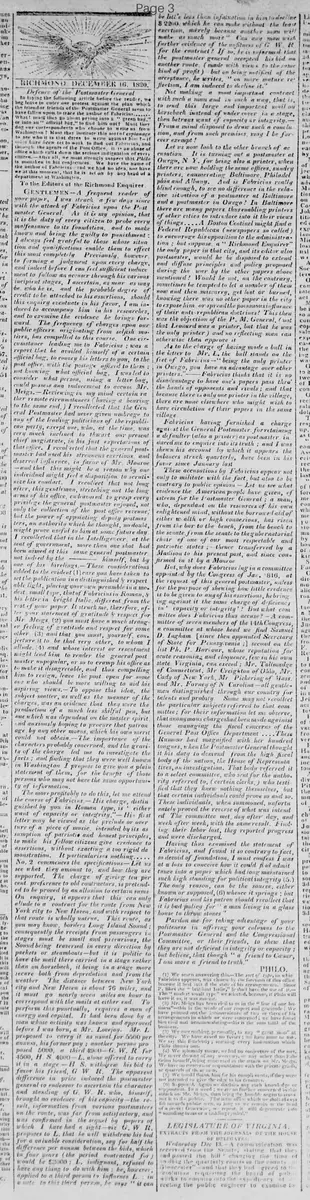
Defence of the Postmaster General
In laying the following article before the reader, we beg leave to enter our protest against the plan which the friend or friends of the Postmaster General seem to have fallen upon to trace the author of Fabricius. What! must they go about prying into a "green bag," or into an "official bag," to find him out? Must they dog our correspondents who choose to write us from Washington? Must they institute this sort of espionage to see who it is that dares to write against him?—if spies have been set to work to find out Fabricius, and though the agents of the Post Office, it is an abuse of office which calls down the serious indignation of every citizen.—After all, we most strongly suspect that Philo is mistaken in his conjectures. We have the name of the author of Fabricius—and we had no idea, nor have we at this moment, that he is set on by any head of a department at Washington.
To the Editors of the Richmond Enquirer.
GENTLEMEN—A frequent reader of your paper, I was struck a few days since with the attack of Fabricius upon the Postmaster General. "As it is my opinion, that it is the duty of every citizen to probe every malfeasance to its foundation, and to make known and bring the guilty to punishment: I always feel grateful to those whose situation and qualifications enable them to effect this most completely. Previously, however, to forming a judgment upon every charge, and indeed before I can feel sufficient inducement to follow an accuser through his various incipient stages, I ascertain, as near as may be who he is, and the probable degree of credit to be attached to his assertions, should this enquiry eventuate in his favor, I am induced to accompany him in his researches, and to examine the evidence he brings forward. The frequency of charges upon our public officers, originating from selfish motives, has compelled to this course. "One circumstance leading me to Fabricius; was a report that he availed himself of a certain official bag, to convey his letters to you, to the post office, with the postage affixed to them; not knowing what official bag, I was led to consider what person, using a letter bag, could possess any inducement to accuse Mr. Meigs.—Reviewing in my mind certain rather remote circumstances (having a bearing to the same end,) I recollected that the General Postmaster had never given umbrage to any of the leading politicians of the republican party, except one, who, at the time, was very much inclined to thwart our present chief magistrate, in his just expectations of that office. I recollected that the general postmaster had used his strenuous exertions and deserved influence, in favor of Mr. Monroe—and that this might be a reason why one individual might feel a disposition to scrutinize his conduct. I recollect that not long after, this gentleman, stretching out the long arms of his office, endeavored to grasp every privilege the general postmaster enjoyed, not only the collection of the post office revenue; but the power of appointing deputy postmasters, an authority which he thought, no doubt, might prove useful to him at some future day. I recollected that in the Intelligencer, at the seat of government, more than one shot had been aimed at this same general postmaster not indeed by the himself, but by one of his hirelings.—These considerations added to the evident care you have taken to set the publication in a distinguished and respectable light, placing your own preamble in a modest, small type, that of Fabricius in Roman, his letter in bright Italic, different from the rest of your paper. It struck me, therefore, after your statement of gratitude & respect for Mr. Meigs, you must have a much stronger feeling of gratitude and respect for some other, and that you must, yourself, conjecture it to be that very other, to whom I allude, and whose interest or resentment might lead him to render the general postmaster unpopular, or so to cramp his office as to make it disagreeable, and thus compelling him to resign, leave the post open for some one who should be more willing to aid his aspiring views.—To oppose this idea, the subject matter, as well as the manner of the charges, was an evidence that they were the production of a much less skilful pen, but one which was dependant on the master spirit and anxiously hoping to procure that patronage, by any other means, which his own merit could not obtain.—The importance of the characters probably concerned, and the gravity of the charge led me to investigate the facts; and finding that they were well known in Washington I propose to give you a plain statement of them, for the benefit of those persons who may not have the same opportunity of information.
The more profitably to do this, let me attend the course of Fabricius.—His charge, distinguished by you in Roman type, is either "want of capacity or integrity."—His first letter may be viewed as the prelude or overture of a piece of music, intended by its assumption of patriotic and honest principles, to make his fellow citizens give credence to assertions, without exacting a too rigid demonstration. It particularises nothing.....
No. 2 commences the specifications—Let us see what they amount to, and how they are supported. The charge of giving ten per cent preference to old contractors, is pretended to be proved by an allusion to certain sums. On enquiry, it appears that this can only allude to a "contract for the route from New York city to New Haven, and with respect to that route is wholly untrue. This route, as you may know, borders Long Island Sound; consequently the receipts from passengers in stages must be small and precarious, the Sound being traversed in every direction by packets or steamboats—but it is politic to have the mail there carried in a stage rather than on horseback, it being in a stage more secure both from depredation and from the weather. The distance between New York city and New Haven is about 76 miles, and it must go nearly seven miles an hour to correspond with the mails at either end. To perform this punctually, requires a man of energy and capital. It had been done by a man whose activity has been known and approved before I was born, a Mr. Lovejoy. Mr L proposed to carry it as usual for $5000 per annum, his former pay; another person proposed $5000, a third $4900, G.W.R. for $4500, H.S. $4000—L. alone offered to carry it in a stage—H.S. withdrew his bid in favor his friend, G.W.R. "The apparent difference in price induced the postmaster general to endeavor to ascertain the character and standing of G. W. R. who, himself, brought no evidence of his capacity—the result, information from various postmasters on the route, was far from satisfactory, and was confirmed in the sequel by papers of which I have had a sight—viz G. W. R. proposes to L. that he will withdraw his bid for a valuable consideration, say for half the difference per annum between the bids, which in four years (the period contracted for) would be $3000; L. indignant, refused to have any thing to do with him; he, however, applied to a third person to influence L: in a note to this third person, he says "it can be little less than infatuation in him to decline $2200, which he can make without the least exertion, merely because another man will make as much more" Can any man wish further evidence of the unfitness of G. W. R for the contract? If so, he is informed that the postmaster general accepted his bid on another route. (made with views to the same kind of profit). but on being notified of the acceptance, he writes. "on more mature reflection, I am induced to decline it."
Not making a most important contract with such a man and in such a way, that is, to send this large and important mail on horseback instead of under cover in a stage, then betrays want of capacity or integrity.—From a mind disposed to draw such a conclusion, and from such premises, may I be forever exempt!
Let us now look to the other branch of accusation. It is turning out a postmaster at Owego, N. Y. for being also a printer, when there are none holding the same offices, sundry printers, enumerating Baltimore, Philadelphia and Albany. And is Fabricius really blind enough, to see no difference in the relative situation of a postmaster at Baltimore and a postmaster in Owego? In Baltimore there are many papers thus enabling printers of other cities to introduce into it their views of things....A Boston Centinel might find a Federal Republican (newspapers so called) to encourage his opposition to the administration; but suppose a "Richmond Enquirer" the only paper in that city, and its editor also postmaster, would he be disposed to extend and diffuse principles and policy proposed during the war by the other papers above mentioned? Would he not, on the contrary, sometimes be tempted to let a number of them now and then miscarry, get lost or burned, knowing there was no other paper in the city to expose him or spread the poisonous influence of their antirepublican doctrines? This then was the objection of the P. M. General. (not that Leonard was a printer, but that he was the only printer) and no reflecting man can otherwise than approve it.
As to the charge of having made a bull in the letter to Mr. L. the bull stands on the feet of Fabricius—"being the only printer in Owego, you have an advantage over other printers." Fabricius thinks that it is no disadvantage to have one's papers pass thro' the hands of opponents and rivals; and that because there is only one printer in the village, there are none elsewhere who might wish to have circulation of their papers in the same village.
Fabricius having furnished a charge against the General Postmaster for retaining a defaulter (also a printer) as postmaster induced me to enquire into its truth; and I was shewn his account by which it appears the balances struck quarterly, have been in his favor since January last.
These accusations by Fabricius appear not only to militate with the fact, but also to be contrary to public opinion—Let us see what evidence the American people have given, of esteem for the Postmaster General; a man, who, dependant on the resources of his own enlightened mind, without the borrowed aid of either wealth or high connexions, has risen from the bar to the bench, from the bench to the senate, from the senate to the gubernatorial chair of one of our most respectable and patriotic states;—thence transferred by a Madison to his present post, and since confirmed in it by a Monroe.
But, why does Fabricius lug in a committee appointed by the Congress of Jan. '16, at the request of this general postmaster, unless for the purpose of shewing how little credence is to be given to any of his assertions, he bringing against it the same charge of deficiency in capacity or integrity? But what committee does Fabricius thus accuse?—A committee of seven members of the 14th Congress, a committee at whose head we find Samuel D. Ingham [since then appointed Secretary of State for Pennsylvania;] second on the list Ph. P. Barbour, whose reputation for acute reasoning and eloquence, few in his own state Virginia, can exceed; Mr. Tallmadge of Connecticut, Mr Creighton of Ohio, Mr. Cady of New York, Mr Pickering of Mass. and Mr. Forney of N Carolina—all gentlemen distinguished through our country for talents and probity. Some may not recollect the particular subjects referred to that committee; for their information let me observe, that anonymous charges had been made against those managing the fiscal concerns of the General Post Office Department ....These Rumour had magnified with her hundred tongues, when the Postmaster General thought it his duty to demand from the high fiscal body of the nation, the House of Representatives, an investigation. That body referred it to a select committee, who sent for the authority referred to, (certain clerks.) who testified that they knew nothing themselves, but that certain individuals could prove so and so. These individuals, when summoned, unfortunately proved the reverse of what was intended. The committee met, day after day, and week after week, with the same result. Finding their labor lost, they reported progress and were discharged.
Having thus examined the statement of Fabricius, and found it so contrary to fact, so devoid of foundation, I must confess I was at a loss to conceive how it could find admittance into a paper which had long maintained such high standing for political integrity. The only reason, can be the source, either known or supposed, whence it springs: but Fabricius and his patron should recollect that it is bad policy for "a man living in a glass house to throw stones."
Pardon me for taking advantage of your politeness in offering your columns to the Postmaster General and the Congressional Committee, or their friends, to shew that they are not deficient in integrity or capacity: but believe, that though "a friend to Caesar, I am more a friend to truth."
PHILO.
(1) We scorn answering this.—The sort of type, in which Fabricius appears, was chosen by the foreman of this office because it best suited the state of his arrangements. Since P. likes the "brilliant Italic" he shall have the use of it.—The "modest small type" we selected, because, if Philo will have it so, it was more apt.
(2) Mr. Meigs has been civil to us in the "line of our business"—this is the whole of our respect and gratitude! We have pointed out the inconvenience of two or three of his arrangements in which we were concerned; we have found him civil and accommodating—this is the sum total of the business.
(3) We owe nothing personally, to any "great man" at the city. We have asked no favors; we have none to ask. We say this frankly; scorning every insinuation which Philo throws out.
(4) We solemnly swear, we had no conjecture of the sort. We never dreamt of any secretary, or any other than Fabricius himself, being concerned in the attack on Mr. Meigs. We have no concern or acquaintance with the private griefs, or quarrels of these men.
We would thank him for his compliments, if they were not intended so give the edge to his censures.
Supposed. Again we disclaim any such knowledge or supposition. In a word: we are no further concerned in this attack on Mr. Meigs, than being the honest organ to transmit it to the public. There is an office which we shall always fill towards public men, so long as we remain in the head of a press: Our press, we repeat it will degenerate into "sounding brass or a tinkling cymbal," mil.
What sub-type of article is it?
What themes does it cover?
What keywords are associated?
What entities or persons were involved?
Letter to Editor Details
Author
Philo
Recipient
To The Editors Of The Richmond Enquirer
Main Argument
philo defends postmaster general meigs against fabricius's charges of want of capacity or integrity in postal contracts and appointments, arguing the accusations are unfounded, factually incorrect, and motivated by personal political grudges against meigs.
Notable Details