Thank you for visiting SNEWPapers!
Sign up free
Letter to Editor
February 10, 1809
The Enquirer
Richmond, Henrico County, Virginia
What is this article about?
Letter urges Congress to extend the Embargo Act until May session to avoid submission to Britain or premature war, criticizing immediate repeal or mere arming of merchantmen as ineffective. Advocates letters of marque and reprisal as a substitute to protect American rights and trade.
Clipping
OCR Quality
98%
Excellent
Full Text
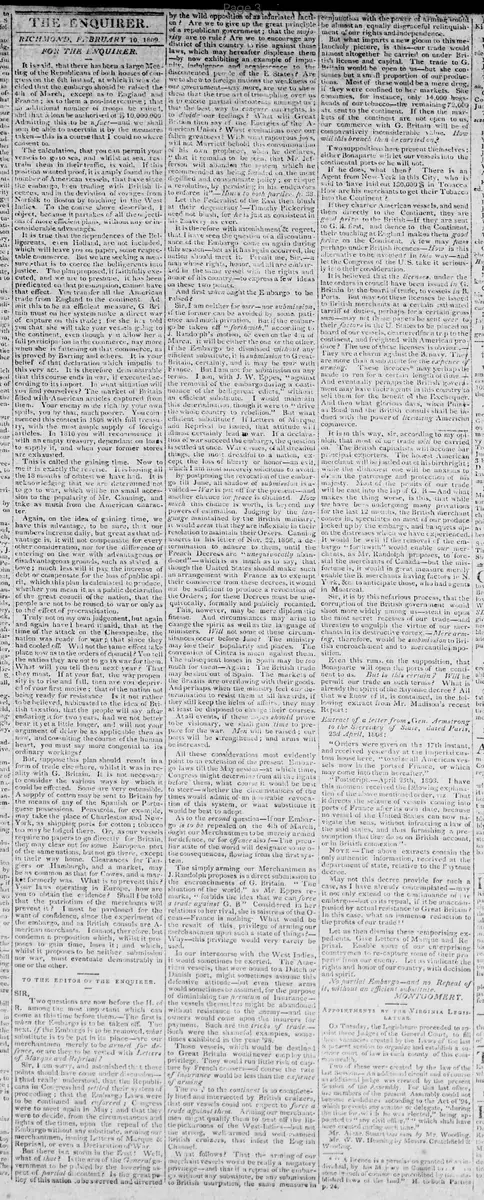
TO THE EDITOR OF THE ENQUIRER.
SIR,
Two questions are now before the H. of R. among the most important which can come at this time before them--The first is when the Embargo is to be taken off. The next, if the Embargo is to be removed, what substitute is to be put in its place--are our merchantmen merely to be armed for defence, or are they to be vested with Letters of Marque and Reprisal?
Sir, I am sorry, and astonished that these points should have come under discussion--I had really understood, that the Republicans in Congress had settled their system of proceeding; that the Embargo Laws were to be continued and enforced; Congress were to meet again in May; and that they were to decide, from the circumstances and lights of the times, upon the repeal of the Embargo without any substitute, arming our merchantmen, issuing Letters of Marque & Reprisal, or even a Declaration of War.
But there is a storm in the East! Well, what of that? Is the arm of the General government to be palsied by the lowering aspect of partial discontent? Is the great policy of this nation to be swerved and diverted by the wild opposition of an infuriated faction? Are we to give up the great principle of a republican government; that the majority are to rule? Are we to encourage any district of this country to rise against those laws, which may hereafter displease them--by now exhibiting an example of impunity, indulgence and acquiescence to the discontented people of the E. States? Are we to shew to foreign nations the weakness of our government--nay more, are we to shew them that the true art of triumphing over us is to excite partial discontents amongst us; that the best way to conquer our rights, is to divide our feelings? What will Great Britain then say of the Energies of the American Union? What exultations over our fallen greatness! With what rapturous joys, will not Marriott behold this consummation of his own prophecy, when he declares, "that it remains to be seen, that Mr. Jefferson will abandon the system which he recommended as being founded on the most dignified and consummate policy; or risque a revolution, by persisting in his endeavors to enforce it" Hints to both Parties. p. 38.
Let the Federalist of the East then blush at their degeneracy!--Timothy Pickering need not blush, for he is just as consistent in his Knavery as ever.
It is therefore with astonishment & regret, that I have seen the question of a discontinuance of the Embargo come on again during this session--but as it has again occurred, the nation should meet it. Permit me, Sir,--a man whose rights, honor, and all are embarked in the same vessel with the rights and honor of his country--to express a few ideas on these two points.
And first when ought the Embargo to be raised?
Sir. I am neither for war--nor submission. If the former can be avoided by some patience and much privation. But if the embargo--be taken off "forthwith." according to J. Randolph's motion, or even on the 4th of March, it will be either the one or the other. If the Embargo be dismissed without any efficient substitute, it is submission to Great Britain, certainly, and it may be war with France. But I am not for submission on any terms. I am, with J. W. Eppes, "against the removal of the embargo during a continuance of the belligerent edicts," without an efficient substitute. I would maintain this determination, though it were to "drive the whole country to rebellion." But what efficient substitute? If Letters of Marque and Reprisal be issued, that attitude will almost certainly lead to war. If a declaration of war succeed the embargo, the question is settled at once. War ensues, and all dreadful things, the most dreadful to a nation, except the loss of liberty or honor--an evil, which I am most sincerely solicitous to avoid.
By postponing the revocation of the embargo till June, all shadow of submission is avoided--War is put off for the present--and another chance for peace is obtained. How much this chance is worth, is beyond my powers of estimation. Judging by the language maintained by the British ministry, it would seem that they are inflexible in their resolution to maintain their Orders. Canning asserts in his letter of Nov. 22, 1808, a determination to adhere to them, until the French Decrees are "unequivocally abandoned"--which is as much as to say, that though the United States should make such an arrangement with France as to exempt their Commerce from these decrees, it would not be sufficient to produce a revocation of the Orders: for these Decrees must be unequivocally, formally and publicly recanted.
This, however, may be mere diplomatic finesse. And circumstances may arise to change the spirit as well as the language of ministers. Will not some of these circumstances occur before June? The ministry may lose their popularity and places. The convention of Cintra is much against them. The subsequent losses in Spain may be too much for them--Again: The British trade may be shut out of Spain. The markets of the Brazils are overflowing with their goods. And perhaps when the ministry feel our determination to resist them at all hazards, if they still keep the helm of affairs, they may at least be disposed to change their courses.
At all events, if these hopes should prove to be visionary, we shall gain time to prepare for the war. Men will be raised; our ports will be strengthened; and arms will be increased.
All these considerations most evidently point to an extension of the present Embargo laws till the May session--at which time, Congress might determine from all the lights before them, what course it would be best to steer--whether the circumstances of the times would admit of an honorable revocation of this system, or what substitute it would be best to adopt.
As to the second question--If our Embargo is to be repealed on the 4th of March, ought our Merchantmen to be merely armed for defence, or for offence also?--The peculiar state of the world will designate some of the consequences, flowing from the first system.
The simply arming our Merchantmen as J. Randolph proposes is a direct submission to the encroachments of G. Britain. "The situation of the world," as Mr. Eppes remarks, "forbids the idea that we can force a trade against G. B." Considered in her relations to her rival, she is mistress of the Ocean--France is nothing: What would be the result of this, privilege of arming our merchantmen upon such a state of things?--
Why--this privilege would very rarely be used.
In our intercourse with the West Indies, it would sometimes be exerted. The American vessels, that were bound to a Dutch or Danish port, might sometimes assume this defensive attitude--but even these arms would sometimes be assumed, for the purpose of diminishing the premium of Insurance--the vessels themselves might be abandoned without resistance to the enemy--and the owners would come upon the insurers for payment. Such are the tricks of trade--Such were the shameful examples, sometimes exhibited in the year '98.
Those vessels, which would be destined to Great Britain would never employ this privilege. They would run little risk of capture by French cruisers--of course the rate of Insurance would be less than the expense of arming.
The road to the continent is so completely lined and intersected by British cruisers, that our vessels could not expect to force a trade against them. Arming our merchantmen might qualify them to beat off the little pickaroons of the West-Indies--but not the strong, well-armed and well manned British cruisers, that infest the English Channel.
What follows? That the arming of our merchant vessels would be really a nugatory privilege--and that if a retreat of the embargo without any substitute, be any submission to British usurpation, the same measure in conjunction with the power of arming would be almost an equally disgraceful relinquishment of our rights and independence.
But what imparts a new gloom to this melancholy picture, is this--our trade would almost altogether be carried on under British license and capital. The trade to G. Britain would be open to us--but she consumes but a small proportion of our productions. Most of these would be a mere drug, if they were confined to her markets. She consumes, for instance, only 14,000 hogsheads of our tobacco--the remaining 72,000 are sent to the continent. If then the markets of the continent are not open to us, our commerce with G. Britain will be of comparatively inconsiderable value. How will this branch then be carried on?
Two suppositions here present themselves: either Bonaparte will let our vessels into the continental ports or he will not.
If he does, what then? There is an Agent from New-York in this City, who is said to have laid out $50,000 in Tobacco. How are his merchants to get their Tobacco into the Continent?
If they charter American vessels, and send them directly to the Continent, they are good prize to the British--If they are sent to G. B. first, and thence to the Continent, their touching at England makes them good prize on the Continent. A few may pass perhaps under British licenses--How is this alternative to be avoided? In this way--and let the Congress of the U. S. take it seriously into their consideration.
It is believed that the licenses, under the late orders in council have been issued in G. Britain by the board of trade, to vessels in B. Ports. But may not these licenses be issued to British merchants at a certain estimated tariff of duties, perhaps for a certain gross sum--may not these papers be sent over to their factors in the U. States to be placed on board of our vessels, chartered for a trip to the continent, and freighted with American produce? The use of these licenses is obvious.--They are a charm against the B. navy. They are more than a substitute for the expense of arming. These licenses* may perhaps be made to run for a certain length of time.+ And eventually perhaps the British government may have their agents in this country to sell them for the benefit of the Exchequer. And then what glorious days, when Phineas Bond and the British consuls shall be indued with the power of licensing American commerce.
It is in this way, sir, according to my opinion, that most of our trade will be carried on. The British capitalists will become our principal exporters. The honest American merchant will be jostled out of his birthright; while the dishonest one will be anxious to obtain the patronage and protection of his majesty. Most of the profits of our trade will be cast into the lap of G. B.--And what makes the thing worse, is thus, that while we have been undergoing many privations for the last 12 months, the British merchant comes in, speculates on most of our produce locked up by the embargo, and banquets upon the distresses which we have experienced.
It would be well if the removal of the embargo "forthwith" would enable our merchants, as Mr. Randolph proposes, to 'forestall the merchants of Canada--but the misfortune is, it would in great measure merely enable the B. merchants having factors in N. York, &c. to anticipate those, who had agents in Montreal.
Sir, it is by this nefarious process, that the corruption of the British government would shoot more widely among us--steal in upon the most secret recesses of our trade--and threaten to engulph the virtue of our merchants in its destructive vortex.--Here arming, therefore, would be submission to British encroachment and to mercantile imposition.
Even this runs, on the supposition, that Bonaparte will open the ports of the continent to us. But is this certain? Will he permit our trade on such terms? What is already the spirit of the Bayonne decree? All that we know of it, is contained, in the following extract from Mr. Madison's recent Report:
Extract of a letter from Gen. Armstrong to the Secretary of State, dated Paris, 23d April, 1808:
"Orders were given on the 17th instant, and received yesterday at the imperial custom house here, to seize all American vessels now in the ports of France, or which may come into them hereafter."
"Postscript.--April 25th, 1808. I have this moment received the following explanation of the above mentioned order, viz That it directs the seizure of vessels coming into ports of France after its own date, because no vessel of the United States can now navigate the seas, without infracting a law of the said states, and thus furnishing a presumption that they do so on British account or in British connexion".
Note--The above extracts contain the only authentic information, received at the department of state, relative to the Bayonne decree.
May not this decree provide for such a case, as I have already contemplated--may it not only extend to the continuance of the embargo--but to its repeal, if it be unaccompanied by actual resistance to Great Britain?
In this case, what an immense reduction to the profits of our trade!
Let us then dismiss these 'emporising expedients. Give Letters of Marque and Reprisal. Enable some of our enterprising countrymen to re-capture some of their property from our enemy. Let us vindicate the rights and honor of our country, with decision and spirit.
No partial Embargo--and no Repeal of it, without an efficient substitute.
MONTGOMERY.
SIR,
Two questions are now before the H. of R. among the most important which can come at this time before them--The first is when the Embargo is to be taken off. The next, if the Embargo is to be removed, what substitute is to be put in its place--are our merchantmen merely to be armed for defence, or are they to be vested with Letters of Marque and Reprisal?
Sir, I am sorry, and astonished that these points should have come under discussion--I had really understood, that the Republicans in Congress had settled their system of proceeding; that the Embargo Laws were to be continued and enforced; Congress were to meet again in May; and that they were to decide, from the circumstances and lights of the times, upon the repeal of the Embargo without any substitute, arming our merchantmen, issuing Letters of Marque & Reprisal, or even a Declaration of War.
But there is a storm in the East! Well, what of that? Is the arm of the General government to be palsied by the lowering aspect of partial discontent? Is the great policy of this nation to be swerved and diverted by the wild opposition of an infuriated faction? Are we to give up the great principle of a republican government; that the majority are to rule? Are we to encourage any district of this country to rise against those laws, which may hereafter displease them--by now exhibiting an example of impunity, indulgence and acquiescence to the discontented people of the E. States? Are we to shew to foreign nations the weakness of our government--nay more, are we to shew them that the true art of triumphing over us is to excite partial discontents amongst us; that the best way to conquer our rights, is to divide our feelings? What will Great Britain then say of the Energies of the American Union? What exultations over our fallen greatness! With what rapturous joys, will not Marriott behold this consummation of his own prophecy, when he declares, "that it remains to be seen, that Mr. Jefferson will abandon the system which he recommended as being founded on the most dignified and consummate policy; or risque a revolution, by persisting in his endeavors to enforce it" Hints to both Parties. p. 38.
Let the Federalist of the East then blush at their degeneracy!--Timothy Pickering need not blush, for he is just as consistent in his Knavery as ever.
It is therefore with astonishment & regret, that I have seen the question of a discontinuance of the Embargo come on again during this session--but as it has again occurred, the nation should meet it. Permit me, Sir,--a man whose rights, honor, and all are embarked in the same vessel with the rights and honor of his country--to express a few ideas on these two points.
And first when ought the Embargo to be raised?
Sir. I am neither for war--nor submission. If the former can be avoided by some patience and much privation. But if the embargo--be taken off "forthwith." according to J. Randolph's motion, or even on the 4th of March, it will be either the one or the other. If the Embargo be dismissed without any efficient substitute, it is submission to Great Britain, certainly, and it may be war with France. But I am not for submission on any terms. I am, with J. W. Eppes, "against the removal of the embargo during a continuance of the belligerent edicts," without an efficient substitute. I would maintain this determination, though it were to "drive the whole country to rebellion." But what efficient substitute? If Letters of Marque and Reprisal be issued, that attitude will almost certainly lead to war. If a declaration of war succeed the embargo, the question is settled at once. War ensues, and all dreadful things, the most dreadful to a nation, except the loss of liberty or honor--an evil, which I am most sincerely solicitous to avoid.
By postponing the revocation of the embargo till June, all shadow of submission is avoided--War is put off for the present--and another chance for peace is obtained. How much this chance is worth, is beyond my powers of estimation. Judging by the language maintained by the British ministry, it would seem that they are inflexible in their resolution to maintain their Orders. Canning asserts in his letter of Nov. 22, 1808, a determination to adhere to them, until the French Decrees are "unequivocally abandoned"--which is as much as to say, that though the United States should make such an arrangement with France as to exempt their Commerce from these decrees, it would not be sufficient to produce a revocation of the Orders: for these Decrees must be unequivocally, formally and publicly recanted.
This, however, may be mere diplomatic finesse. And circumstances may arise to change the spirit as well as the language of ministers. Will not some of these circumstances occur before June? The ministry may lose their popularity and places. The convention of Cintra is much against them. The subsequent losses in Spain may be too much for them--Again: The British trade may be shut out of Spain. The markets of the Brazils are overflowing with their goods. And perhaps when the ministry feel our determination to resist them at all hazards, if they still keep the helm of affairs, they may at least be disposed to change their courses.
At all events, if these hopes should prove to be visionary, we shall gain time to prepare for the war. Men will be raised; our ports will be strengthened; and arms will be increased.
All these considerations most evidently point to an extension of the present Embargo laws till the May session--at which time, Congress might determine from all the lights before them, what course it would be best to steer--whether the circumstances of the times would admit of an honorable revocation of this system, or what substitute it would be best to adopt.
As to the second question--If our Embargo is to be repealed on the 4th of March, ought our Merchantmen to be merely armed for defence, or for offence also?--The peculiar state of the world will designate some of the consequences, flowing from the first system.
The simply arming our Merchantmen as J. Randolph proposes is a direct submission to the encroachments of G. Britain. "The situation of the world," as Mr. Eppes remarks, "forbids the idea that we can force a trade against G. B." Considered in her relations to her rival, she is mistress of the Ocean--France is nothing: What would be the result of this, privilege of arming our merchantmen upon such a state of things?--
Why--this privilege would very rarely be used.
In our intercourse with the West Indies, it would sometimes be exerted. The American vessels, that were bound to a Dutch or Danish port, might sometimes assume this defensive attitude--but even these arms would sometimes be assumed, for the purpose of diminishing the premium of Insurance--the vessels themselves might be abandoned without resistance to the enemy--and the owners would come upon the insurers for payment. Such are the tricks of trade--Such were the shameful examples, sometimes exhibited in the year '98.
Those vessels, which would be destined to Great Britain would never employ this privilege. They would run little risk of capture by French cruisers--of course the rate of Insurance would be less than the expense of arming.
The road to the continent is so completely lined and intersected by British cruisers, that our vessels could not expect to force a trade against them. Arming our merchantmen might qualify them to beat off the little pickaroons of the West-Indies--but not the strong, well-armed and well manned British cruisers, that infest the English Channel.
What follows? That the arming of our merchant vessels would be really a nugatory privilege--and that if a retreat of the embargo without any substitute, be any submission to British usurpation, the same measure in conjunction with the power of arming would be almost an equally disgraceful relinquishment of our rights and independence.
But what imparts a new gloom to this melancholy picture, is this--our trade would almost altogether be carried on under British license and capital. The trade to G. Britain would be open to us--but she consumes but a small proportion of our productions. Most of these would be a mere drug, if they were confined to her markets. She consumes, for instance, only 14,000 hogsheads of our tobacco--the remaining 72,000 are sent to the continent. If then the markets of the continent are not open to us, our commerce with G. Britain will be of comparatively inconsiderable value. How will this branch then be carried on?
Two suppositions here present themselves: either Bonaparte will let our vessels into the continental ports or he will not.
If he does, what then? There is an Agent from New-York in this City, who is said to have laid out $50,000 in Tobacco. How are his merchants to get their Tobacco into the Continent?
If they charter American vessels, and send them directly to the Continent, they are good prize to the British--If they are sent to G. B. first, and thence to the Continent, their touching at England makes them good prize on the Continent. A few may pass perhaps under British licenses--How is this alternative to be avoided? In this way--and let the Congress of the U. S. take it seriously into their consideration.
It is believed that the licenses, under the late orders in council have been issued in G. Britain by the board of trade, to vessels in B. Ports. But may not these licenses be issued to British merchants at a certain estimated tariff of duties, perhaps for a certain gross sum--may not these papers be sent over to their factors in the U. States to be placed on board of our vessels, chartered for a trip to the continent, and freighted with American produce? The use of these licenses is obvious.--They are a charm against the B. navy. They are more than a substitute for the expense of arming. These licenses* may perhaps be made to run for a certain length of time.+ And eventually perhaps the British government may have their agents in this country to sell them for the benefit of the Exchequer. And then what glorious days, when Phineas Bond and the British consuls shall be indued with the power of licensing American commerce.
It is in this way, sir, according to my opinion, that most of our trade will be carried on. The British capitalists will become our principal exporters. The honest American merchant will be jostled out of his birthright; while the dishonest one will be anxious to obtain the patronage and protection of his majesty. Most of the profits of our trade will be cast into the lap of G. B.--And what makes the thing worse, is thus, that while we have been undergoing many privations for the last 12 months, the British merchant comes in, speculates on most of our produce locked up by the embargo, and banquets upon the distresses which we have experienced.
It would be well if the removal of the embargo "forthwith" would enable our merchants, as Mr. Randolph proposes, to 'forestall the merchants of Canada--but the misfortune is, it would in great measure merely enable the B. merchants having factors in N. York, &c. to anticipate those, who had agents in Montreal.
Sir, it is by this nefarious process, that the corruption of the British government would shoot more widely among us--steal in upon the most secret recesses of our trade--and threaten to engulph the virtue of our merchants in its destructive vortex.--Here arming, therefore, would be submission to British encroachment and to mercantile imposition.
Even this runs, on the supposition, that Bonaparte will open the ports of the continent to us. But is this certain? Will he permit our trade on such terms? What is already the spirit of the Bayonne decree? All that we know of it, is contained, in the following extract from Mr. Madison's recent Report:
Extract of a letter from Gen. Armstrong to the Secretary of State, dated Paris, 23d April, 1808:
"Orders were given on the 17th instant, and received yesterday at the imperial custom house here, to seize all American vessels now in the ports of France, or which may come into them hereafter."
"Postscript.--April 25th, 1808. I have this moment received the following explanation of the above mentioned order, viz That it directs the seizure of vessels coming into ports of France after its own date, because no vessel of the United States can now navigate the seas, without infracting a law of the said states, and thus furnishing a presumption that they do so on British account or in British connexion".
Note--The above extracts contain the only authentic information, received at the department of state, relative to the Bayonne decree.
May not this decree provide for such a case, as I have already contemplated--may it not only extend to the continuance of the embargo--but to its repeal, if it be unaccompanied by actual resistance to Great Britain?
In this case, what an immense reduction to the profits of our trade!
Let us then dismiss these 'emporising expedients. Give Letters of Marque and Reprisal. Enable some of our enterprising countrymen to re-capture some of their property from our enemy. Let us vindicate the rights and honor of our country, with decision and spirit.
No partial Embargo--and no Repeal of it, without an efficient substitute.
MONTGOMERY.
What sub-type of article is it?
Persuasive
Political
Provocative
What themes does it cover?
Economic Policy
Military War
Politics
What keywords are associated?
Embargo Extension
Letters Of Marque
British Orders In Council
American Merchantmen
War Declaration
French Decrees
Trade Submission
Congressional Debate
What entities or persons were involved?
Montgomery.
The Editor Of The Enquirer
Letter to Editor Details
Author
Montgomery.
Recipient
The Editor Of The Enquirer
Main Argument
the embargo should be extended until the may session to avoid submission to britain or hasty war; if repealed, merchantmen should receive letters of marque and reprisal rather than mere defensive arming, which would be ineffective and lead to british dominance in american trade.
Notable Details
References J. Randolph's Motion For Immediate Repeal
Cites J. W. Eppes Against Removal Without Substitute
Quotes Canning's Letter Of Nov. 22, 1808
Mentions Bayonne Decree Via Madison's Report
Criticizes Federalists And Timothy Pickering
Quotes Marriott's Prophecy From 'Hints To Both Parties' P. 38