Thank you for visiting SNEWPapers!
Sign up free
New Hampshire Statesman And Concord Register
Concord, Merrimack County, New Hampshire
What is this article about?
George M. Phelps submits an extract from a letter by his nephew Abner Phelps, dated March 22, 1831, from Brazoria, Texas, providing a detailed description of Texas's geography, rivers, bays, climate, soil, and agricultural suitability, emphasizing its commercial and farming advantages within the Mexican Republic.
Merged-components note: Direct textual continuation of the letter describing Texas geography and features from page 2 to page 3; original label of second component was foreign_news but content is part of the domestic letter to the editor.
Clippings
1 of 2
OCR Quality
Full Text
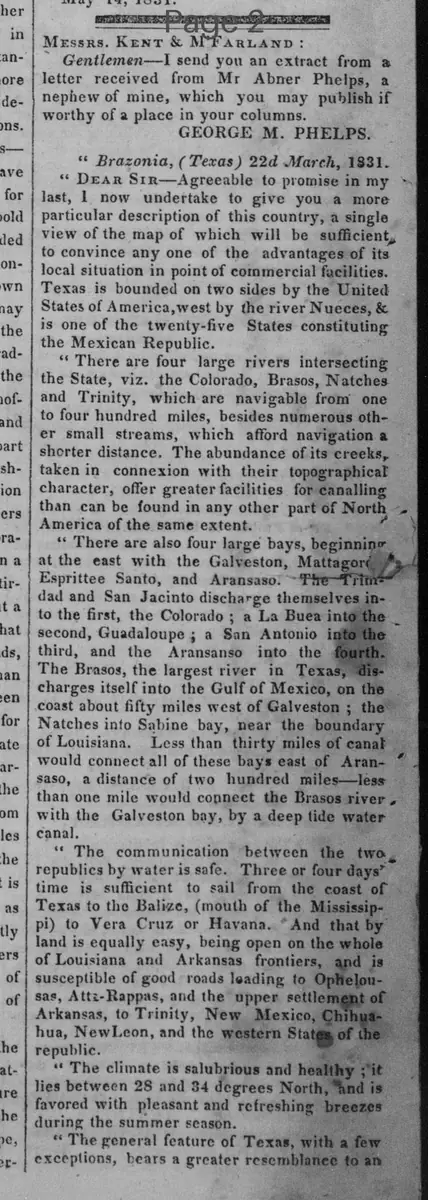
Gentlemen—I send you an extract from a letter received from Mr Abner Phelps, a nephew of mine, which you may publish if worthy of a place in your columns.
GEORGE M. PHELPS.
"Brazoria, (Texas) 22d March, 1831.
"DEAR SIR—Agreeable to promise in my last, I now undertake to give you a more particular description of this country, a single view of the map of which will be sufficient to convince any one of the advantages of its local situation in point of commercial facilities. Texas is bounded on two sides by the United States of America, west by the river Nueces, & is one of the twenty-five States constituting the Mexican Republic.
"There are four large rivers intersecting the State, viz. the Colorado, Brasos, Natches and Trinity, which are navigable from one to four hundred miles, besides numerous other small streams, which afford navigation a shorter distance. The abundance of its creeks, taken in connexion with their topographical character, offer greater facilities for canalling than can be found in any other part of North America of the same extent.
"There are also four large bays, beginning at the east with the Galveston, Mattagorda Esprittee Santo, and Aransaso. The Trinidad and San Jacinto discharge themselves into the first, the Colorado: a La Buea into the second, Guadaloupe; a San Antonio into the third, and the Aransanso into the fourth. The Brasos, the largest river in Texas, discharges itself into the Gulf of Mexico, on the coast about fifty miles west of Galveston; the Natches into Sabine bay, near the boundary of Louisiana. Less than thirty miles of canal would connect all of these bays east of Aransaso, a distance of two hundred miles—less than one mile would connect the Brasos river with the Galveston bay, by a deep tide water canal.
"The communication between the two republics by water is safe. Three or four days' time is sufficient to sail from the coast of Texas to the Balize, (mouth of the Mississippi) Vera Cruz or Havana. And that by land is equally easy, being open on the whole of Louisiana and Arkansas frontiers, and is susceptible of good roads leading to Opelousas, Attak-Rappas, and the upper settlement of Arkansas, to Trinity, New Mexico, Chihuahua, New Leon, and the western States of the republic.
"The climate is salubrious and healthy; it lies between 28 and 34 degrees North, and is favored with pleasant and refreshing breezes during the summer season.
"The general feature of Texas, with a few exceptions, bears a greater resemblance to an inclined plane than any other object ; the highest point being the highlands south of Red river. Its inclination to the southeast is uncommonly uniform ;the surface is generally rolling till within sixty miles of the coast, where it ends in a level. Some parts are hilly, particularly near the sources of the Colorado and Guadalupe, still they do not form ridges so as to prevent the water from flowing to the southeast ; neither is their undulation greater than necessary to render the country beautiful and healthy. The hills gradually diminish, until they are lost in the level strip which borders the coast, from fifty to ninety miles wide--the remaining part of the country is open prairie of the first quality, interspersed with occasional islands of timber. A small part only is subject to inundation in extreme high water, which quickly subsides in consequence of the shortness of the streams. " The whole of the country is entirely free from marsh or lake, quite down to the beach. The timbered bottom lands are from three to twelve miles wide. The soil is alluvial, and presents positive proof of recent formation. " The prairies abound with excellent grass, in winter as well as summer : all kinds of domestic animals are reared with very little trouble. Nature undoubtedly designed Texas for a great agricultural district; it has all the requisites for its several branches—it possesses more than six thousand square miles of good sugar lands south of 29 degrees. The whole of the country produces excellent cotton. The northern parts are well adapted to wheat and small grain. Indigo and figs grow spontaneously in the poorest parts of the country. " Live and other oak is the principal timber ; yet on the Sabine, Natches and Trinity rivers, there is an abundance of pine, cypress and cedar. The forests abound in fine game. In my rambles with my gun this morning, in about thirty or forty minutes I killed a deer, a turkey, and a goose.'
What sub-type of article is it?
What themes does it cover?
What keywords are associated?
What entities or persons were involved?
Letter to Editor Details
Author
George M. Phelps (Submitting Extract From Abner Phelps)
Recipient
Messrs. Kent & M'farland
Main Argument
texas offers superior commercial facilities, navigable rivers and bays ideal for canals, healthy climate, fertile prairies for agriculture including sugar, cotton, and grains, making it a prime agricultural district.
Notable Details