Thank you for visiting SNEWPapers!
Sign up free
Gazette Of The United States
Philadelphia, Philadelphia County, Pennsylvania
What is this article about?
A letter to the Gazette of the United States criticizes advocates of liberty and equality for demanding compensation in the treaty with Britain for slaves who escaped with the British, calling it anti-republican and immoral. It references the French liberation of slaves without compensation and accuses opponents of self-interested patriotism.
Clipping
OCR Quality
Full Text
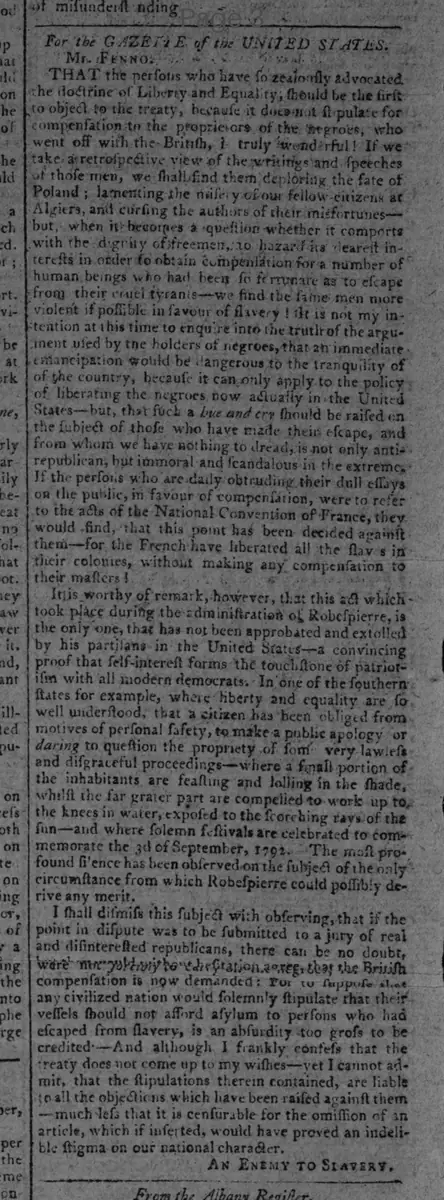
Mr. FENNO:
THAT the persons who have so zealously advocated the doctrine of Liberty and Equality; should be the first to object to the treaty, because it does not stipulate for compensation to the proprietors of the negroes, who went off with the British, is truly wonderful! If we take a retrospective view of the writings and speeches of those men, we shall find them deploring the fate of Poland; lamenting the misery of our fellow-citizens at Algiers, and cursing the authors of their misfortunes-- but, when it becomes a question whether it comports with the dignity of freemen, no hazard to its dearest interests in order to obtain compensation for a number of human beings who had been so fortunate as to escape from their cruel tyrants--we find the same men more violent if possible in favour of slavery! It is not my intention at this time to enquire into the truth of the argument used by the holders of negroes, that an immediate emancipation would be dangerous to the tranquility of the country, because it can only apply to the policy of liberating the negroes now actually in the United States--but, that such a hue and cry should be raised on the subject of those who have made their escape, and from whom we have nothing to dread, is not only anti-republican, but immoral and scandalous in the extreme. If the persons who are daily obtruding their dull essays on the public, in favour of compensation, were to refer to the acts of the National Convention of France, they would find, that this point has been decided against them--for the French have liberated all the slaves in their colonies, without making any compensation to their masters!
It is worthy of remark, however, that this act which took place during the administration of Robespierre, is the only one, that has not been approbated and extolled by his partisans in the United States--a convincing proof that self-interest forms the touchstone of patriotism with all modern democrats. In one of the southern states for example, where liberty and equality are so well understood, that a citizen has been obliged from motives of personal safety, to make a public apology for daring to question the propriety of one very lawless and disgraceful proceeding--where a small portion of the inhabitants are feasting and lashing in the shade, whilst the far greater part are compelled to work up to, the knees in water, exposed to the scorching rays of the sun--and where solemn festivals are celebrated to commemorate the 3d of September, 1792. The most profound silence has been observed on the subject of the only circumstance from which Robespierre could possibly derive any merit.
I shall dismiss this subject with observing, that if the point in dispute was to be submitted to a jury of real and disinterested republicans, there can be no doubt, were not policy wholly to hesitate to agree, that the British compensation is now demanded: for to suppose that any civilized nation would solemnly stipulate that their vessels should not afford asylum to persons who had escaped from slavery, is an absurdity too gross to be credited--And although I frankly confess that the treaty does not come up to my wishes--yet I cannot admit, that the stipulations therein contained, are liable to all the objections which have been raised against them --much less that it is censurable for the omission of an article, which if inserted, would have proved an indelible stigma on our national character.
An Enemy to Slavery,
What sub-type of article is it?
What themes does it cover?
What keywords are associated?
What entities or persons were involved?
Letter to Editor Details
Author
An Enemy To Slavery
Recipient
Mr. Fenno
Main Argument
advocates of liberty and equality hypocritically demand compensation for escaped slaves in the british treaty, which is anti-republican and immoral; the french liberated slaves without compensation, and such a stipulation would stain national character.
Notable Details