Thank you for visiting SNEWPapers!
Sign up free
New Hampshire Statesman And Concord Register
Concord, Merrimack County, New Hampshire
What is this article about?
R.D. Mussey, from Dartmouth College, proposes an improved method for teaching myology using oil-cleared skeletons painted with white ground and colored muscle attachment areas, paired with dried, painted muscle preparations in distinct colors. He claims it halves the learning labor compared to traditional dissections, based on three years of use.
Clipping
OCR Quality
Full Text
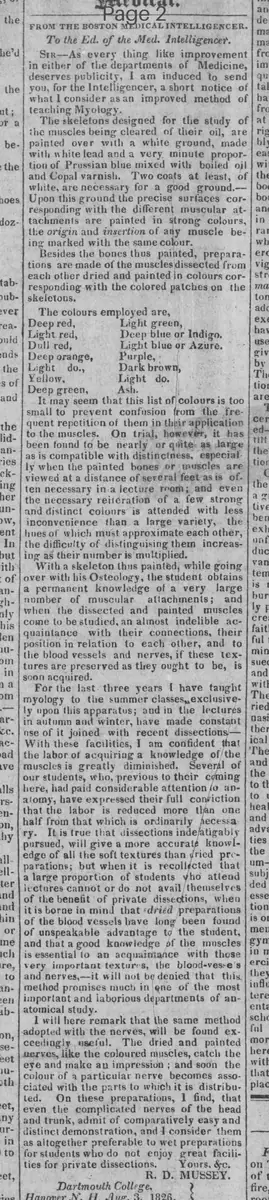
To the Ed. of the Med. Intelligencer.
SIR—As every thing like improvement in either of the departments of Medicine deserves publicity, I am induced to send you, for the Intelligencer, a short notice of what I consider as an improved method of teaching Myology.
The skeletons designed for the study of the muscles being cleared of their oil, are painted over with a white ground, made with white lead and a very minute proportion of Prussian blue mixed with boiled oil and Copal varnish. Two coats at least, of white, are necessary for a good ground.— Upon this ground the precise surfaces corresponding with the different muscular attachments are painted in strong colours, the origin and insertion of any muscle being marked with the same colour.
Besides the bones thus painted, preparations are made of the muscles dissected from each other dried and painted in colours corresponding with the colored patches on the skeletons.
The colours employed are,
Deep red,
Light green,
Light red,
Deep blue or Indigo.
Dull red,
Light blue or Azure.
Deep orange,
Purple,
Light do.,
Dark brown,
Yellow,
Light do.
Deep green,
Ash.
It may seem that this list of colours is too small to prevent confusion from the frequent repetition of them in their application to the muscles. On trial, however, it has been found to be nearly or quite as large as is compatible with distinctness, especially when the painted bones or muscles are viewed at a distance of several feet as is often necessary in a lecture room; and even the necessary reiteration of a few strong and distinct colours is attended with less inconvenience than a large variety, the hues of which must approximate each other, the difficulty of distinguishing them increasing as their number is multiplied.
With a skeleton thus painted, while going over with his Osteology, the student obtains a permanent knowledge of a very large number of muscular attachments; and when the dissected and painted muscles come to be studied, an almost indelible acquaintance with their connections, their position in relation to each other, and to the blood vessels and nerves, if these textures are preserved as they ought to be, is soon acquired.
For the last three years I have taught myology to the summer classes, exclusively upon this apparatus; and in the lectures in autumn and winter, have made constant use of it joined with recent dissections— With these facilities, I am confident that the labor of acquiring a knowledge of the muscles is greatly diminished. Several of our students, who, previous to their coming here, had paid considerable attention to anatomy, have expressed their full conviction that the labor is reduced more than one half from that which is ordinarily necessary. It is true that dissections indefatigably pursued, will give a more accurate knowledge of all the soft textures than dried preparations; but when it is recollected that a large proportion of students who attend lectures cannot or do not avail themselves of the benefit of private dissections, when it is borne in mind that dried preparations of the blood vessels have long been found of unspeakable advantage to the student, and that a good knowledge of the muscles is essential to an acquaintance with those very important textures, the blood-vessels and nerves,—it will not be denied that this method promises much in one of the most important and laborious departments of anatomical study.
I will here remark that the same method adopted with the nerves, will be found exceedingly useful. The dried and painted nerves, like the coloured muscles, catch the eye and make an impression: and soon the colour of a particular nerve becomes associated with the parts to which it is distributed. On these preparations, I find that even the complicated nerves of the head and trunk, admit of comparatively easy and distinct demonstration, and I consider them as altogether preferable to wet preparations for students who do not enjoy great facilities for private dissections.
Yours, &c.
R. D. MUSSEY.
Dartmouth College,
Hanover N. H Aug. 3. 1826.
What sub-type of article is it?
What themes does it cover?
What keywords are associated?
What entities or persons were involved?
Letter to Editor Details
Author
R. D. Mussey
Recipient
Ed. Of The Med. Intelligencer
Main Argument
an improved method of teaching myology involves painting skeletons with colored muscle attachments and using matching dried, painted muscle preparations, which significantly reduces the labor of learning anatomy compared to traditional dissections alone.
Notable Details