Thank you for visiting SNEWPapers!
Sign up free
National Gazette
Philadelphia, Philadelphia County, Pennsylvania
What is this article about?
In the U.S. House of Representatives on Nov. 21, Mr. Findley opposes referring public debt reduction to the Secretary of the Treasury, arguing it violates constitutional separation of powers and the House's duty to originate revenue plans independently.
Clipping
OCR Quality
Full Text
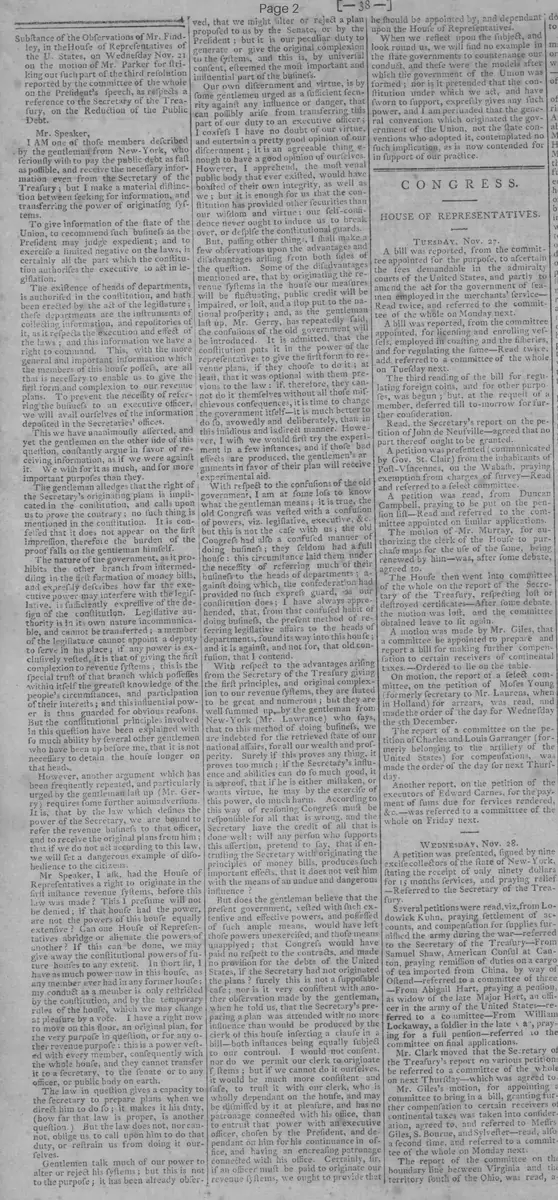
Mr. Speaker,
I AM one of those members described by the gentleman from New-York, who seriously wish to pay the public debt as fast as possible, and receive the necessary information even from the Secretary of the Treasury; but I make a material distinction between seeking for information, and transferring the power of originating systems.
To give information of the state of the Union, to recommend such business as the President may judge expedient; and to exercise a limited negative on the laws, is certainly all the part which the constitution authorizes the executive to act in legislation.
The existence of heads of departments, is authorized in the constitution, and hath been erected by the act of the legislature; these departments are the instruments of collecting information, and repositories of it, as it respects the execution and effect of the laws; and this information we have a right to command. This, with the more general and important information which the members of this house possess, are all that is necessary to enable us to give the first form and complexion to our revenue plans. To prevent the necessity of referring the business to an executive officer, we will avail ourselves of the information deposited in the Secretaries' offices.
This we have unanimously asserted, and yet the gentlemen on the other side of this question, constantly argue in favor of receiving information, as if we were against it. We wish for it as much, and for more important purposes than they.
The gentleman alleges that the right of the Secretary's originating plans is implicated in the constitution, and calls upon us to prove the contrary; no such thing is mentioned in the constitution. It is confessed that it does not appear on the first impression, therefore the burden of the proof falls on the gentleman himself.
The nature of the government, as it prohibits the other branch from intermeddling in the first formation of money bills, and expressly describes how far the executive power may interfere with the legislative, is sufficiently expressive of the design of the constitution. Legislative authority is in its own nature incommunicable, and cannot be transferred; a member of the legislature cannot appoint a deputy to serve in his place; if any power is exclusively vested, it is that of giving the first complexion to revenue systems, this is the special trust of that branch which possesses within itself the greatest knowledge of the people's circumstances, and participation of their interests; and this influential power is thus guarded for obvious reasons.
But the constitutional principles involved in this question have been explained with so much ability by several other gentlemen who have been up before me, that it is not necessary to detain the house longer on that head.
However, another argument which has been frequently repeated, and particularly urged by the gentleman last up (Mr. Gerry) requires some further animadversions.
It is, that by the law which defines the power of the Secretary, we are bound to refer the revenue business to that officer, and to receive the original plans from him: that if we do not act according to this law, we will set a dangerous example of disobedience to the citizens.
Mr. Speaker, I ask, had the House of Representatives a right to originate in the first instance revenue systems, before this law was made? This I presume will not be denied: if that house had the power, are not the powers of this house equally extensive? Can one House of Representatives abridge or alienate the powers of another? If this can be done, we may give away the constitutional powers of future houses to any extent. In short sir, I have as much power now in this house, as any member ever had in any former house: my conduct as a member is only restricted by the constitution, and by the temporary rules of the house, which we may change at pleasure by a vote. I have a right now to move on this floor, an original plan, for the very purpose in question, or for any other revenue purpose: this is a power vested with every member, consequently with the whole house, and they cannot transfer it to a secretary, to the senate or to any officer, or public body on earth.
The law in question gives a capacity to the secretary to prepare plans when we direct him to do so; it makes it his duty. (how far that law is proper, is another question.) But the law does not, nor cannot, oblige us to call upon him to do that duty, or restrain us from doing it ourselves.
Gentlemen talk much of our power to alter or reject his systems; but this is not to the purpose; it has been already observed, that we might alter or reject a plan proposed to us by the Senate, or by the President; but it is our peculiar duty to generate or give the original complexion to the systems, and this is, by universal consent, esteemed the most important and influential part of the business.
Our own discernment and virtue, is by some gentlemen urged as a sufficient security against any influence or danger, that can possibly arise from transferring this part of our duty to an executive officer; I confess I have no doubt of our virtue, discernment; it is an agreeable thing enough to have a good opinion of ourselves. However, I apprehend, the most venal public body that ever existed, would have boasted of their own integrity, as well as we; but it is enough for us that the constitution has provided other securities than our wisdom and virtue: our self-confidence never ought to induce us to break over, or despise the constitutional guards.
But, passing other things, I shall make a few observations upon the advantages and disadvantages arising from both sides of the question. Some of the disadvantages mentioned are, that by originating the revenue systems in the house our measures will be fluctuating, public credit will be impaired, or lost, and a stop put to the national prosperity; and, as the gentleman last up, Mr. Gerry, has repeatedly said, the confusions of the old government will be introduced. It is admitted, that the constitution puts it in the power of the representatives to give the first form to revenue plans, if they choose to do it; at least, that it was optional with them previous to the law: if, therefore, they cannot do it themselves without all those mischievous consequences, it is time to change the government itself—it is much better to do so, avowedly and deliberately, than in this insidious and indirect manner. However, I wish we would first try the experiment in a few instances, and if those bad effects are produced, the gentlemen's arguments in favor of their plan will receive experimental aid.
With respect to the confusions of the old government, I am at some loss to know what the gentleman means; it is true, the old Congress was vested with a confusion of powers, viz. legislative, executive, &c. but this is not the case with us; the old Congress had also a confused manner of doing business; they seldom had a full house: this circumstance laid them under the necessity of referring much of their business to the heads of departments; against doing which, the confederation had provided no such express guard, as our constitution does; I have always apprehended, that, from that confused habit of doing business, the present method of referring legislative affairs to the heads of departments, found its way into this house; and it is against, and not for, that old confusion, that I contend.
With respect to the advantages arising from the Secretary of the Treasury giving the first principles, and original complexion to our revenue systems, they are stated to be great and numerous; but they are well summed up, by the gentleman from New-York (Mr. Lawrence) who says, that to this method of doing business, we are indebted for the retrieved state of our national affairs, for all our wealth and prosperity. Surely if this proves any thing, it proves too much; if the Secretary's influence and abilities can do so much good, it is a proof, that if he is either mistaken, or wants virtue, he may by the exercise of this power, do much harm. According to this way of reasoning Congress must be responsible for all that is wrong, and the Secretary have the credit of all that is done well; will any person who supports this assertion, pretend to say, that if entrusting the Secretary with originating the principles of money bills, produces such important effects, that it does not vest him with the means of an undue and dangerous influence?
But does the gentleman believe that the present government, vested with such extensive and effective powers, and possessed of such ample means, would have left those powers unexercised, and those means unapplied; that Congress would have paid no respect to the contracts, and made no provision for the debts of the United States, if the Secretary had not originated the plans? surely this is not a supposable case; nor is it very consistent with another observation made by the gentleman, when he told us, that the Secretary's preparing a plan was attended with no more influence than would be produced by the clerk of this house inserting a clause in a bill—both instances being equally subject to our controul. I would not consent, nor do we permit our clerk to originate systems; but if we cannot do it ourselves, it would be much more consistent and safe, to trust it with our clerk, who is wholly dependant on the house, and may be dismissed by it at pleasure, and has no patronage connected with his office, than to entrust that power with an executive officer, chosen by the President, and dependant on him for his continuance in office, and having an increasing patronage connected with his office. Certainly, sir, if an officer must be paid to originate our revenue systems, we ought to provide that he should be appointed by, and dependant upon the House of Representatives.
When we reflect upon the subject, and look round us, we will find no example in the state governments to countenance our conduct, and these were the models after which this government of the Union was formed; nor is it pretended that the constitution under which we act, and have sworn to support, expressly gives any such power, and I am persuaded that the general convention which originated the government of the Union, not the state conventions who adopted it, contemplated no such implication, as is now contended for in support of our practice.
What sub-type of article is it?
What keywords are associated?
What entities or persons were involved?
Domestic News Details
Event Date
Wednesday Nov. 21
Key Persons
Event Details
Mr. Findley argues against Mr. Parker's motion to strike out the part of the resolution referring to the Secretary of the Treasury on reducing the public debt, emphasizing constitutional limits on executive involvement in originating revenue plans, the House's exclusive power to give the first form to such systems, and criticizing reliance on departmental information as potentially undermining legislative authority.