Thank you for visiting SNEWPapers!
Sign up free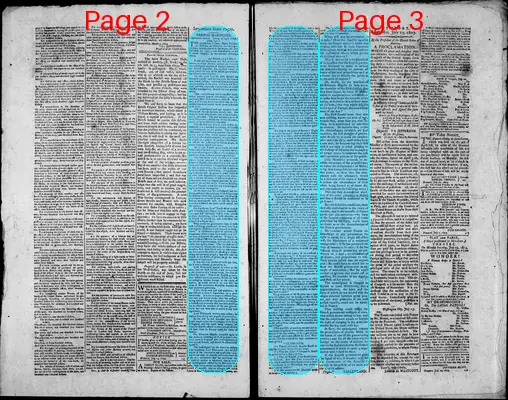
Rhode Island Republican
Newport, Newport County, Rhode Island
What is this article about?
French Manifesto from the Senate on May 13, 1803, denouncing British violations of the Treaty of Amiens, rejecting ultimatums on Malta and Lampedusa, and reaffirming France's commitment to peace while preparing for potential war signaled by Britain.
Merged-components note: Continuation of the French Manifesto article across pages 2-3; same topic and sequential reading order.
Clippings

1 of 2
OCR Quality
Full Text
FRENCH MANIFESTO.
Conservative Senate. Sitting of 23d Floreal (13th May.)
The counselors of State, Bigot, Pradt, Desiles and Fleurieu, orators of government, communicated to the Senate, the note addressed the 22d. to the Ambassadors of his Britannic Majesty, by the minister of foreign affairs.
23d Floreal (13th May.)
Under the important and serious circumstances, in which the two nations are situated, the undersigned minister of foreign relations of the French Republic, has received orders to place before the eyes of the British government, the following communication:
On the 17th Ventose, (8th March) his Britannic majesty made known to his Parliament by a special message, that formidable armaments were preparing in the ports of France and Holland, and that important negotiations, of which the issue was doubtful, divided the two governments.
This extraordinary and unexpected declaration, excited general astonishment; but the maritime affairs of France were manifest. England, and Europe, knew that there was no formidable armament either in the ports of France or Holland.
The undersigned need not repeat to Lord Whitworth all that has been already said. He demande, from what source had come information so unfounded. The personal discernment of Lord Whitworth; the loyalty of his character, could not for an instant be suspected.
The assertion that France made hostile armaments, was a manifest supposition, and which could not impose on any person. The natural effect would be to induce an opinion that it was merely a means that would support particular persons in their hostile opinions, and was eagerly caught as a pretext to produce disturbance, to inflame the passions of the British people, to excite distrust, hatred and alarm.
As to the English government, we must believe that if by false reports it has been led into error respecting the existence of armaments, it could not of the existence of the negotiations.
The ambassador of the republic at London was no sooner informed of the message of his Britannic Majesty, than astonished at that which announced the existence of a negotiation of which he had no knowledge, he addressed himself to Lord Hawkesbury immediately, and entertaining opinions that an appeal to arms founded on these false suppositions might cover a project to violate the treaty of Amiens in those articles which were not already executed, he presented to the minister of his Britannic Majesty, the 19th Ventose, (10th March) a note requiring from him an explanation.
At the same time the undersigned had orders to present to his excellency Lord Whitworth the motives which had determined the English government to authorize in the message two assertions, both equally false, to call the nation to arms and disturb the peace which united the two nations.
His Excellency Lord Hawkesbury replied 24th Ventose, (15th March,) to Gen. Andreossi, in a vague and absolutely hostile note, which far from elucidating, threw fresh obscurity on the subject of discussions, and diminished the prospect of a happy issue.
What could the government reply to such harsh and strange overtures? It could only be a great love for peace that could suppress its indignation. It cultivated a spirit of calmness and temperance, which would leave reason and justice time to oppose the passions. It was penetrated with an ideal that the numerous victims of the discord of governments, have no part in the insults that agitate them. That the millions of brave citizens, who in the vows of their heroic devotion, shed their blood only for their country, have never the desire of offending a neighboring and powerful people; that they take no interest in the tricks of pride, or in the vain pretences of supremacy.
It was not only penetrated with this idea, but it was constantly governed by it.
Lord Whitworth agreed to write to his court, that the First Consul could not consent to the violation of a solemn treaty, but that he wished for peace: That if the English government desired that a convention should be held for arranging matters foreign to the treaty of Amiens, he would accede to it, and that the terms of this convention should be founded on their reciprocal grievances.
These views were just and moderate: It was difficult to form a negotiation on a more liberal basis. It is not improper to observe here, that this was several weeks after the message, during which a difficult negotiation of a weighty interest and uncertain issue had been pending, and in which the ministers of the two governments had not been able to arrive at any true negotiation.
Lord Whitworth receives new orders; he presents successively two projects of convention.
By the first he had proposed that Malta should remain under the sovereignty of the King of England, and this clause being adopted, his Britannic Majesty offered to acknowledge all that had been done in Europe since the treaty of Amiens.
His Britannic Majesty promised again to take measures respecting all those persons in different parts of England who were employed in plots against France, and should be effectually repressed.
The undersigned has the honor to observe to his excellency Lord Whitworth, that the first project of the convention was a palpable violation of the treaty of Amiens, and overturned the basis of a convention that his excellency was charged to present to his court, that as to the acknowledgement offered by his Britannic Majesty, there was in reality no object to which they could be applied, that no changes had taken place in Europe since the treaty of Amiens, un- of the organization of the empire in which his Prussian Majesty had virtually concurred.
That the events relative to the political existence of Piedmont, the kingdom of Etruria, & the Italian and Ligurian republics had their date prior to the treaty of Amiens.
The undersigned observes finally, in short, that France requires on this point, neither the approbation nor the sanction (reconnaisance) of this Prussian Majesty.
The undersigned adds that, as to the Batavian Republic, it has been acknowledged by the King of England, since he has treated with her.
As to the criminal refugees at London and elsewhere, they were far from being repressed, they were treated and pensioned; & in the actual state of the negotiation, he could attach no importance to that article.
His excellency Lord Whitworth proposes a second convention: England demands that the civil government of Malta should be left with the Grand Master, British garrisons occupying the fortifications of the island: This was as impracticable and unheard of as the first project.
It was contrary to the treaty of Amiens, and consequently to the negotiation offered to the First Consul. He further had no right to place an order of Knights who were independent of all Europe, under the arbitrary jurisdiction of any government. It was an offence against the honor and religion of an order bound by all its principles to protect the honor and religion of all Europe.
Thus in all the steps of this negotiation, the government of the Republic was obliged to see in the British government only one will, one single object in view—that of not fulfilling the treaty of Amiens—that of retaining Malta, for the sole reason that Malta was convenient to her, and he called this acquisition a sufficient guarantee.
But what is the power of Europe? Ought it to be thus unequal? Shall one nation submit to the will of another, without discussion of its rights—without appeal to the principles of justice? What is that power to which France shall bend, placed as France has been in the course of this discussion: desired to subscribe conditions dictated at the moment of negotiation, and announced under clashing of arms; under menaces of war, under preparations of armaments—yet as proposals that accord with the rights and interests of the two nations?
Under a circumstance of some analogy; a nation comparatively feeble, not with respect to courage, but in the extent and population of its provinces, has dared to brave the English power, even menacing its exposed capital; to hazard its magazines, its only riches, the result of one hundred years peace, and of industrious economy, rather than subscribe to unjust conditions, similar to those this day proposed. The brave may perish—the colonies may be torn from us—but quel qu'inegale que fut la lutte, the honor of a generous nation can only be lost by her own voluntary act.
In the present discussion, policy speaks the language of honor. If the British government has its option, to conform or not conform to its engagements; if it can, in other treaties it has made, distinguish the spirit from the letter; if it admits mental restriction as authorized except in morals; if, in short, the convenience of England is to explain the end of its political treaties, where will be the end to the concessions which the latter herself to force from the weakness of France? What will be the measure of the sacrifices and the humiliations she will impose upon her? To-day the convenience of England exacts a guarantee against France, and England to garrison Malta! Again, the convenience of England wishes a guarantee against France, and England insists on Dunkirk! Thus, an English commandant shall give law to a country where waves the flag of France! To-morrow the convenience of England may demand a guarantee against the progress of French industry! and may propose a tariff de Commerce, to arrest its prosperity.
If we repair our ports; if we construct a mole; if we dig a canal; if by any encouragements, we improve our manufactures—they will demand that our mole shall be destroyed, that our canals shall be filled up, that our manufactures shall be ruined!—They will exact that France shall become impoverished and disarmed, in order to conform itself to the convenience of England, and to furnish a sufficient guarantee to her government!
When we consider the principles, or when we examine the consequences, we are equally struck with the injustice and scandal of these pretensions. Were we to submit it to an English jury, would they hesitate unanimously to reprobate such conduct?
The government of the Republic has a right to be astonished, that the British minister should think himself authorized to suppose her thus humbled.—How! has he thought that France is not in a profound slumber, and has forgot all her rights and her exploits?
Our provinces—are they less extensive, less populous? Are we not the same people who have sacrificed every thing to maintain their just interests? And if, after success we have shown great moderation, to what shall it be attributed, but to the justice of our cause, and the conviction of our strength?
The manifesto proceeds to recount and recapitulate the grounds of complaint, and circumstances of the negotiation, till he comes to copy the verbal ultimatum offered by Lord Whitworth, and for which eight days consideration were given.
ULTIMATUM.
1. That his Britannic Majesty should retain his troops in Malta for ten years.
2. That the island of Lampedusa should be ceded to him in full possession.
3. That the French troops should evacuate Holland. And that if no Convention on this basis should have been signed within a week, his excellency Lord Whitworth had orders to terminate his mission.
[On this ultimatum the Manifesto speaks in terms of great asperity.]
The undersigned makes bold to say that he never witnessed an example of an ultimatum proposed in terms so imperious.
What! will war be convenient to us only? Does the English minister think the French nation so feeble that treating with her in such important deliberations, he does not even observe the customary usages which govern all civilized nations?
Was it not under a consciousness of its injustice that the English government hesitated to make in writing her demand—hoping to prevent all traces of her real propositions and at a future day to deceive the public as to the cause of rupture?
Or, finally, do the ministers of his Britannic Majesty so little know the character of the First Consul, that they have hoped, by force of provocation to exasperate—to intimidate—to make him forget the interests of his nation, or to irritate him to some open act d'eclat that they might disguise to the eyes of Europe, the commencement of the war?
The First Consul more than any man existing, knows the evils of war, because that, more than any man existing, he is accustomed to calculate its chances. He believes that, under the circumstances in which we find ourselves, the first thought of government should be to avoid the catastrophes and evils which must spring from a new war; he believes that their first wish is not only to avoid yielding to the feelings of irritation but to employ all proper means to moderate the rash and imprudent passions of the people.
(The Manifesto proceeds to examine the nature of the propositions; to repeat the independence of Malta; to say that Lampedusa belongs to another power, to show that the compliance with the ultimatum would be a violation of the treaty of Amiens. It notices the circumstance of their assent being limited to 36 hours &c. and concludes in the following terms)
This day they demand the abolition of this order (alluding to Malta) and that it should be consented to in 36 hours!
But the definitive conditions, were they also conformable to the treaty of Amiens, and to the interests of France quelles leur sont contraires—the form of the demand—the term of 36 hours prescribed for the reply, could leave no doubt as to the determination of the French government.
No!—never would France acknowledge in any government the right to annul, by a single act of her will, the stipulations of a reciprocal engagement: If he has permitted the tone of menace to be used; if he has suffered them to present her an ultimatum of 7 days; an ultimatum of 36 hours; and propositions to conclude treaties before they are negotiated; he could have no object but to show the British government an example of moderation: But he could consent to nothing that would call in question, the interests of her dignity, and those of her power.
The undersigned is charged to declare to Lord Whitworth, that a communication, the spirit and the form of which do not accord with the usages observed between great powers, and with principles of the most perfect equality, could not be admitted in France.
That nothing could oblige the French government to dispose of countries which do not belong to her, and that she could never accede to England the right of violating in any point the treaties she has made with her.
In short, the undersigned repeats the propositions of placing Malta in the hands of one of the guaranteeing powers; and for all the other objects foreign to the treaty of Amiens, she renews the declaration, that the French government is ready to open a negotiation with respect to them.
If the English government gives the signal of war, it remains only for the government of the Republic to confide in the justice of its cause and the God of armies.
(Signed) TALLEYRAND.
What sub-type of article is it?
What keywords are associated?
What entities or persons were involved?
Where did it happen?
Foreign News Details
Primary Location
France
Event Date
23d Floreal (13th May)
Key Persons
Outcome
france rejects british ultimatums on malta, lampedusa, and holland evacuation; renews proposals for negotiation on matters outside treaty of amiens; warns of war if britain signals it.
Event Details
The French Senate communicates a note from the Minister of Foreign Affairs to British ambassadors, denouncing Britain's false claims of French armaments and negotiations, violations of the Treaty of Amiens, and imperious ultimatums demanding retention of Malta for 10 years, cession of Lampedusa, and French evacuation of Holland. France reaffirms commitment to peace but refuses concessions that undermine its dignity and treaties.