Thank you for visiting SNEWPapers!
Sign up free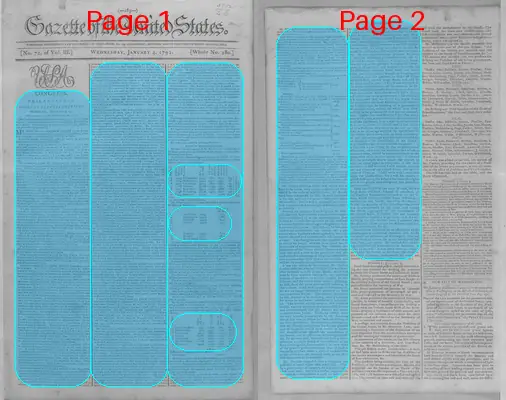
Gazette Of The United States
New York, New York County, New York
What is this article about?
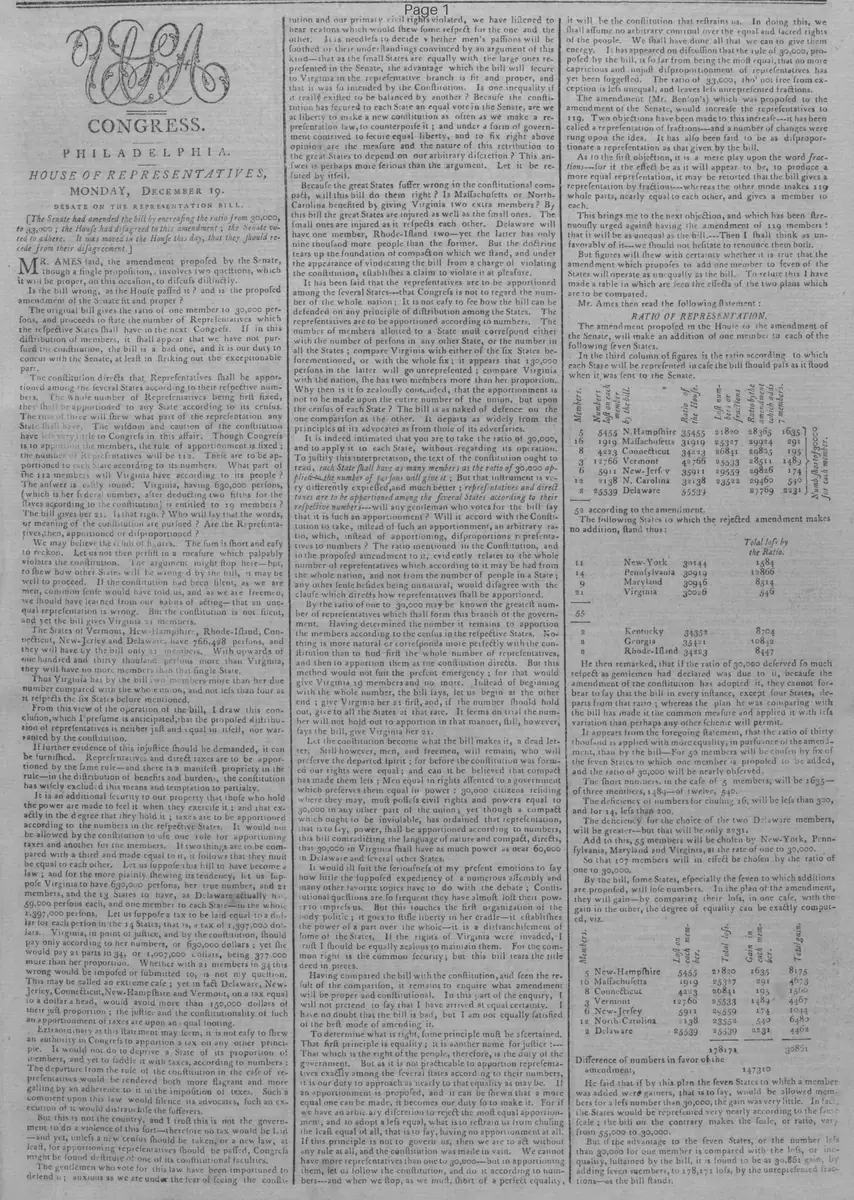
Debate in the U.S. House of Representatives in Philadelphia on December 19 over the Senate's amendment to the Representation Bill, increasing the ratio from 30,000 to 33,000 persons per representative. Mr. Ames argues against the original bill for violating constitutional apportionment equality, favoring a more equal amendment adding members to reach 119 total. Mr. Dayton and Mr. Venable respond on state interests and balance.
Merged-components note: Merged the congressional debate story across page 1 and 2, including the tables which are part of Mr. Ames' statement and calculations read during the debate. Sequential reading order and textual continuation confirm they form a single logical story component.
Clippings
1 of 2
OCR Quality
Full Text
PHILADELPHIA.
HOUSE OF REPRESENTATIVES,
MONDAY, DECEMBER 19.
DEBATE ON THE REPRESENTATION BILL.
The Senate had amended the bill by increasing the ratio from 30,000, to 33,000; the House had disagreed to this amendment; the Senate voted to adhere. It was moved in the House this day, that they should recede from their disagreement.
Mr. AMES said, the amendment proposed by the Senate, though a single proposition, involves two questions, which it will be proper, on this occasion, to discuss distinctly.
Is the bill wrong, as the House passed it? and is the proposed amendment of the Senate fit and proper?
The original bill gives the ratio of one member to 30,000 persons, and proceeds to state the number of Representatives which the respective States shall have in the next Congress. If in this distribution of members, it shall appear that we have not pursued the constitution, the bill is a bad one, and it is our duty to concur with the Senate, at least in striking out the exceptionable part.
The constitution directs that Representatives shall be apportioned among the several States according to their respective numbers. The whole number of Representatives being first fixed, they shall be apportioned to any State according to its census. The rule of three will show what part of the representation any State shall have. The wisdom and caution of the constitution have left very little to Congress in this affair. Though Congress is to apportion the members, the rule of apportionment is fixed; the number of Representatives will be 112. These are to be apportioned to each State according to its numbers. What part of the 112 members will Virginia have according to its people?
The answer is easily found. Virginia, having 630,000 persons, (which is her federal number, after deducting two fifths for the slaves according to the constitution) is entitled to 19 members? The bill gives her 21. Is that right? Who will say that the words, or meaning of the constitution are pursued? Are the Representatives, then, apportioned or disproportionated?
We may believe the result of figures. The sum is short and easy to reckon. Let us not then persist in a measure which palpably violates the constitution. The argument might stop here—but, to show how other States will be wronged by the bill, it may be well to proceed. If the constitution had been silent, as we are men, common sense would have told us, and as we are freemen, we should have learned from our habits of acting—that an unequal representation is wrong. But the constitution is not silent, and yet the bill gives Virginia 21 members.
The States of Vermont, New-Hampshire, Rhode-Island, Connecticut, New-Jersey and Delaware, have 766,428 persons, and they will have by the bill only 21 members. With upwards of one hundred and thirty thousand persons more than Virginia, they will have no more members than that single State.
Thus Virginia has by the bill two members more than her due number compared with the whole union, and not less than four as it respects the six States before mentioned.
From this view of the operation of the bill, I draw this conclusion, which I presume is anticipated, that the proposed distribution of representatives is neither just and equal in itself, nor warranted by the constitution.
If further evidence of this injustice should be demanded, it can be furnished. Representatives and direct taxes are to be apportioned by the same rule—and there is a manifest propriety in the rule—in the distribution of benefits and burdens, the constitution has wisely excluded this means and temptation to partiality.
It is an additional security to our property that those who hold the power are made to feel it when they exercise it; and that exactly in the degree that they hold it; taxes are to be apportioned according to the numbers in the respective States. It would not be allowed by the constitution to use one rule for apportioning taxes and another for the members. If two things are to be compared with a third and made equal to it, it follows that they must be equal to each other. Let us suppose this bill to have become a law; and for the more plainly showing its tendency, let us suppose Virginia to have 630,000 persons, her true number, and 21 members, and the 13 States to have, as Delaware actually has, 59,000 persons each, and one member to each State—in the whole 1,397,000 persons. Let us suppose a tax to be laid equal to a dollar for each person in the 14 States, that is, a tax of 1,397,000 dollars. Virginia, in point of justice, and by the constitution, should pay only according to her numbers, or 630,000 dollars; yet she would pay 21 parts in 34, or 1,007,000 dollars, being 377,000 more than her proportion. Whether with 21 members in 34 this wrong would be imposed or submitted to, is not my question.
This may be called an extreme case: yet in fact Delaware, New-Jersey, Connecticut, New-Hampshire and Vermont, on a tax equal to a dollar a head, would avoid more than 150,000 dollars of their just proportion; the justice and the constitutionality of such an apportionment of taxes are upon an equal footing.
Extraordinary as this statement may seem, it is not easy to show an authority in Congress to apportion a tax on any other principle. It would not do to deprive a State of its proportion of members, and yet to saddle it with taxes, according to numbers: The departure from the rule of the constitution in the case of representatives would be rendered both more flagrant and more galling by an adherence to it in the imposition of taxes. Such a comment upon this law would silence its advocates, such an execution of it would disfranchise the sufferers.
But this is not the country, and I trust this is not the government to do a violence of this sort—therefore no tax would be laid—and yet, unless a new census should be taken, or a new law, at least, for apportioning representatives should be passed, Congress might be found destitute of one of its constitutional faculties.
The gentlemen who vote for this law have been importuned to defend it; anxious as we are under the fear of seeing the constitution and our primary civil rights violated, we have listened to hear reasons which would show some respect for the one and the other. It is needless to decide whether men's passions will be soothed or their understandings convinced by an argument of this kind—that as the small States are equally with the large ones represented in the Senate, the advantage which the bill will secure to Virginia in the representative branch is fit and proper, and that it was so intended by the Constitution. Is one inequality if it really existed to be balanced by another? Because the constitution has secured to each State an equal vote in the Senate, are we at liberty to make a new constitution as often as we make a representation law, to counterpoise it; and under a form of government contrived to secure equal liberty, and to fix right above opinion are the measure and the nature of this retribution to the great States to depend on our arbitrary discretion? This answer is perhaps more serious than the argument. Let it be refuted by itself.
Because the great States suffer wrong in the constitutional compact, will this bill do them right? Is Massachusetts or North-Carolina benefited by giving Virginia two extra members? By this bill the great States are injured as well as the small ones. The small ones are injured as it respects each other. Delaware will have one member, Rhode-Island two—yet the latter has only nine thousand more people than the former. But the doctrine tears up the foundation of comparison which we stand, and under the appearance of vindicating the bill from a charge of violating the constitution, establishes a claim to violate it at pleasure.
It has been said that the representatives are to be apportioned among the several States---that Congress is not to regard the number of the whole nation; It is not easy to see how the bill can be defended on any principle of distribution among the States. The representatives are to be apportioned according to numbers. The number of members allotted to a State must correspond either with the number of persons in any other State, or the number in all the States; compare Virginia with either of the six States beforementioned, or with the whole six; it appears that 130,000 persons in the latter will go unrepresented; compare Virginia with the nation, she has two members more than her proportion.
Why then is it so zealously contended, that the apportionment is not to be made upon the entire number of the union, but upon the census of each State? The bill is as naked of defence on the one comparison as the other. It departs as widely from the principles of its advocates as from those of its adversaries.
It is indeed intimated that you are to take the ratio of 30,000, and to apply it to each State, without regarding its operation. To justify this interpretation, the text of the constitution ought to read, each State shall have as many members as the ratio of 30,000 applied to the number of persons will give it; But that instrument is very differently expressed, and much better; representatives and direct taxes are to be apportioned among the Several States according to their respective numbers---will any gentleman who votes for the bill say that it is such an apportionment? Will it accord with the Constitution to take, instead of such an apportionment, an arbitrary ratio, which, instead of apportioning, disproportionates representatives to numbers? The ratio mentioned in the Constitution, and in the proposed amendment to it, evidently relates to the whole number of representatives which according to it may be had from the whole nation, and not from the number of people in a State; any other sense besides being unnatural, would disagree with the clause which directs how representatives shall be apportioned.
By the ratio of one to 30,000 may be known the greatest number of representatives which shall form this branch of the government. Having determined the number it remains to apportion the members according to the census in the respective States. Nothing is more natural or corresponds more perfectly with the constitution than to find first the whole number of representatives, and then to apportion them as the constitution directs. But this method would not suit the present emergency; for that would give Virginia 19 members and no more. Instead of beginning with the whole number, the bill says, let us begin at the other end; give Virginia her 21 first, and, if the number should hold out, give to all the States at that rate. It seems on trial the number will not hold out to apportion in that manner, still, however, says the bill, give Virginia her 21.
Let the constitution become what the bill makes it, a dead letter. Still however, men, and freemen, will remain, who will preserve the departed spirit; for before the constitution was formed our rights were equal; and can it be believed that compact has made them less; Men equal in rights assented to a government which preserves them equal in power: 30,000 citizens residing where they may, must possess civil rights and powers equal to 30,000 in any other part of the union; yet though a compact which ought to be inviolable, has ordained that representation, that is to say, power, shall be apportioned according to numbers, this bill contradicting the language of nature and compact, directs, that 30,000 in Virginia shall have as much power as near 60,000 in Delaware and several other States.
It would ill suit the seriousness of my present emotions to say how little the supposed expediency of a numerous assembly and many other favorite topics have to do with the debate; Constitutional questions are so frequent they have almost lost their power to impress us. But this touches the first organization of the body politic; it goes to stifle liberty in her cradle—it establishes the power of a part over the whole—it is a disfranchisement of some of the States. If the rights of Virginia were invaded, I trust I should be equally zealous to maintain them. For the common right is the common security; but this bill tears the title deed in pieces.
Having compared the bill with the constitution, and seen the result of the comparison, it remains to enquire what amendment will be proper and constitutional. In this part of the enquiry, I will not pretend to say that I have arrived at equal certainty. I have no doubt that the bill is bad, but I am not equally satisfied of the best mode of amending it.
To determine what is right, some principle must be ascertained. That first principle is equality; it is another name for justice:—That which is the right of the people. therefore, is the duty of the government. But as it is not practicable to apportion representatives exactly among the several states according to their numbers, it is our duty to approach as nearly to that equality as may be. If an apportionment is proposed, and it can be shown that a more equal one can be made, it becomes our duty so to make it. For if we have an arbitrary discretion to reject the most equal apportionment, and to adopt a less equal, what is to restrain us from chusing the least equal of all, that is to say, having no apportionment at all.
If this principle is not to govern us, then we are to act without any rule at all, and the constitution was made in vain. We cannot have more representatives than one to 30,000—but in apportioning them, let us follow the constitution, and do it according to numbers—and when we stop, as we must, short of a perfect equality, it will be the constitution that restrains us. In doing this, we shall assume no arbitrary controul over the equal and sacred rights of the people. We shall have done all that we can to give them energy. It has appeared on discussion that the rule of 30,000, proposed by the bill, is so far from being the most equal, that no more capricious and unjust disproportionment of representatives has yet been suggested. The ratio of 33,000, tho' not free from exception is less unequal, and leaves less unrepresented fractions.
The amendment (Mr. Benson's) which was proposed to the amendment of the Senate, would increase the representatives to 119. Two objections have been made to this increase---it has been called a representation of fractions---and a number of changes were rung upon the idea. It has also been said to be as disproportionate a representation as that given by the bill.
As to the first objection, it is a mere play upon the word fractions---for if the effect be as it will appear to be, to produce a more equal representation, it may be retorted that the bill gives a representation by fractions---whereas the other mode makes 119 whole parts, nearly equal to each other, and gives a member to each.
This brings me to the next objection, and which has been strenuously urged against having the amendment of 119 members: that it will be as unequal as the bill.---Then I shall think as unfavorably of it---we should not hesitate to renounce them both.
But figures will show with certainty whether it is true that the amendment which proposes to add one member to seven of the States will operate as unequally as the bill. To refute this I have made a table in which are seen the effects of the two plans which are to be compared.
Mr. Ames then read the following statement:
RATIO OF REPRESENTATION.
The amendment proposed in the House to the amendment of the Senate, will make an addition of one member to each of the following seven States.
In the third column of figures is the ratio according to which each State will be represented in case the bill should pass as it stood when it was sent to the Senate.
52 according to the amendment.
The following States to which the rejected amendment makes no addition, stand thus:
He then remarked, that if the ratio of 30,000 deserved so much respect as gentlemen had declared was due to it, because the amendment of the constitution has adopted it, they cannot forbear to say that the bill in every instance, except four States, departs from that ratio; whereas the plan he was comparing with the bill has made it the common measure and applied it with less variation than perhaps any other scheme will permit.
It appears from the foregoing statement, that the ratio of thirty thousand is applied with more equality, in pursuance of the amendment, than by the bill—For 50 members will be chosen by six of the seven States to which one member is proposed to be added, and the ratio of 30,000 will be nearly observed.
The short numbers. in the case of 5 members, will be 1635— of three members, 1487—of twelve, 540.
The deficiency of numbers for chusing 16, will be less than 300, and for 14, less than 200.
The deficiency for the choice of the two Delaware members, will be greater—but that will be only 2231.
Add to this, 55 members will be chosen by New-York, Pennsylvania, Maryland and Virginia, at the rate of one to 30,000.
So that 107 members will in effect be chosen by the ratio of one to 30,000.
By the bill, some States, especially the seven to which additions are proposed, will lose numbers. In the plan of the amendment, they will gain—by comparing their loss, in one case, with the gain in the other, the degree of equality can be exactly computed. viz.
Difference of numbers in favor of the amendment,
147310
He said that if by this plan the seven States to which a member was added were gainers, that is to say, would be allowed members for a less number than 30,000, the gain was very little. In fact. the States would be represented very nearly according to the scale; the bill on the contrary makes the scale, or ratio, vary from 55,000 to 30,000
But if the advantage to the seven States, or the number less than 30,000 for one member is compared with the loss, or inequality, sustained by the bill, it is found to be as 90,86 gain, by adding seven members, to 178,171 loss, by the unrepresented fractions—as the bill stands.
| Members. | Numbers lost on each member by the bill. | Ratio of the House. | Lost numbers or fractions | Ratio by the amendment which adds 7 members. |
| 5 | 5455 N. Hampshire | 35455 | 21820 | 28365 1635 |
| 16 | 1919 Massachusetts | 31919 | 25327 | 29924 291 |
| 8 | 4223 Connecticut | 34223 | 26841 | 29805 195 |
| 3 | 12766 Vermont | 42766 | 35533 | 28511 1489 |
| 6 | 5911 New-Jersey | 35911 | 29559 | 29826 174 |
| 12 | 2138 N. Carolina | 32138 | 23522 | 29460 540 |
| 2 | 25539 Delaware | 55539 | 27769 2231 |
| Total loss by the Ratio. | |||
| 11 | New-York | 30144 | 1584 |
| 14 | Pennsylvania | 30919 | 12866 |
| 9 | Maryland | 30946 | 8514 |
| 21 | Virginia | 30026 | 546 |
| 55 | |||
| 2 | Kentucky | 34352 | 8704 |
| 2 | Georgia | 35421 | 10812 |
| 2 | Rhode-Island | 34223 | 8447 |
| Members. | Lost on each member. | Total loss. | Total in each member. | Total gain. | |
| 5 New-Hampshire | 5455 | 21820 | 1635 | 8175 | |
| 16 Massachusetts | 1919 | 25327 | 291 | 4673 | |
| 8 Connecticut | 4223 | 26841 | 195 | 1560 | |
| 3 Vermont | 12766 | 25533 | 1489 | 4467 | |
| 6 New-Jersey | 5911 | 29559 | 174 | 1044 | |
| 12 North-Carolina | 2138 | 23552 | 549 | 6480 | |
| 2 Delaware | 25539 | 25539 | 2231 | 4462 | |
| 178171 | 30851 |
Mr. Ames made a number of remarks to elucidate the statements and to show the unequal operation of the bill, and the fairness of the other plan.
After which he proceeded to show that the States of Kentucky, Georgia, and Rhode-Island would have the most cause to complain of fractions or unrepresented numbers. But he said the fractions of those three States amounted to the fractional number of one only of the seven States to which a member would be added.
If no nearer approach could be made towards an exactly equal proportion, no just objection could be urged against the plan on the part of Rhode-Island, Georgia, or Kentucky; for they would see the case could not be remedied. He then urged the equal operation of the plan between States having equal numbers, and contrasted the bill and the amendment which had been proposed in the House.
From aggregate loss and gain on the two modes of apportionment in the foregoing statements, see the comparison more particularly between particular States, viz.
Virginia has 21 members. The loss, that is, the excess of her numbers over 30,000, is 546.
Massachusetts has 15. New-Hampshire 4. The loss to those two states? One to be added on 19 members is 47147 to each. 2 or nearly as 2 to 1.
Members 21. On the other hand, the gain on 21 members, or numbers short of 30,000 for a member, is, for New-Hampshire and Massachusetts only, 12848.
New-York has 11 members—loss, or excess of? 1584.
North-Carolina, 11 members—loss >23552.
Whereas the gain to North-Carolina by adding? 6480 a member, will be only.
The difference between the loss and gain, or the balance against the bill, is 17072.
Maryland has nine members—her lost numbers 8514.
Connecticut has seven members—lost numbers by the bill are, 26841.
Vermont has two—lost numbers by the bill are, 52374 25533.
Difference against the bill is 43860.
By adding a member to Connecticut and Vermont, the numbers gained will be 6027.
Balance against the bill is 37733.
The question is—will the amendment adding one member to Massachusetts, and one to New-Hampshire, cure the error ?—
The answer appears by the statement, that Virginia will be as fully represented, according to numbers, as those two states, saving a difference of 13389, or within two-fifths of a member. In 42 members, that fractional inequality is scarcely an error.
In like manner, by adding a member to North-Carolina, the error or inequality compared with New-York is equal to a fourth part the number for one member—whereas, by the bill, Massachusetts and New-Hampshire will lose almost two members, and Virginia will gain two; a difference little short of four members.
Mr. Dayton said that if the vote which was about to be taken, were merely to determine what should be the ratio of representation, he should have been contented, he said, to have remained in his seat, and to have given a silent vote upon the occasion; but to him it appeared to involve in it a question and a principle of infinitely higher moment.
Two of the members from Virginia, Mr. Dayton observed, had candidly admitted the inequalities complained of in the apportionment prescribed by the bill sent up to the Senate, and had acknowledged the advantages to be given to their state over every other: they did not, he said, contradict the calculations, nor combat the arguments which had been offered against it, but they boldly claimed and exacted those advantages as a right. This being the case, the question was in reality no longer, whether 30 or 33,000 should be the rule of apportionment, but whether the legislature of the Union were in future to frame their acts with a view to the particular and almost exclusive advantage of Virginia, and to bend and accommodate their laws to the interests and will of the people or representatives of that state.
It was now also to be determined, Mr. Dayton further observed, whether Pennsylvania was hereafter destined to hold in her hands, as she had been in some measure used to do, the political balance of the states, to be the umpire in our disputes, and the centre of our union.—Judging, he said, from the votes upon record relating to this business, and from some other circumstances, she was no longer intended or qualified to hold that important station. The ancient prophecy, he said, seemed to be verifying among a people for whom he had never considered it as intended. The saviour of this country, the political Shiloh, was now among us, and universally known and acknowledged, and the sceptre was about to depart from Judah. These, he added, were the well known preparatives to the summons which was soon to follow for their assembling at the New-Jerusalem. He concluded by saying, that not Pennsylvania alone, but far the greatest part of the union would have reason to repent the determination against the amendment of the Senate, and of adherence to the original bill.
He, for his own part, believed that such a determination not only struck at the existence of the state sovereignties, but reached to the very vitals of the general government, and that it must eventually produce either a general consolidation of the union into one national mass, or an absolute separation of its members.
Mr. Venable supposed that a Virginian was possessed of equal rights with other men; if this be a government of compact, he has equal rights with other men; but is it a reason, that because Virginia has relinquished a part of her rights when this compact was forming, that she should not now hold what she has not resigned? The dispute on the ratio of representation does not affect Virginia; for whatever ratio may be adopted, her representation must always be complete: whether this be a consolidated or federal government, Virginia will have her full proportion in every case except one, that is, in case the ratio should be reduced to a less number than one member; so that, upon whatever grounds we take it, whether fractional or constitutional, the result will be nearly the same. Calculations therefore are out of the question, and after all the arguments of northern and southern interests, of the differences between small states and large states, the comparison is brought to Virginia and Delaware, and the question to strike off even members from the five large states, and add to the seven smaller ones—Thus is one-sixteenth of the whole representation of the union to be deducted unconstitutionally from one part, & given away to another, which has already more than a just proportion in the government: for although it is contended that we should not argue from the proportion the small states bear in the Senate, yet I hold it fair, in speaking of a government of representation, to take the whole into view, and not to be governed by such partial comparisons. Under this consideration I say, that every man in Virginia, as represented in the two branches of the legislature, is to a man in Delaware only as one to eleven and one half, and in the election of a President only as one to one and an half.
This is an advantage enjoyed by individuals in the smaller states more than by those in the larger, and this advantage would be still increased by an adoption of the amendment of the Senate:
Is it therefore just to increase this inequality? Is it fair that a man living in the neighbourhood of another, with only the boundary line of a state between them, should be represented only in the proportion of one to eleven and an half? I contend that the principle which comes the nearest to hold out equal rights to every man, is the most proper one, and one that I will always contend for as a citizen of the United States, and as a citizen of Virginia. I shall never wish to encroach upon the constitution, but I will be equally against destroying the balance between the rights which the people have delegated, and those they have retained.
Take the subject in any point of view. the five large states will send, suppose 81 members. to the House of Representatives, and 10 to the Senate, whilst the nine smaller states will have 31 members in this House, and 18 in the Senate:
so that the majority of the representation in the one is overpowered in the other, and taking the whole aggregate of the inhabitants of the United States, if divided into the majority contained in those five large states, and the minority in the nine smaller ones, it appears that the minority of the people can dictate to the majority in elections, &c. &c.
Government is formed by an association of the people upon principles of equality, and whilst we admit the argument of sovereignty retained to the states in Senate, let us not lose sight of justice, right, and equity. He concluded by declaring himself of the same opinion as formerly, in favor of the bill; and as there were no reasons offered by the Senate, or for them, that could induce him to change, consequently he could not recede from his opinion. (To be continued.)
What sub-type of article is it?
What themes does it cover?
What keywords are associated?
What entities or persons were involved?
Where did it happen?
Story Details
Key Persons
Location
Philadelphia
Event Date
Monday, December 19
Story Details
Debate on whether the House should recede from disagreement with Senate's amendment to increase representation ratio to 33,000; Ames argues original bill unconstitutionally favors Virginia, proposes amendment to 119 members for equality; Dayton warns of Virginia dominance; Venable defends Virginia's rights and equal representation principles.