Thank you for visiting SNEWPapers!
Sign up free
Editorial
March 11, 1948
Marion Progress
Marion, Mcdowell County, North Carolina
What is this article about?
Editorial critiques President Truman's proposal for 10 million new dwellings and 100,000 annual low-rent public housing units, questioning urban bias in allocation and advocating for inclusion of rural low-income farmers and workers in federal housing aid.
Clipping
OCR Quality
98%
Excellent
Full Text
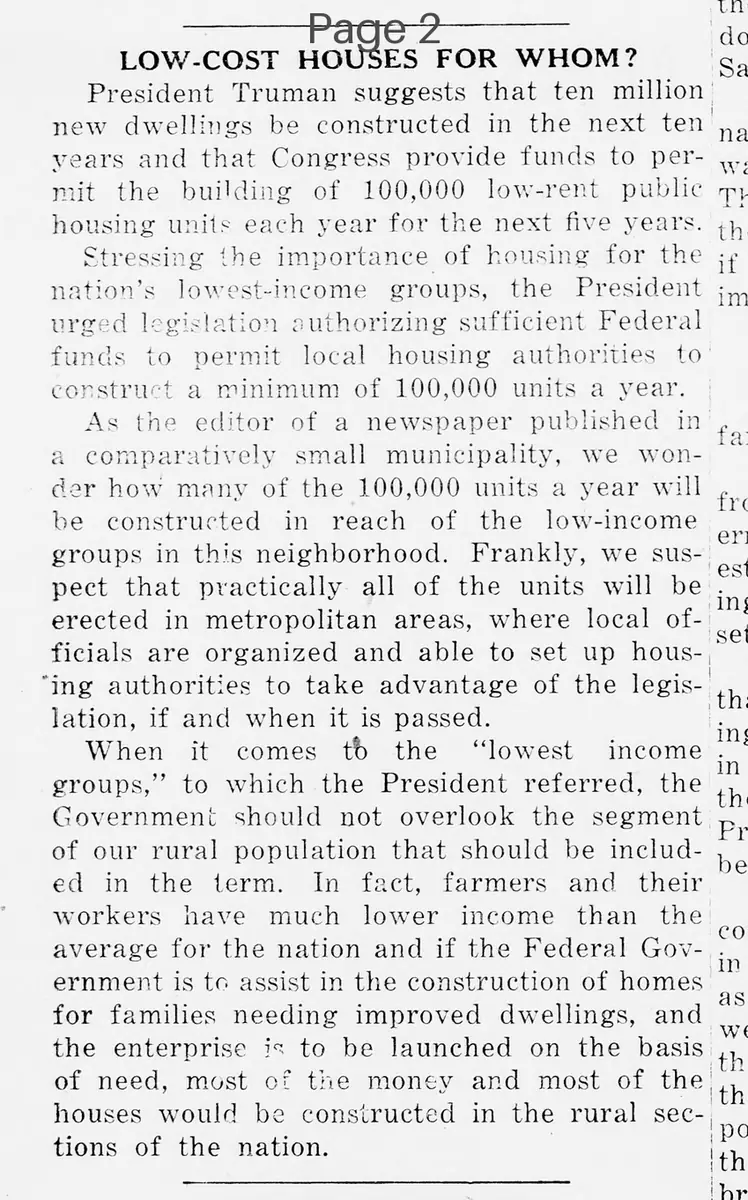
LOW-COST HOUSES FOR WHOM?
President Truman suggests that ten million new dwellings be constructed in the next ten years and that Congress provide funds to permit the building of 100,000 low-rent public housing units each year for the next five years.
Stressing the importance of housing for the nation's lowest-income groups, the President urged legislation authorizing sufficient Federal funds to permit local housing authorities to construct a minimum of 100,000 units a year.
As the editor of a newspaper published in a comparatively small municipality, we wonder how many of the 100,000 units a year will be constructed in reach of the low-income groups in this neighborhood. Frankly, we suspect that practically all of the units will be erected in metropolitan areas, where local officials are organized and able to set up housing authorities to take advantage of the legislation, if and when it is passed.
When it comes to the "lowest income groups," to which the President referred, the Government should not overlook the segment of our rural population that should be included in the term. In fact, farmers and their workers have much lower income than the average for the nation and if the Federal Government is to assist in the construction of homes for families needing improved dwellings, and the enterprise is to be launched on the basis of need, most of the money and most of the houses would be constructed in the rural sections of the nation.
President Truman suggests that ten million new dwellings be constructed in the next ten years and that Congress provide funds to permit the building of 100,000 low-rent public housing units each year for the next five years.
Stressing the importance of housing for the nation's lowest-income groups, the President urged legislation authorizing sufficient Federal funds to permit local housing authorities to construct a minimum of 100,000 units a year.
As the editor of a newspaper published in a comparatively small municipality, we wonder how many of the 100,000 units a year will be constructed in reach of the low-income groups in this neighborhood. Frankly, we suspect that practically all of the units will be erected in metropolitan areas, where local officials are organized and able to set up housing authorities to take advantage of the legislation, if and when it is passed.
When it comes to the "lowest income groups," to which the President referred, the Government should not overlook the segment of our rural population that should be included in the term. In fact, farmers and their workers have much lower income than the average for the nation and if the Federal Government is to assist in the construction of homes for families needing improved dwellings, and the enterprise is to be launched on the basis of need, most of the money and most of the houses would be constructed in the rural sections of the nation.
What sub-type of article is it?
Economic Policy
Infrastructure
Social Reform
What keywords are associated?
Low Cost Housing
Public Housing
Rural Housing
Truman Proposal
Federal Funds
Low Income Groups
Urban Bias
What entities or persons were involved?
President Truman
Congress
Local Housing Authorities
Farmers And Rural Workers
Editorial Details
Primary Topic
Federal Low Rent Public Housing Allocation Favoring Rural Areas
Stance / Tone
Skeptical Of Urban Bias, Advocating Rural Inclusion
Key Figures
President Truman
Congress
Local Housing Authorities
Farmers And Rural Workers
Key Arguments
Truman Proposes 10 Million New Dwellings In 10 Years
100,000 Low Rent Units Annually For 5 Years Via Federal Funds
Suspected Urban Metropolitan Areas Will Receive Most Units
Rural Low Income Groups Like Farmers Overlooked
Housing Aid Should Prioritize Need, Directing Most To Rural Sections