Thank you for visiting SNEWPapers!
Sign up free
Daily Richmond Whig
Richmond, Virginia
What is this article about?
Detailed description of the Regency of Algiers' natural resources, including fertile soil, abundant vegetation, minerals like lead and salt, diverse fruits, grains, livestock, and wildlife, highlighting its productivity compared to neighboring regions.
Merged-components note: Merged as the second component continues the article on the natural resources, population, and tribes of Algiers from the first; relabeled the second from 'story' to 'foreign_news' to match the overall content.
Clippings
1 of 2
OCR Quality
Full Text
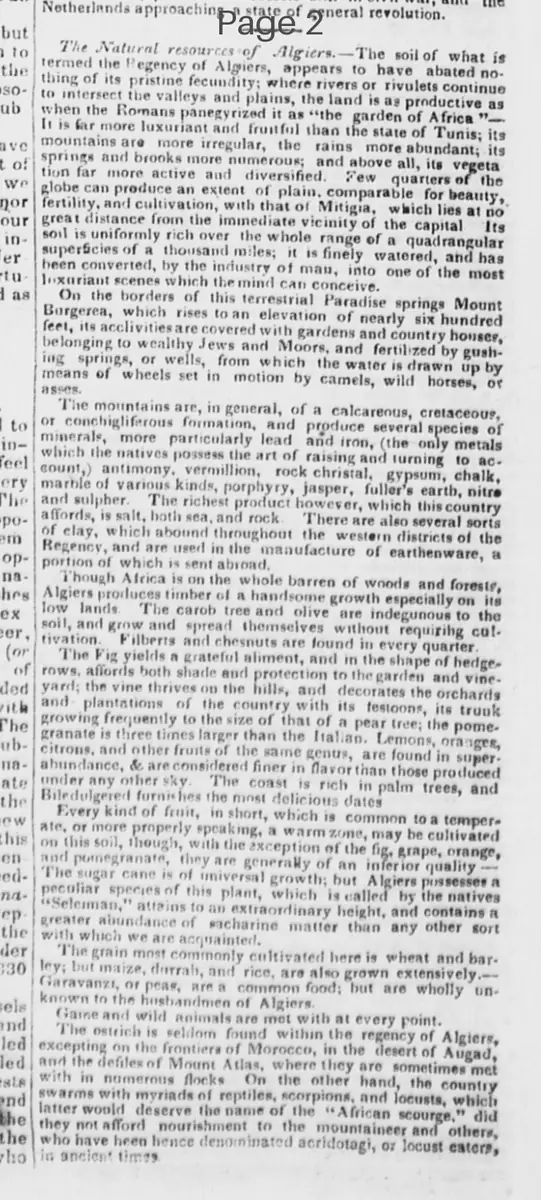
On the borders of this terrestrial Paradise springs Mount Bourjerea, which rises to an elevation of nearly six hundred feet, its acclivities are covered with gardens and country houses, belonging to wealthy Jews and Moors, and fertilized by gushing springs, or wells, from which the water is drawn up by means of wheels set in motion by camels, wild horses, or asses.
The mountains are, in general, of a calcareous, cretaceous, or conchiferous formation, and produce several species of minerals, more particularly lead and iron, (the only metals which the natives possess the art of raising and turning to account,) antimony, vermillion, rock crystal, gypsum, chalk, marble of various kinds, porphyry, jasper, fuller's earth, nitre and sulphur. The richest product however, which this country affords, is salt, both sea, and rock. There are also several sorts of clay, which abound throughout the western districts of the Regency, and are used in the manufacture of earthenware, a portion of which is sent abroad.
Though Africa is on the whole barren of woods and forests, Algiers produces timber of a handsome growth especially on its low lands. The carob tree and olive are indigenous to the soil, and grow and spread themselves without requiring cultivation. Filberts and chesnuts are found in every quarter. The Fig yields a grateful aliment, and in the shape of hedge rows, affords both shade and protection to the garden and vineyard; the vine thrives on the hills, and decorates the orchards and plantations of the country with its festoons, its trunk growing frequently to the size of that of a pear tree; the pomegranate is three times larger than the Italian. Lemons, oranges, citrons, and other fruits of the same genus, are found in super abundance, & are considered finer in flavor than those produced under any other sky. The coast is rich in palm trees, and Biledulgered furnishes the most delicious dates.
Every kind of fruit, in short, which is common to a temperate, or more properly speaking, a warm zone, may be cultivated on this soil, though, with the exception of the fig, grape, orange, and pomegranate, they are generally of an inferior quality—The sugar cane is of universal growth; but Algiers possesses a peculiar species of this plant, which is called by the natives 'Seleuman,' attains to an extraordinary height, and contains a greater abundance of saccharine matter than any other sort with which we are acquainted.
The grain most commonly cultivated here is wheat and barley; but maize, durra, and rice, are also grown extensively.—Garavance, or peas, are a common food; but are wholly unknown to the husbandmen of Algiers.
Game and wild animals are met with at every point. The ostrich is seldom found within the regency of Algiers, excepting on the frontiers of Morocco, in the desert of Augad, and the defiles of Mount Atlas, where they are sometimes met with in numerous flocks. On the other hand, the country swarms with myriads of reptiles, scorpions, and locusts, which latter would deserve the name of the 'African scourge,' did they not afford nourishment to the mountaineer and others, who have been hence denominated acridophagi, or locust eaters, in ancient times.
The Arabian, Moorish and Amaghhuan tribes, who constitute the internal population of this regency live principally in pastoral state, their chief wealth consists in flocks and herds; and every province being full of pastures of the most extensive descriptions, they are rich in all kinds of domestic animals.— horses, oxen, camels, asses, mules, cattle, goats, &c. The Barbary horse stands in high repute on his native soil, competing with, if not surpassing the Arabian, in beauty and swiftness: though the Moor is, after all, but a negligent groom, and the choicest breed is consequently becoming scarce. Cattle are small in size, the cow yields but a scanty supply of milk, as compared with her European sisterhood, and runs dry as soon as she looses her calf. Algiers is, in common with Morocco, the native country of the famous Merino sheep; and the breed which has the large broad tail, is much more numerous here than in any other of the Barbary states. The Algerine ass is pre-eminently large and handsome: nor is it a matter of surprise, that a country which produces so fine a race of horses and asses, should possess an unrivalled breed of mules, a breed capable of carrying heavier burthens, and enduring greater fatigue than any other. The steady and elongated pace of these animals is given to them by keeping their fore legs tied for considerable time together, and suspending a weight to the pasterns of their hinder legs.— Balt. Amer.
What sub-type of article is it?
What keywords are associated?
Where did it happen?
Foreign News Details
Primary Location
Regency Of Algiers
Event Details
The Regency of Algiers maintains fertile soil and abundant natural resources, including productive plains like Mitidja, minerals such as lead, iron, and salt, diverse vegetation with fruits like olives, figs, and a unique sugar cane variety, grains including wheat and barley, wildlife, and livestock like Barbary horses and Merino sheep.