Thank you for visiting SNEWPapers!
Sign up free
Morning Star
Limerick, York County, Maine
What is this article about?
The Boston Atlas offers a critical description of Texas, contrasting with land speculators' views. It describes much of the territory as desert, limited habitable areas prone to fevers, poor crop yields, and suitability mainly for livestock breeding on prairies.
Clipping
OCR Quality
Full Text
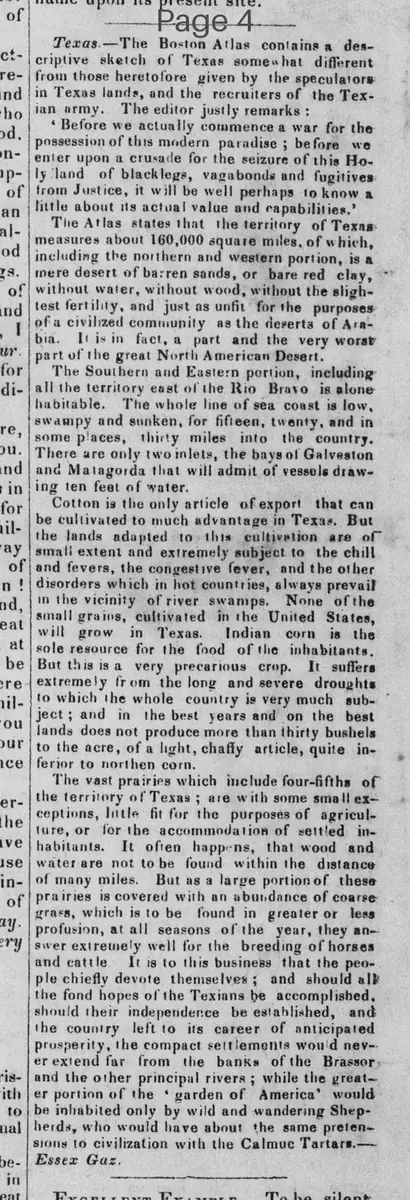
The Boston Atlas contains a descriptive sketch of Texas somewhat different from those heretofore given by the speculators in Texas lands, and the recruiters of the Texian army. The editor justly remarks:
Before we actually commence a war for the possession of this modern paradise; before we enter upon a crusade for the seizure of this Holy land of blacklegs, vagabonds and fugitives from Justice, it will be well perhaps to know a little about its actual value and capabilities.
The Atlas states that the territory of Texas measures about 160,000 square miles, of which, including the northern and western portion, is a mere desert of barren sands, or bare red clay, without water, without wood, without the slightest fertility, and just as unfit for the purposes of a civilized community as the deserts of Arabia. It is in fact, a part and the very worst part of the great North American Desert.
The Southern and Eastern portion, including all the territory east of the Rio Bravo is alone habitable. The whole line of sea coast is low, swampy and sunken, or fifteen, twenty, and in some places, thirty miles into the country. There are only two inlets, the bays of Galveston and Matagorda that will admit of vessels drawing ten feet of water.
Cotton is the only article of export that can be cultivated to much advantage in Texas. But the lands adapted to this cultivation are of small extent and extremely subject to the chill and fevers, the congestive fever, and the other disorders which in hot countries, always prevail in the vicinity of river swamps. None of the small grains, cultivated in the United States, will grow in Texas. Indian corn is the sole resource for the food of the inhabitants. But this is a very precarious crop. It suffers extremely from the long and severe droughts to which the whole country is very much subject; and in the best years and on the best lands does not produce more than thirty bushels to the acre, of a light, chaffy article, quite inferior to northern corn.
The vast prairies which include four-fifths of the territory of Texas; are with some small exceptions, little fit for the purposes of agriculture, or for the accommodation of settled inhabitants. It often happens, that wood and water are not to be found within the distance of many miles. But as a large portion of these prairies is covered with an abundance of coarse grass, which is to be found in greater or less profusion, at all seasons of the year, they answer extremely well for the breeding of horses and cattle It is to this business that the people chiefly devote themselves; and should all the fond hopes of the Texians be accomplished, should their independence be established, and the country left to its career of anticipated prosperity, the compact settlements would never extend far from the banks of the Brazos and the other principal rivers; while the greater portion of the garden of America' would be inhabited only by wild and wandering Shepherds, who would have about the same pretensions to civilization with the Calmuc Tartars.--Essex Gaz.
What sub-type of article is it?
What keywords are associated?
Where did it happen?
Domestic News Details
Primary Location
Texas
Event Details
The Boston Atlas provides a descriptive sketch of Texas, noting its 160,000 square miles mostly desert in the north and west, habitable only in the south and east east of the Rio Bravo, with limited ports at Galveston and Matagorda bays. Cotton is the main export but lands are fever-prone; no small grains grow, Indian corn yields poorly due to droughts. Prairies suit livestock breeding, limiting settlements to river banks, with inhabitants like wandering shepherds.