Thank you for visiting SNEWPapers!
Sign up free
Richmond Enquirer
Richmond, Richmond County, Virginia
What is this article about?
Debates in the House of Commons on June 22 and 26 regarding Queen Caroline's name in the liturgy, the green bag charges, and proposals for inquiry or trial, with divisions supporting resolutions against further secret proceedings.
Clipping
OCR Quality
Full Text
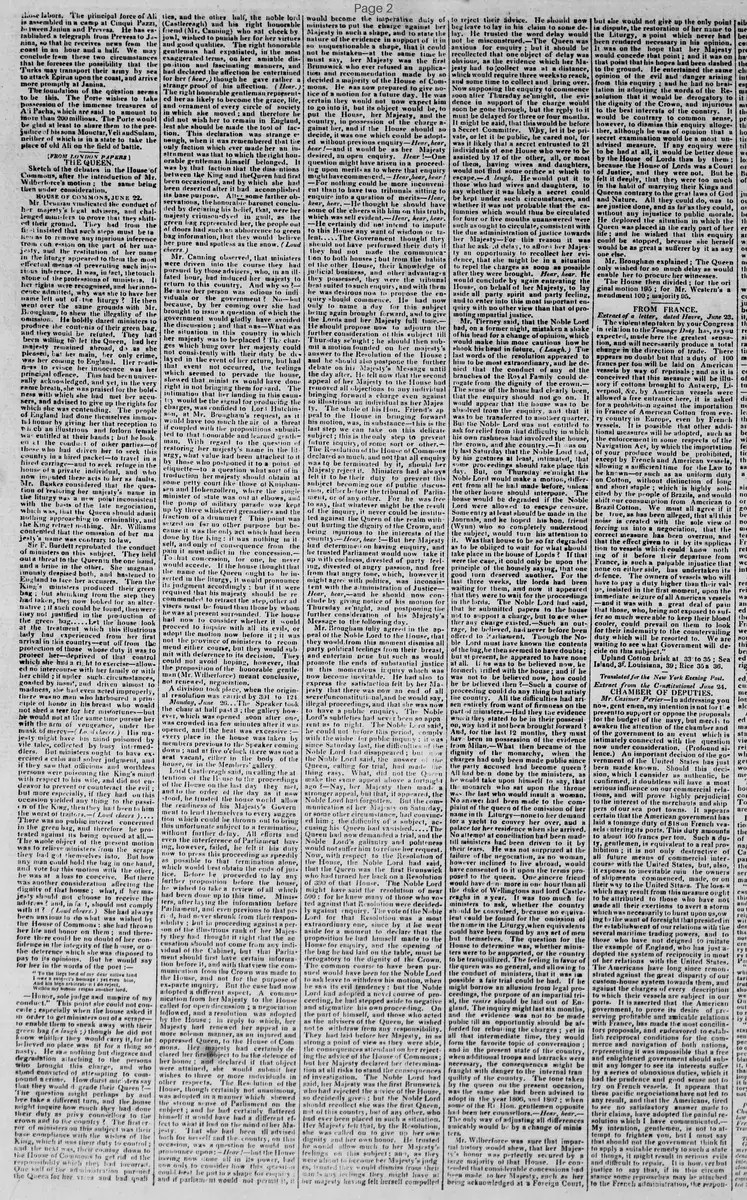
THE QUEEN.
Sketch of the debates in the House of Commons, after the introduction of Mr. Wilberforce's motion; the same being then under consideration.
HOUSE OF COMMONS, JUNE 22.
Mr. Denman vindicated the conduct of her majesty's legal advisers, and challenged ministers to prove that they shifted their ground. They had from the first insisted that such steps must be taken as to remove any injurious inference from concession on the part of her majesty, and the restitution of her name in the liturgy appeared to them the most effectual means of preventing such injurious inference. It was, in fact, the touchstone of the professions of ministers. If her rights were recognised, and her innocence admitted, why was she to have her name left out of the liturgy? He then went over the same grounds with Mr. Brougham, to shew the illegality of the omission. He boldly dared ministers to produce the contents of their green bag, and they would be refuted. They had been willing to let the Queen, had her majesty remained abroad, do as she pleased, but her main, her only crime, was her coming to England. Her readiness to evince her innocence was her principal offence. This had been universally acknowledged, and yet, in the very same breath, she was praised for the boldness with which she had met her accusers, and advised to give up the rights for which she was contending. The people of England had done themselves immortal honor by giving her that reception to which an illustrious and forlorn female was entitled at their hands: but he looked at the conduct of other parties—of those who had driven her to seek this country in a hired packet—to travel in a hired carriage—and to seek refuge in the house of a private individual, and who now imputed these acts to her as faults.
Mr. Bankes considered that the question of restoring her majesty's name in the liturgy was a new point inconsistent with the basis of the late negociation, which was, that the Queen should admit nothing approaching to criminality, and the King retract nothing. Mr. Williams contended that the omission of her majesty's name was contrary to law.
Sir F. Burdett reprobated the conduct of ministers on this subject. They held out a threat to the Queen on the one hand, and a bribe on the other. She magnanimously despised both, and hastened to England to face her accusers. Then the King's ministers produced their green bag: but shrinking from the step they had taken, they now looked for an alternative; if such could be found, then were they not justified in the production of the green bag.....Let this house look at the treatment which this illustrious lady has experienced from her first arrival in this country—cut off from the protection of those whose duty it was to protect her—deprived of that control which she had a right to exercise—allowed no intercourse with her family or with her child; if under such circumstances, goaded by insult, and driven almost to madness, she had even acted improperly, there was no man who harboured a principle of honor in his breast who would not shed a tear for her misfortune—but he would not at the same time pursue her with the arrow of vengeance, under the mask of mercy—(Loud cheers.) His majesty might have his mind poisoned by vile tales, collected by busy intermeddlers. But ministers ought to have exercised a calm and sober judgment, and if they saw that officious and worthless persons were poisoning the King's mind with respect to his wife, and did not endeavor to prevent or counteract the evil; but more especially, if they had on this occasion yielded anything to the passion of the King, then they had been to him the worst of traitors—(Loud cheers).... There was no public interest concerned in the green bag, and therefore he protested against its being opened at all.— The whole object of the present motion was to relieve ministers from the scrape they had got themselves into. But how any man could hold the bag in one hand, and vote for this motion with the other, he was at a loss to conceive. But there was another consideration affecting the dignity of that house: what, if her majesty should not choose to receive the address? and, in fact, should not comply with it? (Loud cheers.) She had always been anxious to do what was wished by the House of Commons: she had thrown her life and honor on them: and therefore there could be no doubt of her confidence in the integrity of the house, or of the deference which she was disposed to pay to its opinions. But he would say for her in the words of the poet: -
"To the liege lord of my dear native land I owe a subject's homage: yet even him, And his high arbitration I do reject, Within my bosom reigns another lord. -Honor, sole judge and umpire of my conduct."'This point she could not concede: especially when the house asked it in order to get ministers out of a scrape- to enable them to sneak away with their green bag (a laugh:) though he did not know whither they would carry it, for he believed no place was fit for a thing so nasty. He saw nothing but disgrace and degradation attaching to the persons who brought this charge, and who stood convicted of attempting to compound a crime. How durst ministers say that they would degrade their Queen?- The question might perhaps by and bye take a different turn, and the house might inquire how much they had done their duty as privy counsellors to the crown and to the country? The first error of ministers on this subject was their base compliance with the wishes of the King, which it was their duty to control: had the next was, their coming down to the House of Commons to get rid of the responsibility which they had incurred. One half of the administration pursued the Queen for her vices and bad qualities, and the other half, the noble lord (Castlereagh) and his right honorable friend (Mr. Canning) who sat cheek by jowl, wished to punish her for her virtues and good qualities. The right honorable gentleman had expatiated, in the most exaggerated terms, on her amiable disposition and fascinating manners, and had declared the affection he entertained for her (hear,) though he gave rather a strange proof of his affection. (Hear.) The right honorable gentleman represented her as likely to become the grace, life, and ornament of every circle of society in which she moved: and therefore he did not wish her to remain in England, lest she should be made the tool of faction. This declaration was strange enough, when it was remembered that the only faction which ever made her an instrument was that to which the right honorable gentleman himself belonged. It was by that faction that the dissensions between the King and the Queen had first been occasioned, and by which she had been deserted after it had accomplished its base purpose. After some further observations, the honorable baronet concluded by declaring his belief, that, were her majesty crimson-dyed in guilt, as the green bag represented her, the people out of doors had such an abhorrence to green bag information, that they would believe her pure and spotless as the snow. (Loud cheers.)
Mr. Canning observed, that ministers were driven into the course they had pursued by those advisers, who, in an ill-fated hour, had induced her majesty to return to this country. And why so?- Because her person was odious to individuals or the government? No-but because, by her coming over she had brought to issue a question of which the government would gladly have avoided the discussion; and that was—What was the situation in this country in which her majesty was to be placed? The charges which hung over her majesty could not consistently with their duty be delayed in the event of her return, but had that event not occurred, the feelings which seemed to pervade the house, shewed that ministers would have done right in not bringing them forward. The intimation that her landing in this country would be the signal for producing the charges, was confided to Lord Hutchinson, at Mr. Brougham's request, as it would have too much the air of a threat if coupled with the propositions submitted to that honorable and learned gentleman. With regard to the question of restoring her majesty's name in the liturgy, what value had been attached to it by those who postponed it to a point of etiquette—to a question what sort of introduction her majesty should obtain at some petty court like those of Kniphausen and Hokenzollern, where the single minister of state was out at elbows, and the pomp of military parade was kept up by three whiskered grenadiers and the fraction of a drummer? This point was seized on for no other purpose but because it was the only act which had been done by the King: it was nothing in itself, and only of consequence from the pain it must inflict in the concession.- To that concession, for one, he never would accede. If the house thought that the name of the Queen ought to be inserted in the liturgy, it would pronounce its judgment accordingly: but if it were required that his majesty should be recommended to retract the step, other advisers must be found than those by whom he was at present surrounded. This house had now to consider whether it would proceed to inquire with all its evils, or adopt the motion now before it; it was not the province of ministers to recommend either course, but they would submit with deference to its decision. They could not avoid hoping, however, that the proposition of the honorable gentleman (Mr. Wilberforce) meant conclusive, not renewed, negociation.
A division took place, when the original resolution was carried by 381 to 124. Monday, June 26...The Speaker took the chair at half past 3: the gallery however, which was opened soon after one, was crowded in a few minutes after it was opened, and, the heat was excessive :- every place in the house was taken by members previous to the Speaker coming down: and at five o'clock there was not a seat vacant, either in the body of the house, or in the Members' gallery.
Lord Castlereagh said, calling the attention of the House to the proceedings of the House on the last day they met, and to the order of the day as it now stood, he trusted the house would allow the readiness of his Majesty's Government to lend themselves to every suggestion which could be thrown out to bring this unfortunate subject to a termination, without further delay. All efforts and even the interference of Parliament having, however, failed, he felt it his duty now to press this proceeding as speedily as possible to that termination alone which would best obtain the ends of justice. Before he proceeded to lay any further proposition before the house, he wished to take a review of all which had been done up to this time. Ministers, after laying the information before Parliament, and even previous to that period, had never shrunk from their responsibility: but in proceeding against a person of the illustrious rank of her Majesty they had thought it right that the accusation should not come from any individual of the Cabinet, but that Parliament should first have certain information before it, and with that view the communication from the Crown was made to the House, and not for the purpose of ex-parte inquiry. But the case had now adopted a different aspect. A communication from her Majesty to the House called for open discussion; a negociation followed, and a resolution was adopted by the House; in reply to which, her Majesty had renewed her appeal in a more solemn manner, as an injured and oppressed Queen, to The House of Commons. Her majesty had certainly declared her first object to be the defence of her honor; and declared if that object were attained, she would submit her wishes to three or more individuals in other respects. The Resolution of the House, though certainly not unanimous, was adopted in a manner which shewed the strong Sense of Parliament on the subject: and he had certainly flattered himself it would have had a different effect to what it had on the mind of her Majesty. That she had been ill-advised both for herself and the country, on this occasion, was a question he would not pronounce upon:—Hear!—but the House having now done all in its power, had now only to consider how this question could best be put in a shape for enquiry: and if parliament would not permit it, should become the incentive for ministers to put the charge against her Majesty in such a shape, and to state the nature of the evidence in support of it in so unquestionable a shape, that it could not be mistaken—at the same time he must say, her Majesty was the first Brunswick who ever refused an application and recommendation made by so decided a majority of the House of Commons. He was now prepared to give notice of a motion for a future day. He was certain they would not now expect him to go into it, but its object would be, to put the House, her Majesty, and the country, in possession of the charge against her, and if the House should so decide, it was one which could be adopted without previous enquiry—Hear, hear, hear!—and it would be as her Majesty desired, an open enquiry. Hear!—One question might have arisen in a proceeding upon merits as to where that enquiry might have commenced.—Hear hear. hear! -For nothing could be more inconvenient than to have two tribunals sitting to enquire into a question of merits—Hear, hear, hear. -He thought he should have some of the cheers with him on this truth, which was self evident.—Hear. hear, hear. --He certainly did not intend to impute to this House any want of wisdom or talent.....The Government thought they should not have performed their duty if they had not made the communication to both houses; but from the habits of the other House, their knowledge of judicial business, and other advantages they possessed, they were the tribunal best suited to such enquiry, and with them he was desirous now to propose the enquiry should commence. He had now only to name a day for this subject being again brought forward, and to give the Lords and her Majesty full time.- He should propose now to adjourn the further consideration of this subject till Thursday se'nnight: he should then submit a motion founded on her majesty's answer to the Resolution of the House: and he should also postpone the further debate on his Majesty's Message until the day after. He felt now that the second appeal of her Majesty to the House had removed all objections to any individual bringing forward a charge even against so illustrious an individual as her Majesty. The whole of his Hon. Friend's appeal to the House in bringing forward his motion, was, in substance—his is the last step we can take on this delicate subject; this is the only step to prevent future enquiry, of some sort or other.- The Resolution of the House of Commons declared so much, and not that all enquiry was to be terminated by it, should her Majesty reject it. Ministers had always felt it to be their duty to prevent this subject becoming one of public discussion, either before the tribunal of Parliament, or of any other. For he was free to say, that whatever might be the result of this inquiry, it never could be instituted against the Queen of the realm without hurting the dignity of the Crown, and being injurious to the interests of the country.—Hear, hear !—But her Majesty had determined on having enquiry, and he trusted Parliament would now take it up with coolness, divested of party feeling, divested of angry passion, and free from that angry tone, which, however it might agree with politics, was inconsistent with the administration of Justice- Hear, hear,—and he should now conclude by giving notice of his motion for Thursday se'nnight, and postponing the further consideration of his Majesty's Message to the following day.
Mr. Brougham fully agreed in the appeal of the Noble Lord to the House, that they would from this moment dismiss all party political feelings from their breast, and entertain none but such as would promote the ends of substantial justice in this momentous inquiry which was now become inevitable. He had also to express the satisfaction felt by her Majesty that there was now an end of all secret unconstitutional, and he would say, illegal proceedings, and that she was now to have a public enquiry. The Noble Lord's subtleties had never been so apparent as to night. The Noble Lord said, he could not before this period, comply with the wish for public enquiry: it was since Saturday last, the difficulties of the Noble Lord had disappeared: but now the Noble Lord said, the answer of the Queen, calling for trial, had made the thing easy. What, did not the Queen make the same appeal above a fortnight ago?—Nay, her Majesty then made a stronger appeal, but that, it appeared, the Noble Lord had forgotten. But the communication of her Majesty on Saturday, or some other circumstance, had convinced him: the difficulty of a subject, accusing his Queen had vanished.....The Queen had now demanded a trial, and the Noble Lord's gallantry and politeness would not suffer him to refuse her request. Now, with respect to the Resolution of the House, the Noble Lord had said, that the Queen was the first Brunswick who had turned her back on a Resolution of 300 of that House. The Noble Lord might have said the resolution of near 500: for he knew many of those who voted against that Resolution were decidedly against enquiry. The vote of the Noble Lord for that Resolution was a most extraordinary one, since by it he went aside for a moment to declare that the proposition he had himself made to the House for enquiry, and the opening of the bag he had laid on the table, must be derogatory to the dignity of the Crown. The common course to have been pursued would have been for the Noble Lord to ask leave to withdraw his motion, when he saw its evil tendency: but the Noble Lord had adopted a novel course of proceeding, he had stepped aside to negative and stigmatize his own proceeding. On the part of himself, and those who acted as the advisers of the Queen, he wished not to withdraw from any responsibility. They had laid before her Majesty, in as strong a point of view as they were able, the consequences attendant on her rejecting the advice of the House of Commons; but her Majesty declared her determination at all risks to stand the consequences of investigation. The Noble Lord had said, her Majesty was the first Brunswick who had rejected the advice of the House, so decidedly given: but the Noble Lord should recollect she was the first Queen, not of this country, but of any other, who had ever been placed in such a situation. Her Majesty felt that, by the Resolution, she was called on to give up her own dignity and her own honor. He trusted he would allow much to her Majesty's feelings on this subject: and, as they were about to become her Majesty's judges, trusted they could dismiss from their minds any feelings they might have at her majesty having felt herself compelled to reject their advice. He should now beg leave to lay in his claim to some delay. He trusted the word delay would not be misconstrued. The Queen was anxious for enquiry: but it should be recollected that one object of delay was obvious, as the evidence which her Majesty had to collect was at a distance, which would require three weeks to reach, and some time to collect and bring over. Now supposing the enquiry to commence soon after Thursday se'nnight, the evidence in support of the charge would soon be gone through, but the reply to it must be delayed for three or four months. It might be said, that this would be before a Secret Committee. Why, let it be private, or let it be public, he cared not, for was it likely that a secret entrusted to 21 individuals of one House who were to be assisted by 17 of the other, all, or most of them, having wives and daughters, would not find some orifice at which to escape.—A laugh. He would put it to those who had wives and daughters, to say whether it was likely a secret could be kept under such circumstances, and whether it was not probable that the calumnies which would thus be circulated for four or five months unanswered were such as ought to circulate, consistent with the due administration of justice towards her Majesty—For this reason it was that he asked delay, to afford her Majesty an opportunity to recollect her evidence, that she might be in a situation to repel the charges as soon as possible after they were brought. Hear, hear. He would conclude by again entreating the House, on behalf of her Majesty, to lay aside all party spirit and party feeling, and to enter into this most important enquiry with no other view than that of promoting impartial justice.
Mr. Tierney said, that the Noble Lord had, on a former night, mistaken a shake of his head for a change of opinion, which would make him more cautious how he shook his head in future. (Laugh.) The last words of the resolution appeared to him to be most extraordinary, and he denied that the conduct of any of the branches of the Royal Family could derogate from the dignity of the crown.- The sense of the house had clearly been that the enquiry should not go on. It would appear that the house was to be absolved from the enquiry, and that it was to be transferred to another quarter. But the Noble Lord was not entitled to ask for relief from that difficulty in which his own rashness had involved the house, the crown, and the country.—It was only last Saturday that the Noble Lord had, by his gestures at least, intimated, that some proceedings should take place this day. But, on Thursday se'nnight the Noble Lord would make a motion, different from all he had made before, unless the other house should interpose. The house would be degraded if the Noble Lord were allowed to escape censure. Some entry at least should be made in the Journals, and he hoped his hon. friend (Wynn) who so completely understood the subject, would turn his attention to it. Was that house to be so far degraded as to be obliged to wait for what should take place in the house of Lords? If that were the case, it could only be upon the principle of the homely saying, that one good turn deserved another. For the last three weeks, the lords had been waiting for them, and now it appeared that they were to wait for the proceedings in the lords. The Noble Lord had said, that he submitted papers to the house not to support a charge, but to see whether any charge existed.—Such an outrage, he believed, had never before been offered to Parliament. Though the Noble Lord must have known the contents of the bag, he then seemed to have doubts; but at present, he appeared to have none at all. If he was to be believed now, he formerly trifled with the house: and if he was not to be believed now, how could he be believed then?—Such a course of proceeding could do any thing but satisfy the country. All the difficulties had arisen entirely from want of firmness on the part of ministers.—Had they the evidence which they stated to be in their possession, why had it not been brought forward? And, for the last 12 months, they must have been in possession of the evidence from Milan.—What then became of the dignity of the monarchy, when the charges had only been made public since the party accused had become queen? All had been done by the ministers, as he would take upon himself to say, that the monarch who sat upon the throne was the last who would insult a woman. No answer had been made to the complaint of the queen of the omission of her name in the Liturgy—none to her demand for a yacht to convey her over, and a palace for her residence when she arrived. No attempt at conciliation had been made till ministers had been driven to it by their fears. He was not surprised at the failure of the negociation, as no woman, however inclined to live abroad, would have consented to it upon the terms proposed to the queen. One sincere friend would have done more in one hour than all the duke of Wellingtons and lord Castlereaghs in a year. It was too much for ministers to ask, whether the country should be convulsed, because no equivalent could be found for the omission of the name in the Liturgy, when equivalents could have been found by any set of men but themselves. The question for the House to determine was, whether ministers were to be supported, or the country to be tranquillized. The feeling in favor of the queen was so general, and allowing to the conduct of ministers, that it was impossible a fair trial could be had. If he might borrow an allusion from legal proceedings, the purpose of an impartial trial, the venire should be laid out of England. The inquiry might last six months, and the evidence was not to be made public till an opportunity should be afforded for rebutting the charges; yet in all that intermediate time, they would form the favorite topic of conversation; and in the present state of the country, when additional troops and barracks were necessary, the consequences might be fraught with danger to the internal tranquillity of the country. The tone taken by the queen on the present occasion, was the same she had been advised to adopt in the year 1806, and 1807; when some of the Rt. Hon. gentlemen opposite had been her counsellors.—Hear, hear.— The only way of adjusting all differences amicably would be by a change of ministers.
Mr. Wilberforce was sure that impartial history would shew, that her Majesty's honor was perfectly secured by a large majority of that House. He contended that considerable concessions had been made to her Majesty, such as her being acknowledged at a Foreign Court, but she would not give up the only point in dispute, the restoration of her name to the Liturgy, a point which never had been rendered necessary in his opinion. It was on the hope that her Majesty would concede that point; and it was on that point that his hopes had been dashed to the ground. He entertained the same opinion of the evil and danger arising from this enquiry; and he had no hesitation in adopting the words of the Resolution that it would be derogatory to the dignity of the Crown, and injurious to the best interests of the country. It would be contrary to common sense, however, to dismiss this enquiry altogether, although he was of opinion that a secret examination would be a most unadvised measure. If any enquiry were to be had at all, it would be better done by the House of Lords than by them; because the House of Lords was a Court of Justice, and they were not. But he felt it deeply, that they were too much in the habit of marrying their Kings and Queens contrary to the great laws of God and Nature. All they could do, was to see justice done, and as far as they could, without any injustice to public morals. He deplored the situation in which the Queen was placed in the early part of her life; and he wished that this enquiry could be stopped, because she herself would be as great a sufferer by it as any one else.
Mr. Brougham explained; The Queen only wished for so much delay as would enable her to procure her witnesses.
The House then divided: for the original motion 195; for Mr. Western's amendment 100; majority 95.
What sub-type of article is it?
What keywords are associated?
What entities or persons were involved?
Where did it happen?
Foreign News Details
Primary Location
London
Event Date
June 22, June 26
Key Persons
Outcome
original resolution carried by 381 to 124 on june 22; on june 26, original motion 195, mr. western's amendment 100, majority 95. notice given for motion on thursday se'nnight for inquiry in house of lords.
Event Details
Debates on Mr. Wilberforce's motion regarding restoration of Queen Caroline's name to the liturgy, legality of omission, green bag charges, failed negotiations, and proposals for public inquiry or trial in House of Lords. Speakers defended Queen's conduct, criticized ministers, and called for justice without party bias.