Thank you for visiting SNEWPapers!
Sign up free
Letter to Editor
January 29, 1819
Daily National Intelligencer
Washington, District Of Columbia
What is this article about?
A letter to the editors opposing the Sedition Act, arguing its unconstitutionality by citing a 1811 Virginia General Court decision that truth justifies libels against public officials under the Bill of Rights, contrasting it with common law and claiming the Act violates free speech and press.
Clipping
OCR Quality
98%
Excellent
Full Text
Messrs. EDITORS.
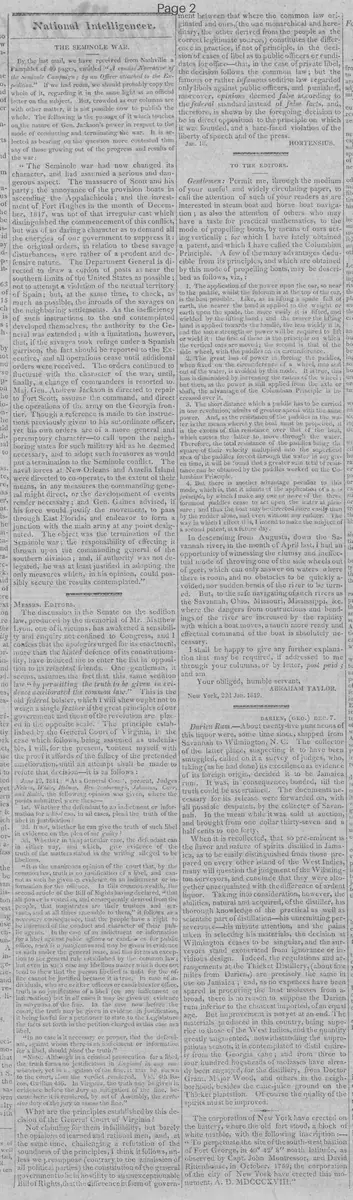
The discussion in the Senate on the sedition law, produced by the memorial of Mr. Matthew Lyon, one of its victims, has awakened a sensibility and enquiry not confined to Congress, and I confess that the apologies urged for its enactment, more than the hinted defence of its constitutionality, have induced me to enter the list in opposition to its reluctant friends. One gentleman, it seems, assumes the fact that this same sedition law "by permitting the truth to be given in evidence ameliorated the common law." This is the old federal bolster, which I will shew ought not to weigh a single feather if the great principles of our government and those of the revolution are placed in the opposite scale. The principle established by the General Court of Virginia, in the case which follows, being assumed as undeniable, I will, for the present, content myself with the proof it affords of the fallacy of the pretended amelioration, until an attempt shall be made to refute that decision—it is as follows:
June 12, 1811: "At a General Court, present, Judges Nelson, White, Holmes, Brodnax, Johnston, Carr, and Smith, the following opinion was given, where the points submitted were these—
1st. Whether the defendant to an indictment or information for a libel can, in all cases, plead the truth of the libel in justification?
2d. If not, whether he can give the truth of such libel in evidence on the plea of not guilty?
3d. Whether in this particular case, the defendant can in either way, and which, give evidence of the truth of the matters stated in the writing alleged to be libellous.
"It is the unanimous opinion of the court that, by the common law, truth is no justification of a libel, and cannot as such be given in evidence on an indictment or information for the offence. In this commonwealth, the second article of the Bill of Rights having declared, 'that all power is vested in, and consequently derived from the people, that magistrates are their trustees and servants, and at all times amenable to them,' it follows as a necessary consequence, that the people have a right to be informed of the conduct and character of their public agents. In the case of an indictment or information for a libel against public officers or candidates for public office, truth is a justification and may be given in evidence as such under the general issue, and thus forms an exception to the general rule established by the common law; but even in such case any libellous matter which does not tend to shew that the person libelled is unfit for the office cannot be justified because it is true. In case of individuals, who are neither officers or candidates for office, truth is no justification of a libel (on any indictment or information) but in all cases it may be given in evidence in mitigation of the fine. In the case now before the court, the truth may be given in evidence in justification, it being lawful for a petitioner to state to the Legislature the facts set forth in the petition charged in this case as a libel,
"In no case is it necessary or proper, that the defendant, against whom there is an indictment or information for a libel, should plead the truth."
"Note. Although in a criminal prosecution for a libel, the truth forms no justification in England in any case whatever, yet in mitigation of the fine, it may be shewn to the court, after the verdict rendered. Vid. 4th Bacon, Gwillim 456. In Virginia, the truth may be given in evidence before the Jury in mitigation of the fine, because here it is rendered, by act of Assembly, the exclusive duty of the jury to assess the fine."
What are the principles established by this decision of the General Court of Virginia?
Not claiming for them infallibility, but barely the opinions of learned and rational men, and, at the same time, challenging a refutation of the soundness of the principles, I think it follows, unless we presuppose (contrary to the admission of all political parties) the constitution of the general government to be in hostility to an unexceptionable Bill of Rights, that the difference in form of government between that where the common law originated and ours, (the one monarchical and hereditary, the other derived from the people as the only legitimate source,) constitutes the difference in practice, if not of principle, in the decision of cases of libel as to public officers or candidates for office—that, in the case of private libel, the decision follows the common law; but the famous or rather infamous sedition law regarded only libels against public officers, and punished, moreover, opinions deemed false according to the federal standard instead of false facts, and therefore, is shewn by the foregoing decision to be in direct opposition to the principle on which it was founded, and a bare-faced violation of the liberty of speech and of the press.
Jan. 18.
HORTENSIUS.
The discussion in the Senate on the sedition law, produced by the memorial of Mr. Matthew Lyon, one of its victims, has awakened a sensibility and enquiry not confined to Congress, and I confess that the apologies urged for its enactment, more than the hinted defence of its constitutionality, have induced me to enter the list in opposition to its reluctant friends. One gentleman, it seems, assumes the fact that this same sedition law "by permitting the truth to be given in evidence ameliorated the common law." This is the old federal bolster, which I will shew ought not to weigh a single feather if the great principles of our government and those of the revolution are placed in the opposite scale. The principle established by the General Court of Virginia, in the case which follows, being assumed as undeniable, I will, for the present, content myself with the proof it affords of the fallacy of the pretended amelioration, until an attempt shall be made to refute that decision—it is as follows:
June 12, 1811: "At a General Court, present, Judges Nelson, White, Holmes, Brodnax, Johnston, Carr, and Smith, the following opinion was given, where the points submitted were these—
1st. Whether the defendant to an indictment or information for a libel can, in all cases, plead the truth of the libel in justification?
2d. If not, whether he can give the truth of such libel in evidence on the plea of not guilty?
3d. Whether in this particular case, the defendant can in either way, and which, give evidence of the truth of the matters stated in the writing alleged to be libellous.
"It is the unanimous opinion of the court that, by the common law, truth is no justification of a libel, and cannot as such be given in evidence on an indictment or information for the offence. In this commonwealth, the second article of the Bill of Rights having declared, 'that all power is vested in, and consequently derived from the people, that magistrates are their trustees and servants, and at all times amenable to them,' it follows as a necessary consequence, that the people have a right to be informed of the conduct and character of their public agents. In the case of an indictment or information for a libel against public officers or candidates for public office, truth is a justification and may be given in evidence as such under the general issue, and thus forms an exception to the general rule established by the common law; but even in such case any libellous matter which does not tend to shew that the person libelled is unfit for the office cannot be justified because it is true. In case of individuals, who are neither officers or candidates for office, truth is no justification of a libel (on any indictment or information) but in all cases it may be given in evidence in mitigation of the fine. In the case now before the court, the truth may be given in evidence in justification, it being lawful for a petitioner to state to the Legislature the facts set forth in the petition charged in this case as a libel,
"In no case is it necessary or proper, that the defendant, against whom there is an indictment or information for a libel, should plead the truth."
"Note. Although in a criminal prosecution for a libel, the truth forms no justification in England in any case whatever, yet in mitigation of the fine, it may be shewn to the court, after the verdict rendered. Vid. 4th Bacon, Gwillim 456. In Virginia, the truth may be given in evidence before the Jury in mitigation of the fine, because here it is rendered, by act of Assembly, the exclusive duty of the jury to assess the fine."
What are the principles established by this decision of the General Court of Virginia?
Not claiming for them infallibility, but barely the opinions of learned and rational men, and, at the same time, challenging a refutation of the soundness of the principles, I think it follows, unless we presuppose (contrary to the admission of all political parties) the constitution of the general government to be in hostility to an unexceptionable Bill of Rights, that the difference in form of government between that where the common law originated and ours, (the one monarchical and hereditary, the other derived from the people as the only legitimate source,) constitutes the difference in practice, if not of principle, in the decision of cases of libel as to public officers or candidates for office—that, in the case of private libel, the decision follows the common law; but the famous or rather infamous sedition law regarded only libels against public officers, and punished, moreover, opinions deemed false according to the federal standard instead of false facts, and therefore, is shewn by the foregoing decision to be in direct opposition to the principle on which it was founded, and a bare-faced violation of the liberty of speech and of the press.
Jan. 18.
HORTENSIUS.
What sub-type of article is it?
Persuasive
Political
Informative
What themes does it cover?
Press Freedom
Constitutional Rights
Politics
What keywords are associated?
Sedition Law
Virginia Court
Libel Justification
Truth In Evidence
Free Speech
Press Freedom
Bill Of Rights
Constitutional Principles
What entities or persons were involved?
Hortensius.
Messrs. Editors.
Letter to Editor Details
Author
Hortensius.
Recipient
Messrs. Editors.
Main Argument
the sedition act is unconstitutional as it punishes opinions against public officers without allowing truth as justification, violating principles derived from the bill of rights and differing from common law, as shown by the 1811 virginia court decision.
Notable Details
Cites Virginia General Court Opinion From June 12, 1811, On Libel And Truth As Justification
References Bill Of Rights Article 2 On Power From The People
Contrasts Monarchical Common Law Origins With Republican Government