Thank you for visiting SNEWPapers!
Sign up free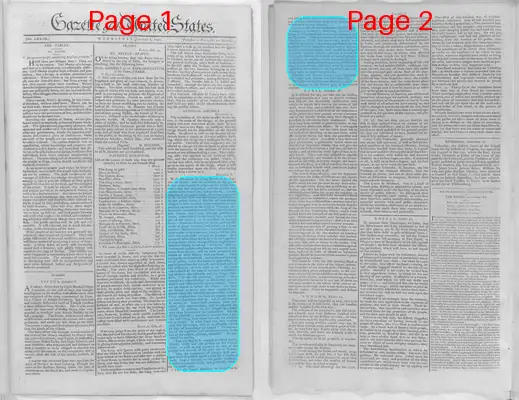
Gazette Of The United States
New York, New York County, New York
What is this article about?
On October 6, M. de Mirabeau addressed the French National Assembly on money scarcity, public funds discredit blamed partly on M. Necker, and corn shortages linked to currency issues. He proposed demanding corn payments from the U.S. for debts, establishing a national bank, and inviting King's Ministers to sit with the Assembly. Motions were debated and adjourned; Duke de Bouillon offered part of his income to the nation.
Merged-components note: Continuation of the same article on M. de Mirabeau's speech in the National Assembly, split across pages.
Clippings
1 of 2
OCR Quality
Full Text
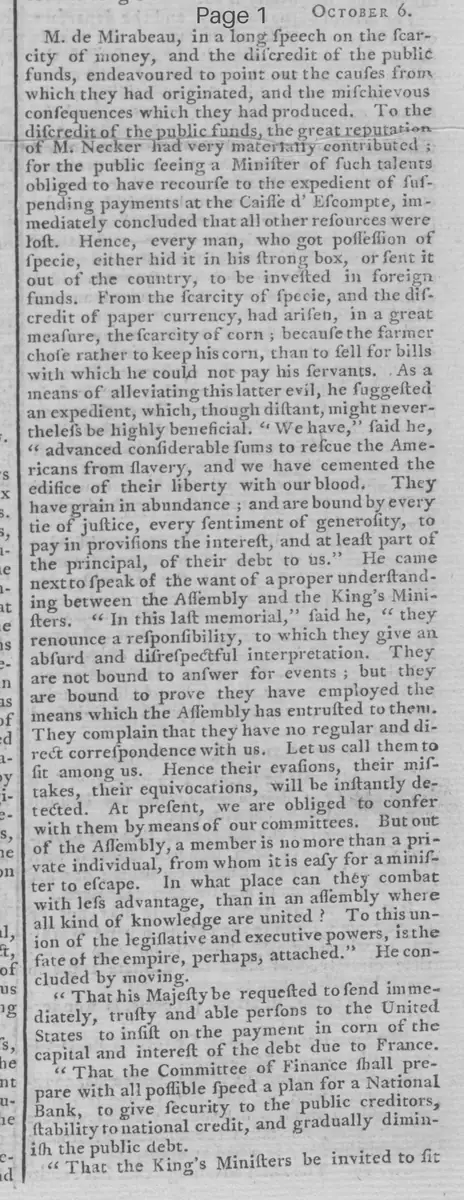
M. de Mirabeau, in a long speech on the scarcity of money, and the discredit of the public funds, endeavoured to point out the causes from which they had originated, and the mischievous consequences which they had produced. To the discredit of the public funds, the great reputation of M. Necker had very materially contributed; for the public seeing a Minister of such talents obliged to have recourse to the expedient of suspending payments at the Caisse d'Escompte, immediately concluded that all other resources were lost. Hence, every man, who got possession of specie, either hid it in his strong box, or sent it out of the country, to be invested in foreign funds. From the scarcity of specie, and the discredit of paper currency, had arisen, in a great measure, the scarcity of corn; because the farmer chose rather to keep his corn, than to sell for bills with which he could not pay his servants. As a means of alleviating this latter evil, he suggested an expedient, which, though distant, might nevertheless be highly beneficial. "We have," said he, "advanced considerable sums to rescue the Americans from slavery, and we have cemented the edifice of their liberty with our blood. They have grain in abundance; and are bound by every tie of justice, every sentiment of generosity, to pay in provisions the interest, and at least part of the principal, of their debt to us."
He came next to speak of the want of a proper understanding between the Assembly and the King's Ministers. "In this last memorial," said he, "they renounce a responsibility, to which they give an absurd and disrespectful interpretation. They are not bound to answer for events; but they are bound to prove they have employed the means which the Assembly has entrusted to them. They complain that they have no regular and direct correspondence with us. Let us call them to sit among us. Hence their evasions, their mistakes, their equivocations, will be instantly detected. At present, we are obliged to confer with them by means of our committees. But out of the Assembly, a member is no more than a private individual, from whom it is easy for a minister to escape. In what place can they combat with less advantage, than in an assembly where all kinds of knowledge are united? To this union of the legislative and executive powers, is the fate of the empire, perhaps, attached." He concluded by moving,
"That his Majesty be requested to send immediately, trusty and able persons to the United States to insist on the payment in corn of the capital and interest of the debt due to France.
"That the Committee of Finance shall prepare with all possible speed a plan for a National Bank, to give security to the public creditors, stability to national credit, and gradually diminish the public debt.
"That the King's Ministers be invited to sit with the Assembly."
and advise in the National Assembly, without voting, till the constitution shall have fixed rules to be followed in that respect.
Several members objected to the last resolution, as dangerous to liberty, observing, that the Parliament of England had never been corrupted but by Ministers. Others maintained, that admitting Ministers to advise, but not to vote, would be a bulwark to liberty; that being questioned on the business of their respective departments, without previous communication, they would be obliged to answer without reserve; and that it would be extremely difficult for a weak or wicked minister to deceive the vigilance of the National Assembly.
Both parties admitted the importance of establishing a national bank—but they were by no means agreed on the resources to be expected from American faith, or American granaries.
The first and second articles were adjourned till Friday next, and the third till next day.
The Duke de Bouillon has offered 332,484 livres to the nation, as the fourth part of his annual income.
What sub-type of article is it?
What keywords are associated?
What entities or persons were involved?
Where did it happen?
Foreign News Details
Primary Location
France
Event Date
October 6
Key Persons
Outcome
motions on u.s. debt payment in corn and national bank adjourned to friday; invitation for king's ministers adjourned to next day; duke de bouillon offered 332,484 livres to the nation.
Event Details
M. de Mirabeau delivered a speech in the National Assembly on causes of money scarcity and public funds discredit, attributing part to M. Necker's actions leading to specie hoarding and corn shortages. He proposed sending envoys to the U.S. for corn payments on debts, urged a national bank plan, and suggested inviting King's Ministers to sit and advise in the Assembly without voting. Debate ensued on the ministerial invitation, with objections on liberty risks and counterarguments on accountability benefits. Agreement on bank importance but skepticism on U.S. reliability.