Thank you for visiting SNEWPapers!
Sign up free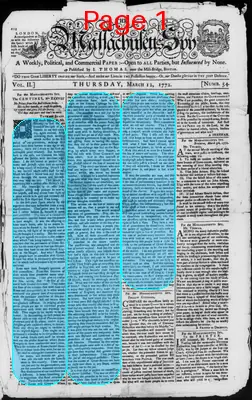
Letter to Editor
March 12, 1772
The Massachusetts Spy
Boston, Suffolk County, Massachusetts
What is this article about?
An anonymous writer argues that Parliament lacks the right to tax American colonies, as ancestors emigrated independently from Britain due to oppression, severing ties per the law of nature and nations. The charter provides no basis for taxation, preserving colonial independence except for specified protections.
Clipping
OCR Quality
98%
Excellent
Full Text
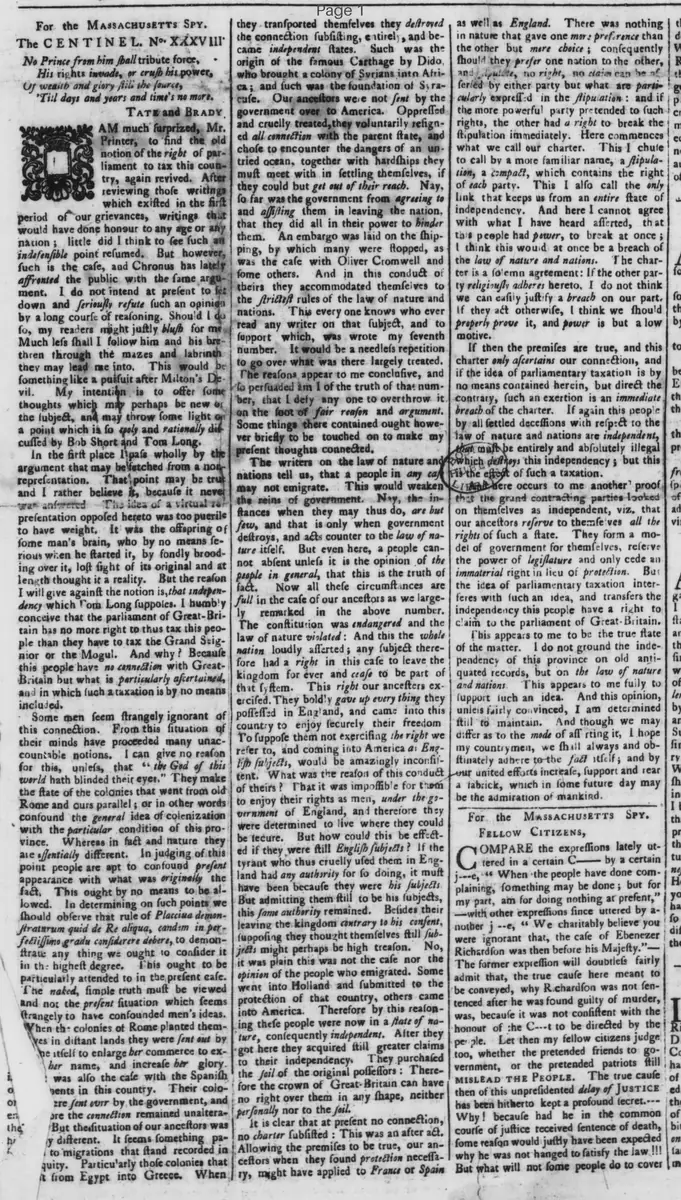
I am much surprised, Mr. Printer, to find the old notion of the right of parliament to tax this country, again revived. After reviewing those writings which existed in the first period of our grievances, writings that would have done honour to any age or any nation; little did I think to see such an indefensible point resumed. But however such is the case, and Chronus has lately affronted the public with the same argument. I do not intend at present to set down and seriously refute such an opinion by a long course of reasoning. Should I do so, my readers might justly blush for me. Much less shall I follow him and his brethren through the mazes and labyrinth they may lead me into. This would be something like a pursuit after Milton's Devil. My intention is to offer some thoughts which may perhaps be new on the subject, and may throw some light upon a point which is so subtly and rationally discussed by Bob Short and Tom Long.
In the first place I pass wholly by the argument that may be fetched from a non-representation. That point may be true and I rather believe it, because it never was answered. The idea of a virtual representation opposed hereto was too puerile to have weight. It was the offspring of some man's brain, who by no means serious when he started it, by fondly brooding over it, lost sight of its original and at length thought it a reality. But the reason I will give against the notion is, that independence which Tom Long supposes. I humbly conceive that the parliament of Great-Britain has no more right to thus tax this people than they have to tax the Grand Seignior or the Mogul. And why? Because this people have no connection with Great-Britain but what is particularly ascertained, and in which such a taxation is by no means included.
Some men seem strangely ignorant of this connection. From this situation of their minds have proceeded many unaccountable notions. I can give no reason for this, unless, that the God of this world hath blinded their eyes. They make the state of the colonies that went from old Rome and ours parallel; or in other words confound the general idea of colonization with the particular condition of this province. Whereas in fact and nature they are essentially different. In judging of this point people are apt to confound present appearance with what was originally the fact. This ought by no means to be allowed. In determining on such points we should observe that rule of Placcius demonstrationum quid de Re aliqua, candem in perfectissimo gradu considerare debere, to demonstrate any thing we ought to consider it in the highest degree. This ought to be particularly attended to in the present case. The naked, simple truth must be viewed and not the present situation which seems strangely to have confounded men's ideas.
When the colonies of Rome planted themselves in distant lands they were sent out by her to enlarge her commerce to extend her name, and increase her glory. It was also the case with the Spanish settlements in this country. Their colonies sent over by the government, and more the connection remained unaltered. But the situation of our ancestors was very different. It seems something parallel to migrations that stand recorded in antiquity. Particularly those colonies that set from Egypt into Greece. When they transported themselves they destroyed the connection uniting entirely, and became independent states. Such was the origin of the famous Carthage by Dido, who brought a colony of Syrians into Africa; and such was the foundation of Syracuse. Our ancestors were not sent by the government over to America. Oppressed and cruelly treated, they voluntarily resigned all connection with the parent state, and chose to encounter the dangers of an untried ocean, together with hardships they must meet with in settling themselves, if they could but get out of their reach. Nay, so far was the government from agreeing to and assisting them in leaving the nation, that they did all in their power to hinder them. An embargo was laid on the shipping, by which many were stopped, as was the case with Oliver Cromwell and some others. And in this conduct of theirs they accommodated themselves to the strictest rules of the law of nature and nations. This every one knows who ever read any writer on that subject, and to support which, was wrote my seventh number. It would be a needless repetition to go over what was there largely treated. The reasons appear to me conclusive, and so persuaded am I of the truth of that number, that I defy any one to overthrow it on the foot of fair reason and argument.
Some things there contained ought however briefly to be touched on to make my present thoughts connected.
The writers on the law of nature and nations tell us, that a people in any case may not emigrate. This would weaken the reins of government. Nay, the instances when they may thus do, are but few, and that is only when government destroys, and acts counter to the law of nature itself. But even here, a people cannot absent unless it is the opinion of the people in general, that this is the truth of fact. Now all these circumstances are full in the case of our ancestors as we largely remarked in the above number. The constitution was endangered and the law of nature violated: And this the whole nation loudly asserted; any subject therefore had a right in this case to leave the kingdom for ever and cease to be part of that system. This right our ancestors exercised. They boldly gave up every thing they possessed in England, and came into this country to enjoy securely their freedom. To suppose them not exercising the right we refer to, and coming into America as English subjects, would be amazingly inconsistent. What was the reason of this conduct of theirs? That it was impossible for them to enjoy their rights as men, under the government of England, and therefore they were determined to live where they could be secure. But how could this be effected if they were still English Subjects? If the tyrant who thus cruelly used them in England had any authority for so doing, it must have been because they were his subjects. But admitting them still to be his subjects, this same authority remained. Besides their leaving the kingdom contrary to his consent, supposing they thought themselves still Subjects might perhaps be high treason. No, it was plain this was not the case nor the opinion of the people who emigrated. Some went into Holland and submitted to the protection of that country, others came into America. Therefore by this reasoning these people were now in a state of nature, consequently independent. After they got here they acquired still greater claims to their independency. They purchased the soil of the original possessors: Therefore the crown of Great-Britain can have no right over them in any shape, neither personally nor to the soil.
It is clear that at present no connection, no charter united: This was an after act. Allowing the premises to be true, our ancestors when they found protection necessary, might have applied to France or Spain as well as England. There was nothing in nature that gave one more preference than the other but mere choice; consequently should they prefer one nation to the other, and stipulate, no right, no claim can be cried by either party but what are particularly expressed in the stipulation: and if the more powerful party pretended to such rights, the other had a right to break the stipulation immediately. Here commences what we call our charter. This I choose to call by a more familiar name, a stipulation, a compact, which contains the right of each party. This I also call the only link that keeps us from an entire state of independency. And here I cannot agree with what I have heard asserted, that this people had power, to break at once; I think this would at once be a breach of the law of nature and nations. The charter is a solemn agreement: If the other party religiously adheres hereto, I do not think we can easily justify a breach on our part. If they act otherwise, I think we should properly prove it, and power is but a low motive.
If then the premises are true. and this charter only ascertains our connection, and if the idea of parliamentary taxation is by no means contained herein, but directly the contrary, such an exertion is an immediate breach of the charter. If again this people by all settled decisions with respect to the law of nature and nations are independent, that act be entirely and absolutely illegal which destroys this independency; but this is the effect of such a taxation.
Last as a further proof that the grand contracting parties looked on themselves as independent, viz, that our ancestors reserve to themselves all the rights of such a state. They form a model of government for themselves, reserve the power of legislature and only cede an immaterial right in lieu of protection. But the idea of parliamentary taxation interferes with such an idea, and transfers the independency this people have a right to claim to the parliament of Great-Britain.
This appears to me to be the true state of the matter. I do not ground the independency of this province on old antiquated records, but on the law of nature and nations. This appears to me fully to support such an idea. And this opinion, unless fairly convinced, I am determined still to maintain. And though we may differ as to the mode of asserting it, I hope my countrymen, we shall always and obstinately adhere to the fact itself; and by our united efforts increase, support and rear a fabrick, which in some future day may be the admiration of mankind.
In the first place I pass wholly by the argument that may be fetched from a non-representation. That point may be true and I rather believe it, because it never was answered. The idea of a virtual representation opposed hereto was too puerile to have weight. It was the offspring of some man's brain, who by no means serious when he started it, by fondly brooding over it, lost sight of its original and at length thought it a reality. But the reason I will give against the notion is, that independence which Tom Long supposes. I humbly conceive that the parliament of Great-Britain has no more right to thus tax this people than they have to tax the Grand Seignior or the Mogul. And why? Because this people have no connection with Great-Britain but what is particularly ascertained, and in which such a taxation is by no means included.
Some men seem strangely ignorant of this connection. From this situation of their minds have proceeded many unaccountable notions. I can give no reason for this, unless, that the God of this world hath blinded their eyes. They make the state of the colonies that went from old Rome and ours parallel; or in other words confound the general idea of colonization with the particular condition of this province. Whereas in fact and nature they are essentially different. In judging of this point people are apt to confound present appearance with what was originally the fact. This ought by no means to be allowed. In determining on such points we should observe that rule of Placcius demonstrationum quid de Re aliqua, candem in perfectissimo gradu considerare debere, to demonstrate any thing we ought to consider it in the highest degree. This ought to be particularly attended to in the present case. The naked, simple truth must be viewed and not the present situation which seems strangely to have confounded men's ideas.
When the colonies of Rome planted themselves in distant lands they were sent out by her to enlarge her commerce to extend her name, and increase her glory. It was also the case with the Spanish settlements in this country. Their colonies sent over by the government, and more the connection remained unaltered. But the situation of our ancestors was very different. It seems something parallel to migrations that stand recorded in antiquity. Particularly those colonies that set from Egypt into Greece. When they transported themselves they destroyed the connection uniting entirely, and became independent states. Such was the origin of the famous Carthage by Dido, who brought a colony of Syrians into Africa; and such was the foundation of Syracuse. Our ancestors were not sent by the government over to America. Oppressed and cruelly treated, they voluntarily resigned all connection with the parent state, and chose to encounter the dangers of an untried ocean, together with hardships they must meet with in settling themselves, if they could but get out of their reach. Nay, so far was the government from agreeing to and assisting them in leaving the nation, that they did all in their power to hinder them. An embargo was laid on the shipping, by which many were stopped, as was the case with Oliver Cromwell and some others. And in this conduct of theirs they accommodated themselves to the strictest rules of the law of nature and nations. This every one knows who ever read any writer on that subject, and to support which, was wrote my seventh number. It would be a needless repetition to go over what was there largely treated. The reasons appear to me conclusive, and so persuaded am I of the truth of that number, that I defy any one to overthrow it on the foot of fair reason and argument.
Some things there contained ought however briefly to be touched on to make my present thoughts connected.
The writers on the law of nature and nations tell us, that a people in any case may not emigrate. This would weaken the reins of government. Nay, the instances when they may thus do, are but few, and that is only when government destroys, and acts counter to the law of nature itself. But even here, a people cannot absent unless it is the opinion of the people in general, that this is the truth of fact. Now all these circumstances are full in the case of our ancestors as we largely remarked in the above number. The constitution was endangered and the law of nature violated: And this the whole nation loudly asserted; any subject therefore had a right in this case to leave the kingdom for ever and cease to be part of that system. This right our ancestors exercised. They boldly gave up every thing they possessed in England, and came into this country to enjoy securely their freedom. To suppose them not exercising the right we refer to, and coming into America as English subjects, would be amazingly inconsistent. What was the reason of this conduct of theirs? That it was impossible for them to enjoy their rights as men, under the government of England, and therefore they were determined to live where they could be secure. But how could this be effected if they were still English Subjects? If the tyrant who thus cruelly used them in England had any authority for so doing, it must have been because they were his subjects. But admitting them still to be his subjects, this same authority remained. Besides their leaving the kingdom contrary to his consent, supposing they thought themselves still Subjects might perhaps be high treason. No, it was plain this was not the case nor the opinion of the people who emigrated. Some went into Holland and submitted to the protection of that country, others came into America. Therefore by this reasoning these people were now in a state of nature, consequently independent. After they got here they acquired still greater claims to their independency. They purchased the soil of the original possessors: Therefore the crown of Great-Britain can have no right over them in any shape, neither personally nor to the soil.
It is clear that at present no connection, no charter united: This was an after act. Allowing the premises to be true, our ancestors when they found protection necessary, might have applied to France or Spain as well as England. There was nothing in nature that gave one more preference than the other but mere choice; consequently should they prefer one nation to the other, and stipulate, no right, no claim can be cried by either party but what are particularly expressed in the stipulation: and if the more powerful party pretended to such rights, the other had a right to break the stipulation immediately. Here commences what we call our charter. This I choose to call by a more familiar name, a stipulation, a compact, which contains the right of each party. This I also call the only link that keeps us from an entire state of independency. And here I cannot agree with what I have heard asserted, that this people had power, to break at once; I think this would at once be a breach of the law of nature and nations. The charter is a solemn agreement: If the other party religiously adheres hereto, I do not think we can easily justify a breach on our part. If they act otherwise, I think we should properly prove it, and power is but a low motive.
If then the premises are true. and this charter only ascertains our connection, and if the idea of parliamentary taxation is by no means contained herein, but directly the contrary, such an exertion is an immediate breach of the charter. If again this people by all settled decisions with respect to the law of nature and nations are independent, that act be entirely and absolutely illegal which destroys this independency; but this is the effect of such a taxation.
Last as a further proof that the grand contracting parties looked on themselves as independent, viz, that our ancestors reserve to themselves all the rights of such a state. They form a model of government for themselves, reserve the power of legislature and only cede an immaterial right in lieu of protection. But the idea of parliamentary taxation interferes with such an idea, and transfers the independency this people have a right to claim to the parliament of Great-Britain.
This appears to me to be the true state of the matter. I do not ground the independency of this province on old antiquated records, but on the law of nature and nations. This appears to me fully to support such an idea. And this opinion, unless fairly convinced, I am determined still to maintain. And though we may differ as to the mode of asserting it, I hope my countrymen, we shall always and obstinately adhere to the fact itself; and by our united efforts increase, support and rear a fabrick, which in some future day may be the admiration of mankind.
What sub-type of article is it?
Persuasive
Political
Philosophical
What themes does it cover?
Politics
Constitutional Rights
Economic Policy
What keywords are associated?
Parliamentary Taxation
Colonial Independence
Law Of Nature
Charter Compact
Emigration Rights
Virtual Representation
Ancestral Migration
What entities or persons were involved?
Mr. Printer
Letter to Editor Details
Recipient
Mr. Printer
Main Argument
parliament has no right to tax the american colonies, as the ancestors emigrated independently from britain due to oppression, entering a state of nature and gaining independence; the subsequent charter is a compact that does not include taxation rights, per the law of nature and nations.
Notable Details
References To Roman And Ancient Colonies
Comparison To Carthage And Syracuse
Mention Of Oliver Cromwell's Emigration
Critique Of Virtual Representation
Invocation Of Law Of Nature And Nations
Allusion To Milton's Devil