Thank you for visiting SNEWPapers!
Sign up free
Story
February 24, 1875
Green Mountain Freeman
Montpelier, Washington County, Vermont
What is this article about?
Descriptive account of intensive farming practices in Eastern Flanders, Belgium, including crop rotations, animal husbandry, and land management that support a dense population on poor soil through efficient use of resources and careful cultivation.
Clipping
OCR Quality
95%
Excellent
Full Text
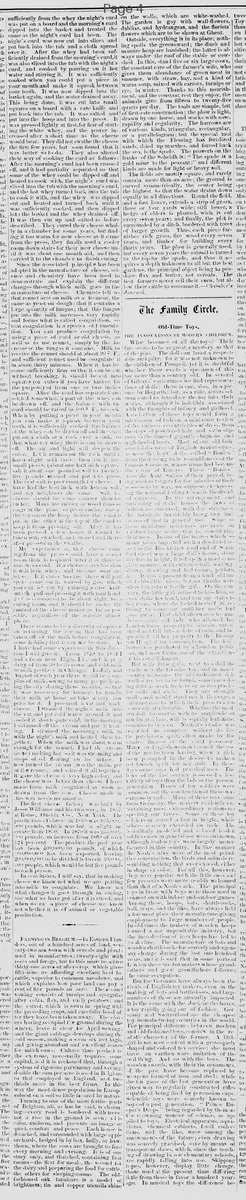
Farming in Belgium.—In Eastern Flanders, out of a hundred acres of land, seventy-two are sown with cereals and plants used in manufactures; twenty-eight with roots and forage, but to this must be added thirty-one acres of after-crop, which gives fifty-nine as affording excellent food for cattle, superior to common meadows, and which explains how poor land can pay a rent of five pounds an acre. The second sowing consists of turnips and spergula after colza, flax, and early potatoes; and the carrot, which is sown in spring with the preceding crops, and carefully hoed after they have been taken away. The clovers having occupied the ground during the winter, leave it clear for April sowing; and the giant cabbage develops during the cold season, making a stem six feet high, and giving abundant and excellent leaves for milch cows. Culture thus pushed to the extreme, necessarily requires some capital, and it is reckoned that, through a system of rigorous parsimony and saving, double the sum per acre is used in Belgium to that employed in England, and two thirds more in the best farms. In this way the most dense population in Europe subsist on a soil so little favored by nature.
Turning to one of the most fertile parts of Belgium, all, as has been said, is charming—every road is bordered with trees, not a rise in the ground is seen; all is calm, uniform, and presents an image of quiet, comfort and peace. Each house is detached, and surrounded with large apple orchards, hedged in by box, holly, or hawthorn, where the cows are brought to feed every morning and evening. It is of one story only, and thatched, containing four rooms—the first for meals, the second for the dairy and preparing the food for cattle, the others for sleeping-rooms. The old-fashioned oak furniture is a model of brightness: tin and copper utensils shine on the walls, which are white-washed.
The garden is gay with wall-flowers, dahlias, and hydrangeas, and the florists flowers which are to be shown at Ghent. Outside, everything is in its place; nothing spoils the greensward; the ditch and manure heap are banished; the latter is always under the roof of the stable or cow-shed. In this, stand five or six large cows, the constant care of the farmer's wife, who gives them abundance of green meat in summer, with straw, hay, and a kind of warm soup, mixed with carrots, turnips or rye, in winter. Thanks to this nourishment, and the constant rest they enjoy, the animals give from fifteen to twenty-five quarts per day. The tools are simple, but of first-rate construction; the plow is light, drawn by one horse, and works with ease, rapidity and regularity. The harrows are of various kinds, triangular, rectangular, or a parallelogram; but the special tool with which the Fleming has fertilized sands, dried up marshes, and forced back the sea, is the spade. The proverb on the banks of the Scheldt is: "The spade is a gold mine to the peasant;" and different kinds are made for light or heavy soil.
The fields are mostly square, and rarely contain more than an acre; the ground is curved symmetrically, the center being the highest, so that the water drains down equally in all directions. Round the field, and a foot lower, extends a strip of grass, three or four yards wide; still lower, a hedge of elders is planted, which is cut every seven years; and finally, the plot is surrounded by a ditch, bordered with trees of larger growth. Thus, each piece furnishes rich grass, fire wood every seven years, and timber for building every thirty years. The plow is generally used, but every seven years the subsoil is turned to the top by the spade, and thus it acquires a depth unknown to all but the best gardens, the principal object being to produce flax and butter, not cereals. The best farmers never sell their corn, but allow their cattle to consume it.—(Chamber's Journal.
Turning to one of the most fertile parts of Belgium, all, as has been said, is charming—every road is bordered with trees, not a rise in the ground is seen; all is calm, uniform, and presents an image of quiet, comfort and peace. Each house is detached, and surrounded with large apple orchards, hedged in by box, holly, or hawthorn, where the cows are brought to feed every morning and evening. It is of one story only, and thatched, containing four rooms—the first for meals, the second for the dairy and preparing the food for cattle, the others for sleeping-rooms. The old-fashioned oak furniture is a model of brightness: tin and copper utensils shine on the walls, which are white-washed.
The garden is gay with wall-flowers, dahlias, and hydrangeas, and the florists flowers which are to be shown at Ghent. Outside, everything is in its place; nothing spoils the greensward; the ditch and manure heap are banished; the latter is always under the roof of the stable or cow-shed. In this, stand five or six large cows, the constant care of the farmer's wife, who gives them abundance of green meat in summer, with straw, hay, and a kind of warm soup, mixed with carrots, turnips or rye, in winter. Thanks to this nourishment, and the constant rest they enjoy, the animals give from fifteen to twenty-five quarts per day. The tools are simple, but of first-rate construction; the plow is light, drawn by one horse, and works with ease, rapidity and regularity. The harrows are of various kinds, triangular, rectangular, or a parallelogram; but the special tool with which the Fleming has fertilized sands, dried up marshes, and forced back the sea, is the spade. The proverb on the banks of the Scheldt is: "The spade is a gold mine to the peasant;" and different kinds are made for light or heavy soil.
The fields are mostly square, and rarely contain more than an acre; the ground is curved symmetrically, the center being the highest, so that the water drains down equally in all directions. Round the field, and a foot lower, extends a strip of grass, three or four yards wide; still lower, a hedge of elders is planted, which is cut every seven years; and finally, the plot is surrounded by a ditch, bordered with trees of larger growth. Thus, each piece furnishes rich grass, fire wood every seven years, and timber for building every thirty years. The plow is generally used, but every seven years the subsoil is turned to the top by the spade, and thus it acquires a depth unknown to all but the best gardens, the principal object being to produce flax and butter, not cereals. The best farmers never sell their corn, but allow their cattle to consume it.—(Chamber's Journal.
What sub-type of article is it?
Curiosity
What themes does it cover?
Triumph
Survival
What keywords are associated?
Belgian Farming
Eastern Flanders
Crop Rotation
Cattle Husbandry
Agricultural Tools
Land Management
Where did it happen?
Eastern Flanders, Belgium
Story Details
Location
Eastern Flanders, Belgium
Story Details
Intensive farming in Eastern Flanders uses crop rotations, after-crops, and careful animal feeding to maximize productivity on poor soil, supporting dense population through parsimony and tools like the spade.