Thank you for visiting SNEWPapers!
Sign up free
The Patowmac Guardian, And Berkeley Advertiser
Martinsburg, Shepherdstown, Berkeley County, Jefferson County, West Virginia
What is this article about?
Editorial criticizes U.S. President's order halting Pennsylvania's town-building and military detachment at Presqu'Isle, attributing it to British-manipulated Six Nations Indians via agents like Cornplanter and Chapin. Argues for state rights, necessity of occupation for defense, and against further treaties.
Clipping
OCR Quality
Full Text
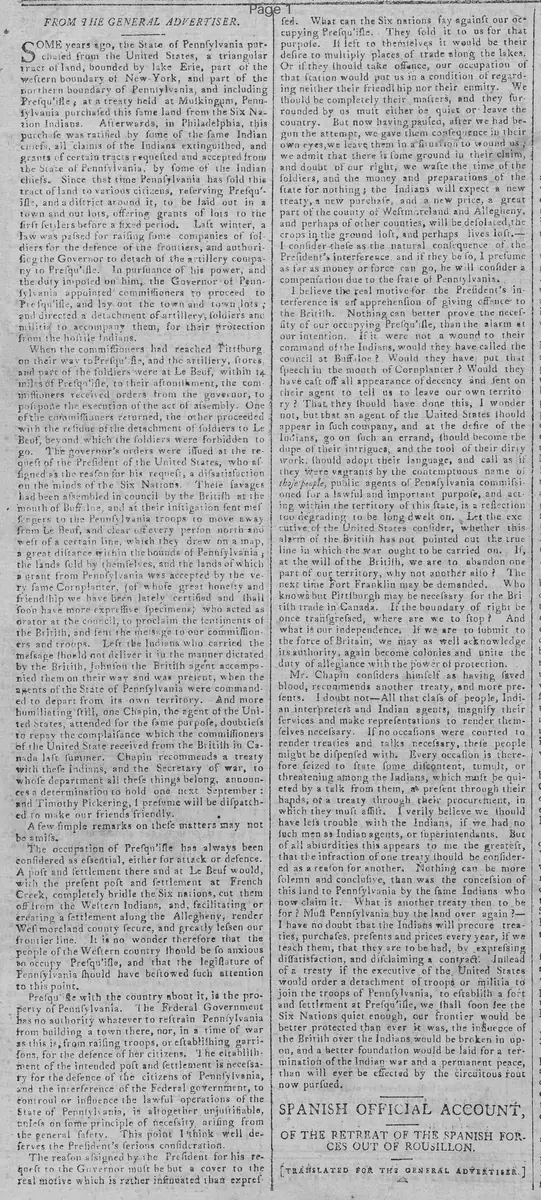
SOME years ago, the State of Pennsylvania purchased from the United States, a triangular tract of land, bounded by Lake Erie, part of the western boundary of New-York, and part of the northern boundary of Pennsylvania, and including Presqu'Isle: at a treaty held at Muskingum, Pennsylvania purchased this same land from the Six Nation Indians. Afterwards, in Philadelphia, this purchase was ratified by some of the same Indian chiefs, all claims of the Indians extinguished, and grants of certain tracts requested and accepted from the State of Pennsylvania, by some of the Indian chiefs. Since that time Pennsylvania has sold this tract of land to various citizens, reserving Presqu'Isle, and a district around it, to be laid out in a town and out lots, offering grants of lots to the first settlers before a fixed period. Last winter, a law was passed for raising some companies of soldiers for the defence of the frontiers, and authorizing the Governor to detach of the artillery company to Presqu'Isle. In pursuance of his power, and the duty imposed on him, the Governor of Pennsylvania appointed commissioners to proceed to Presqu'Isle, and lay out the town and town lots; and directed a detachment of artillery, soldiers and militia to accompany them, for their protection from the hostile Indians.
When the commissioners had reached Pittsburgh, on their way to Presqu'Isle, and the artillery, stores, and part of the soldiers were at Le Boeuf, within 14 miles of Presqu'Isle, to their astonishment, the commissioners received orders from the governor, to postpone the execution of the act of assembly. One of the commissioners returned, the other proceeded with the residue of the detachment of soldiers to Le Boeuf, beyond which the soldiers were forbidden to go. The governor's orders were issued at the request of the President of the United States, who assigned as the reason for his request, a dissatisfaction on the minds of the Six Nations. These savages had been assembled in council by the British at the mouth of Buffalo, and at their instigation sent messengers to the Pennsylvania troops to move away from Le Boeuf, and clear off every person north and west of a certain line, which they drew on a map, a great distance within the bounds of Pennsylvania; the lands sold by themselves, and the lands of which a grant from Pennsylvania was accepted by the very same Cornplanter, (of whose great honesty and friendship we have been largely certified and shall soon have more expressive specimens; who acted as orator at the council, to proclaim the sentiments of the British, and sent the message to our commissioners and troops. Lest the Indians who carried the message should not deliver it in the manner dictated by the British, Johnston the British agent accompanied them on their way and was present, when the agents of the State of Pennsylvania were commanded to depart from its own territory. And more humiliating still, one Chapin, the agent of the United States, attended for the same purpose, doubtless to repay the complaisance which the commissioners of the United States received from the British in Canada last summer. Chapin recommends a treaty with these Indians, and the Secretary of war, to whose department all these things belong, announces a determination to hold one next September: and Timothy Pickering, I presume will be dispatched to make our friends friendly.
A few simple remarks on these matters may not be amiss.
The occupation of Presqu'Isle has always been considered as essential, either for attack or defence. A post and settlement there and at Le Boeuf would, with the present post and settlement at French Creek, completely bridle the Six Nations, cut them off from the Western Indians, and, facilitating or creating a settlement along the Allegheny, render Westmoreland county secure, and greatly lessen our frontier line. It is no wonder therefore that the people of the Western country should be so anxious to occupy Presqu'Isle, and that the legislature of Pennsylvania should have bestowed such attention to this point.
Presqu'Isle with the country about it, is the property of Pennsylvania. The Federal Government has no authority whatever to restrain Pennsylvania from building a town there, nor, in a time of war as this is; from raising troops, or establishing garrisons, for the defence of her citizens. The establishment of the intended post and settlement is necessary for the defence of the citizens of Pennsylvania, and the interference of the Federal government, to control or influence the lawful operations of the State of Pennsylvania, is altogether unjustifiable, unless on some principle of necessity arising from the general safety. This point I think well deserves the President's serious consideration.
The reason assigned by the President for his request to the Governor must be but a cover to the real motive which is rather insinuated than expressed. What can the Six Nations say against our occupying Presqu'Isle. They sold it to us for that purpose. If left to themselves it would be their desire to multiply places of trade along the lakes. Or if they should take offence, our occupation of that station would put us in a condition of regarding neither their friendship nor their enmity. We should be completely their masters, and they surrounded by us must either be quiet or leave the country. But now having paused, after we had begun the attempt, we gave them consequence in their own eyes, we leave them in a situation to wound us; we admit that there is some ground in their claim. And doubt of our right, we waste the time of the soldiers, and the money and preparations of the State for nothing: the Indians will expect a new treaty, a new purchase, and a new price, a great part of the county of Westmoreland and Allegheny, and perhaps of other counties, will be desolated, the crops in this ground lost, and perhaps lives lost.
I consider these as the natural consequence of the President's interference. And if they be so, I presume as far as money or force can go, he will consider a compensation due to the State of Pennsylvania.
I believe the real motive for the President's interference is an apprehension of giving offence to the British. Nothing can better prove the necessity of our occupying Presqu'Isle, than the alarm at our intention. If it were not a wound to their command of the Indians, would they have called the council at Buffalo? Would they have put that speech in the mouth of Cornplanter? Would they have cast off all appearance of decency and sent on their agent to tell us to leave our own territory? That they should have done this, I wonder not, but that an agent of the United States should appear in such company, and at the desire of the Indians, go on such an errand, should become the dupe of their intrigues, and the tool of their dirty work, should adopt their language, and call us as if they were vagrants by the contemptuous name of those people, public agents of Pennsylvania commissioned for a lawful and important purpose, and acting within the territory of this state, is a reflection too degrading to be long dwelt on. Let the executive of the United States consider, whether this alarm of the British has not pointed out the true line in which the war ought to be carried on. If, at the will of the British, we are to abandon one part of our territory, why not another also? The next time Fort Franklin may be demanded. Who knows but Pittsburgh may be necessary for the British trade in Canada. If the boundary of right be once transgressed, where are we to stop? And what is our independence. If we are to submit to the force of Britain; we may as well acknowledge its authority, again become colonies and unite the duty of allegiance with the power of protection.
Mr. Chapin considers himself as having saved blood, recommends another treaty, and more presents. I doubt not--All that class of people, Indian interpreters and Indian agents, magnify their services and make representations to render themselves necessary. If no occasions were courted to render treaties and talks necessary, these people might be dispensed with. Every occasion is therefore seized to raise some discontent, tumult, or threatening among the Indians, which must be quieted by a talk from them, a present through their hands; or a treaty through their procurement, in which they must assist. I verily believe we should have less trouble with the Indians, if we had no such men as Indian agents, or superintendents. But of all absurdities this appears to me the greatest, that the infraction of one treaty should be considered as a reason for another. Nothing can be more solemn and conclusive, than was the concession of this land to Pennsylvania by the same Indians who now claim it. What is another treaty then to be for? Must Pennsylvania buy the land over again? I have no doubt that the Indians will procure treaties, purchases, presents and prices every year, if we teach them, that they are to be had, by expressing dissatisfaction, and disclaiming a contract: Instead of a treaty if the executive of the United States would order a detachment of troops or militia to join the troops of Pennsylvania, to establish a fort and settlement at Presqu'Isle, we shall soon see the Six Nations quiet enough, our frontier would be better protected than ever it was, the influence of the British over the Indians would be broken upon, and a better foundation would be laid for a termination of the Indian-war and a permanent peace, than will ever be effected by the circuitous route now pursued.
What sub-type of article is it?
What keywords are associated?
What entities or persons were involved?
Editorial Details
Primary Topic
Criticism Of Federal Interference In Pennsylvania's Presqu'isle Settlement Plans Due To Indian And British Pressures
Stance / Tone
Strongly Critical Of U.S. President And Agents For Yielding To British Influenced Indian Demands, Advocating State Sovereignty And Military Occupation
Key Figures
Key Arguments