Thank you for visiting SNEWPapers!
Sign up free
Richmond Enquirer
Richmond, Richmond County, Virginia
What is this article about?
Letters from 1828 detailing the 1814 court-martial of soldier John Woods for mutiny during Gen. Jackson's Creek Indian campaign, his punishment, and broader context on army discipline amid hardships.
Merged-components note: Continuation of the communicated article detailing the 'Case of John Woods' across pages, with sequential reading order and thematic continuity.
Clippings
1 of 2
OCR Quality
Full Text
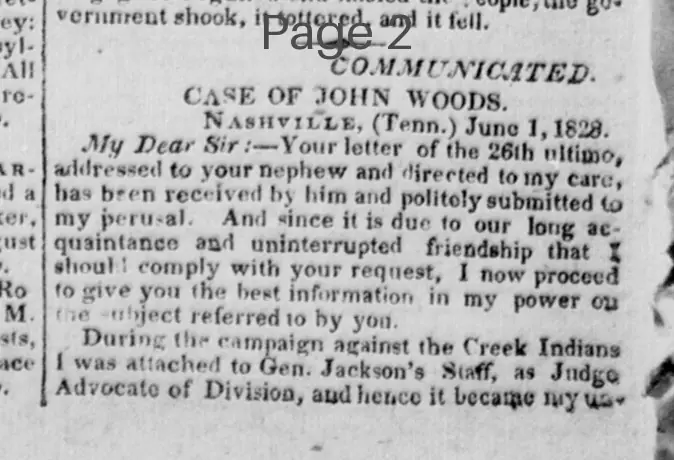
CASE OF JOHN WOODS.
NASHVILLE, (Tenn.) June 1, 1828.
My Dear Sir :-Your letter of the 26th ultimo, addressed to your nephew and directed to my care, has been received by him and politely submitted to my perusal. And since it is due to our long acquaintance and uninterrupted friendship that I should comply with your request, I now proceed to give you the best information in my power on the subject referred to by you.
During the campaign against the Creek Indians I was attached to Gen. Jackson's Staff, as Judge Advocate of Division, and hence it became my duty to investigate the case of John Woods, a soldier in the 39th regt. who was charged with mutiny and desertion. The circumstances of the case, as developed on the trial, were briefly these:
The army was on its march from Fort Strother to the Tallapoosa, and on the evening of the 26th of March, 1814, encamped on a small creek, a few miles short of where the battle of the Horse Shoe was fought on the 27th. The spot selected for the encampment was on a very high and commanding eminence, and the troops were ordered to throw up a breast work of logs, to protect them from the balls of the enemy, should they be attacked during the night. The men were fatigued with a long and rapid march, and the labor of throwing up the breast work was very severe. The next morning, before day, the army was put in motion, and arrived at the Horse Shoe about sunrise, where a bloody battle ensued, in which the Indians were defeated with great slaughter.
After the battle, the army encamped on the battle ground, and on the same day, the 27th, John Woods was brought a prisoner before me, charged with mutiny and desertion, and I was directed by Gen. Jackson to try him by a drum head court martial, and if found guilty, to execute him on the spot. I immediately assembled a court, consisting of three officers, and proceeded to investigate the charge. The evidence was, that on the evening of the 26th, after the troops had encamped, and while they were throwing up the breast work, Woods, who was a very small, delicate man, and much exhausted by the march, sat down on a log, and refused to work any longer, saying that he was tired, and could not work any more that night. The officer of the company to which he belonged, ordered him to go to work, but he refused, and continued sitting on the log. The officer then reported him to his Captain, who ordered him to be tied and carried to the guard house. He was tied, and while being carried to the guard house, he broke loose, and ran into the woods. He was pursued and brought back, and tied to a tree near the guard fire, where he remained during the night. In the morning, before day, when the army marched, he was untied, and marched with the guard to the battle ground, where he was again tied to a tree, and left there during the battle. After the battle, he was brought before me for trial.
The court, after hearing the evidence, found him guilty of mutiny, but acquitted him of the charge of desertion, as he did not leave the encampment with the intention of deserting the service, but merely to avoid the labor of throwing up the breast work. The court sentenced him to receive one hundred lashes on his bare back, and to be branded on the left hand with the letter "D", and to wear a board around his neck, with the words "Deserter" in large letters, for the term of six months.
The sentence of the court was approved by Gen. Jackson, and immediately carried into execution. Woods was taken to a tree, his shirt was taken off, and he was tied by the hands and feet to the tree, and received the one hundred lashes on his bare back. He was then branded on the left hand with a hot iron, with the letter "D", and the board with the word "Deserter" was hung around his neck. He was then turned loose, and marched with the army as a soldier, with the board around his neck, until he was discharged at the end of the campaign.
This is the substance of the case of John Woods, as I recollect it, after a lapse of fourteen years. I have no doubt that the facts are substantially correct, as they made a strong impression on my mind at the time, and I have never had any reason to doubt the justice of the sentence. The discipline of the army required that an example should be made, and Woods was selected as the victim.
I am, dear sir, very respectfully, your friend and servant,
JOHN WILLIAMS.
It is a pleasant duty to manage all prosecutions for offences against Martial law and the police of the army. But it so turned out, that I was prevented by absence and severe indisposition, from the performance of that duty in the case of John Woods, wherein you have desired particular information. I shall therefore, say nothing in regard to the facts attending his trial and execution, farther than I have never had a doubt as to their being such as fully to justify the Court Martial who tried him, and the commanding General who approved his sentence. But you will reasonably infer from the office I held in the army, that no individual enjoyed a better opportunity of judging the conduct of the General and determining whether it was in accordance with the dictates of justice and humanity, or otherwise. In justice to him, then, (from the information I possess) it affords me pleasure to state, that so far as I was capable of judging, no man in his situation, could have dealt out justice with a more even or impartial hand. It is true, perhaps, that he was somewhat rigid, in enforcing subordination and wholesome discipline in his army, but none, I am persuaded, ever knew him to turn a deaf ear to the claims of innocence or cries of distress. Now, in order to give you a tolerably correct idea of the terrible necessity which rendered the infliction of capital punishment justifiable in our army, I must, for a moment, present to your mind a retrospective view of its progress and condition, anterior to the time of Woods's trial and execution.
No sooner was it perceived that a war with the Creek Indians was unavoidable, than our legislature, in anticipation of the General Government, ordered out a competent number of volunteers and militia to carry the war into the enemy's country. and General Jackson was selected as the Commander-in-Chief. At first there was no want of patriotic ardor in the troops, or cheerfulness in submitting to the salutary restraints, and hardships inseparable from active military duty. But the army had to penetrate into the heart of a pathless wilderness of vast extent, before any important blow could be struck at the enemy, and this was not to be accomplished at once; but was the result of long continued exertion, peril and privation. In the outset, these difficulties were encountered and partially overcome without a murmur, and it was some time before an instance occurred of a Court Martial, or the lightest punishment was inflicted. But at length a period arrived, when this desirable condition of the army was to undergo a gradual but perceptible deterioration. From the negligence of the public contractors or some other causes, which I will not attempt to trace, after the army had with an indescribable fatigue, opened a road with necessary bridges and causeways, and penetrated a considerable depth into the forest, supplies became scarce in camp. This, of itself, is always sufficient in an army to create discontent; but I was then and still am of the opinion, that that circumstance was eagerly seized on by many as a pretext for their abating patriotism, when, in truth, the ruling motive was an inward desire to return to their homes and firesides, and thereby avoid the hardships and dangers incident to a farther prosecution of the campaign. But whatever might have been the cause or motives by which they were actuated, certain it is, that there was plainly manifested about this period, a spirit of discontent and insubordination on the part of many officers and soldiers. A day never passed without one or more courts martial, before whom were frequently brought divers offenders, and the duties of my office became confining and laborious.
[Continued narrative detailing the deterioration, punishments, and Jackson's leadership, culminating in the execution example and reform, ending with assurances of friendship and esteem.]
WILL WHITE.
To Dr. George Morris, Orange Courthouse.
What sub-type of article is it?
What themes does it cover?
What keywords are associated?
What entities or persons were involved?
Where did it happen?
Story Details
Key Persons
Location
From Fort Strother To The Tallapoosa, Near The Horse Shoe Battle Ground
Event Date
March 26 27, 1814
Story Details
Soldier John Woods refused to work on breastworks due to exhaustion, was charged with mutiny and desertion, tried by drum head court martial, found guilty of mutiny, sentenced to 100 lashes, branding with 'D', and wearing 'Deserter' board for six months; punishment executed immediately after Battle of Horseshoe.