Thank you for visiting SNEWPapers!
Sign up free
Daily National Intelligencer
Washington, District Of Columbia
What is this article about?
Proceedings of the U.S. House of Representatives on Saturday, April 2, 1814, covering unfavorable reports on petitions, communications from War and Treasury Secretaries, Senate bills on clerks' compensation and relief, resolutions on meeting times and military routes (first lost, second tabled), rejection of committee on Berlin/Milan decrees, discharge of a petition, passage of bills on laws distribution and relief, and debate on a resolution to inquire into establishing a National Bank, which faced a motion for indefinite postponement amid constitutional and timing concerns.
Clipping
OCR Quality
Full Text
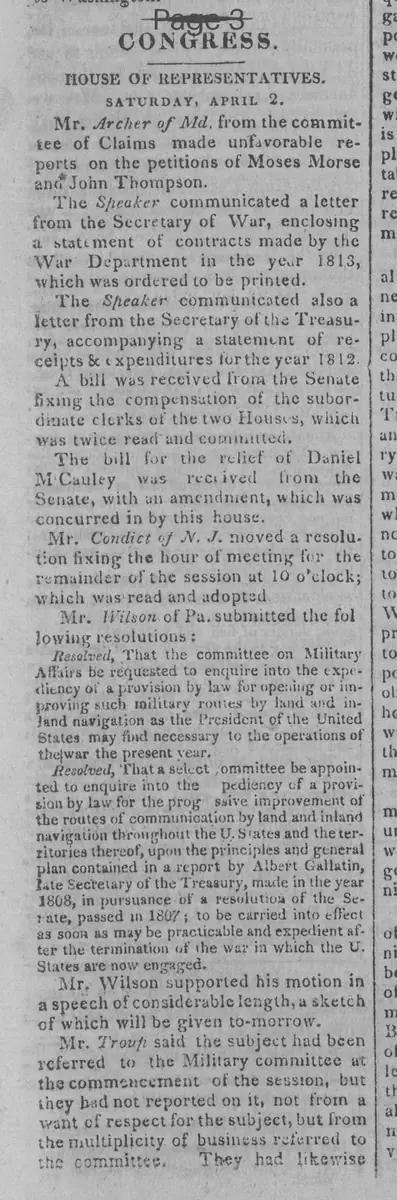
HOUSE OF REPRESENTATIVES.
SATURDAY, APRIL 2.
Mr. Archer of Md. from the committee of Claims made unfavorable reports on the petitions of Moses Morse and John Thompson.
The Speaker communicated a letter from the Secretary of War, enclosing a statement of contracts made by the War Department in the year 1813, which was ordered to be printed.
The Speaker communicated also a letter from the Secretary of the Treasury, accompanying a statement of receipts & expenditures for the year 1812.
A bill was received from the Senate fixing the compensation of the subordinate clerks of the two Houses, which was twice read and committed.
The bill for the relief of Daniel M'Cauley was received from the Senate, with an amendment, which was concurred in by this house.
Mr. Condict of N. J. moved a resolution fixing the hour of meeting for the remainder of the session at 10 o'clock; which was read and adopted.
Mr. Wilson of Pa. submitted the following resolutions:
Resolved, That the committee on Military Affairs be requested to enquire into the expediency of a provision by law for opening or improving such military routes by land and inland navigation as the President of the United States may find necessary to the operations of the war the present year.
Resolved, That a select committee be appointed to enquire into the expediency of a provision by law for the progressive improvement of the routes of communication by land and inland navigation throughout the U. States and the territories thereof, upon the principles and general plan contained in a report by Albert Gallatin, late Secretary of the Treasury, made in the year 1808, in pursuance of a resolution of the Senate, passed in 1807; to be carried into effect as soon as may be practicable and expedient after the termination of the war in which the U. States are now engaged.
Mr. Wilson supported his motion in a speech of considerable length, a sketch of which will be given to-morrow.
Mr. Trout said the subject had been referred to the Military committee at the commencement of the session, but they had not reported on it, not from a want of respect for the subject, but from the multiplicity of business referred to the committee.
They had likewise consulted the Secretary of War, as to the improvement of certain routes just mentioned by Mr. Wilson, but he did not believe such an undertaking was now absolutely necessary, and it was thought the money might be more eligibly employed, &c.
The question was then taken, at the instance of the mover, on the first resolution, and lost.
The second resolution was, on motion of Mr. Archer, laid on the table.
Mr. Webster of N. H. moved that the House now resolve itself into a committee of the whole House on the report of the Secretary of State, made at the last session, on the repeal of the Berlin and Milan decrees.
The question on Mr. Webster's motion was decided by yeas and nays in the negative, as follows:
For the motion, 37.
Against it, 75.
So the House refused to take the subject now into consideration.
On motion of Mr. M'Kim of Md. the committee of the whole was discharged from the further consideration of the report on the petition of James Anderson, and the petitioner had leave to withdraw his papers.
The bills, authorising a subscription to an edition of the laws of the U S. and providing for the distribution of the same; and for the relief of George Shannon, respectively passed through committees of the whole, and were ordered to a third reading.
NATIONAL BANK.
Mr. Grundy of Ten. submitted the following resolution for consideration:
Resolved, That a committee be appointed to enquire into the expediency of establishing a National Bank; and that they have leave to report by bill or otherwise.
Mr. Newton of Va. moved that the resolution be postponed indefinitely. He said that, by this motion, he meant not the slightest disrespect to the mover of the resolution; but feeling as he did, a firm conviction that the constitution had not given to Congress the power to establish such an institution, the correctness of which opinion had been tried and settled by a former Congress, he could not consent to the adoption of the resolution. Besides, said Mr. N. the session is now drawing to a close. the day of adjournment has been fixed by a vote of this House, and the mind of every member is anxiously directed to the moment which is to restore him to his family and home. The time is now too short for the consideration of so important a subject; and for this, as well as the intrinsic objections he had to the object of the resolution, he hoped his motion to postpone it indefinitely would prevail.
Mr. Grundy said he trusted the motion to postpone would not succeed. He believed there was time enough left for the consideration of the subject, and if the House would bring itself to discuss it, all constitutional difficulties, he was persuaded, would be removed. The gentleman from Virginia, by his motion to postpone, would bring the subject at once before the House; but it would be much better to refer the enquiry to a committee, let them investigate the question thoroughly, and report the result to the House, and they would then be enabled to act understandingly. Besides, said Mr. G. the gentleman has opposed the resolution without knowing what kind of a Bank is contemplated, or upon what principles or in what manner it is to be established. Let the matter be referred to a committee; it will then come regularly before the House, and every member will know how to act.
Mr. Grosvenor of N. Y. said he had always believed it improper for the general government to legislate in erecting banks, except so far as to accomplish national objects, facilitating the collection of the revenue, &c. As to these objects, however, it was the constitutional duty of the Secretary of the Treasury to devise the ways and means, and if such an institution were necessary for the purposes of government, it was the duty of that officer to recommend it. He wished the Secretary to say whether such a Bank was necessary, and not that the subject should be referred to a committee of this House, and they to enquire privately of the Secretary as to the expediency of the measure. When the proposition came in at the proper constitutional door, & appeared to be necessary for the financial purposes of the government, he should not object to it. If such a necessity exists, he wished the government to come forward and declare it, and not shrink from the responsibility of recommending the measure.
Mr. Findley of Pa. made a few remarks not distinctly heard. He was understood to say the erection of a bank was not so desirable on account of the government as for the general convenience of the country.
Mr. Oakley of N. Y. made a number of forcible remarks against the indefinite postponement. He said he did not believe it was so exclusively the duty of the Executive Department to recommend the establishment of a National Bank, even if required by the finances of the government, as his colleague (Mr. Grosvenor) seemed to think. He had no doubt that a National Bank was indispensable to the proper management of the fiscal affairs of government; but, independent of this consideration, he believed it was necessary to the general convenience of the community: and should a plan for such an institution be brought forward in a shape that he approved, he should certainly give it his support. Supposing, however, that it was the duty of the Secretary of the Treasury to recommend a national bank, and that he should be unwilling to assume the responsibility; such conduct would doubtless be reprehensible, but would that be a good reason why Congress should decline to establish an institution that would alike benefit the government and promote the general good? Mr. O. said that although, the proposition did not "come in at the proper door," still it was no reason the House should refuse to act on it. Whether this be a proper mode of establishing a national bank is properly to be decided when the question comes before us in a regular form. The question now turns only on our belief as to the expediency of such a bank and if expedient of the fitness of the time, &c. of incorporating such an institution. He was therefore clearly of opinion on general principles, that the motion for an indefinite postponement ought not to prevail. The question of a National Bank, he added, must be connected, from the very nature of the institution, with the finances of the government. But though he should be as loth as any one to volunteer his aid to the administration in support of the war, yet he was not to be deterred by the fear of incidentally doing so from doing what he believed to be of itself right and proper. It is our duty, said he, to legislate for a settled state of things. A National Bank is necessity, in my judgment, to the permanent interest of the country, and therefore I am and shall be in favor of it if the details of the bill establishing it shall be such as to meet my approbation.
Mr. Wright of Md. said he had heretofore voted a National Bank unconstitutional; he was then satisfied it was so, and he believed that to be the opinion of a great portion, if not a majority of the people. If so, why take up the time of the house, and consume two or three weeks in discussing a question which may be determined at this moment? He could not consent to spend the precious time of the house to no purpose, & being satisfied that no National Bank could be passed through this house, he should vote for the indefinite postponement of the motion.
Mr. Webster of N. H. said this was a subject of great importance and required mature consideration. The hour of adjournment having arrived, he moved that the house do now adjourn.
Negatived, 69 to 67.
Mr. Newton repeated, he had moved the indefinite postponement, assuredly not from any disrespect to the mover of the resolution, but on this ground: The time rapidly approached at which this house had resolved to adjourn; but nine days remained of the session if the determination of this house in that respect received the sanction of the Senate, and, after so long a sitting, every member must turn his eyes with pleasure to that moment. The subject of a National Bank was one which had been discussed in the house before, and in private circles, over & often; and he had not the least doubt but every gentleman who heard him had made up his mind on the subject, and that a year's discussion would not change it. He therefore thought it would be best in the first instance to ascertain whether a majority was or was not prepared to vote for such a measure.
Mr. Grundy then said, that he certainly should never, have brought forward this proposition without having reflected much on it. He knew that it had been agitated in this house & in the nation heretofore, and had been much opposed by many of those politicians with whom he usually acted in this house; but he did not believe that each Congress was so bound by the decisions of that which preceded it, that it was a good argument against a measure for Members of a former Congress to come in and say, "we have decided it heretofore." As a Representative, Mr. G. said he claimed the right to give at least one vote on this subject as well as the gentleman from Virginia. The spirit of our constitution had wisely ordained the frequency of elections for the very purpose of undoing what had been wrongly done by their predecessors, and of doing that which had been left undone. If the gentleman from Virginia would reflect on this subject as much as others who had been instrumental in bringing forward the proposition, he was sure he would not be so confident that he acted correctly in refusing a deliberate consideration to it. I (said Mr. G.) have no secret on this subject: I wish to see a Bank established as a national object. let who will be in power: as a general measure I wish to see it adopted. Look at the situation of our country—and I say the gentleman should forget his home, and not leave his country in peril. You have authorised a loan for twenty-five millions, and have provided for the expenditure of so much money. Where is the money? Some well informed men say there will be no difficulty in obtaining it: others as well informed say that the attempt to obtain it may not be successful. I hope that gentlemen of the former description are correct. I know not what the prospect is; but one thing I do know—I would run no hazard on this point; and for one, though I have as much anxiety to be at home as any one, I am willing to sit a few days longer to see how it will be. The gentleman from Va. no doubt felt the same anxiety for the public service; and Mr. G. said if his constitutional scruples were so great that he could not vote for this measure, in case the money should not be conveniently obtained it might be necessary to resort to some other. For general considerations, Mr. G. said, he had always been in favor of a measure of this sort; and he entertained no constitutional scruples about it. In point of time he thought the present situation of the country afforded a cogent argument in favor of the measure.
Mr. Gaston of N. C. expressed his entire disapprobation of the indirect introduction of Executive recommendations into the House, as producing legislation without intelligence, and action without responsibility, &c. If therefore the vote on this question were to test his approbation of this indirect mode of attaining a measure supposed to be in favor of the Executive, he should certainly be inclined to vote against it. But, when a proposition was made by any member of this House, which recommended itself to his best judgment, on which he felt no constitutional scruples, and which he believed to be at all times expedient, he could not give a direct vote against it merely because the Executive, if wishing its adoption, had not recommended it as openly as could have been wished. That it is expedient to establish a National Bank, he had no doubt, and he congratulated the House that at the moment when gentlemen on his side of the House found some of their wishes about to be gratified by the abolition of the restrictive system, the constitutional scruples which had cramped the operations of the government, were vanishing also; that at the moment when they were about to liberate commerce, the fetters would also be loosed, with which a narrow constitutional exposition had heretofore bound the government. He should have been much more pleased, he said, if the measure had been directly recommended by the Executive, by an intimation that its adoption would conduce to a successful management of our finances; but merely for the reasons that it had not come before the House in that manner he could not vote against a proposition which on general grounds met his approbation.
Mr. Newton spoke in explanation. He was as ready as the gentleman from Tennessee to yield not only his time but his personal service to his country; and, had he but a dollar in the world, would freely lend it to contribute to the support of the government in a righteous war. But this question could be decided as intelligently in a day as in a month; and, if a majority was opposed to it, it was not advisable to consume time unnecessarily upon it. Under this impression he had made the motion for indefinite postponement, to ascertain the sense of the House on this point.
A motion was now made to adjourn, and carried by three or four votes.
What sub-type of article is it?
What keywords are associated?
What entities or persons were involved?
Domestic News Details
Event Date
Saturday, April 2
Key Persons
Outcome
unfavorable reports on petitions of moses morse and john thompson; war department contracts for 1813 printed; treasury receipts/expenditures for 1812 received; senate bill on clerks' compensation committed; amendment to daniel m'cauley's relief bill concurred; meeting time set at 10 o'clock; first military routes resolution lost; second on post-war improvements laid on table; motion to consider berlin/milan decrees report rejected 37-75; petition of james anderson withdrawn; bills on laws subscription/distribution and george shannon relief ordered to third reading; national bank inquiry resolution debated, motion to indefinitely postpone pending, adjournment carried by narrow margin.
Event Details
The House received and acted on various reports, letters, and bills from committees and Senate. Mr. Wilson proposed resolutions for military route improvements during and after the war, supported by speech but first lost and second tabled after debate. Mr. Webster's motion to enter committee on Secretary of State's report rejected. Petition discharged. Two bills advanced. Mr. Grundy proposed committee to inquire into National Bank establishment; Mr. Newton moved indefinite postponement citing constitutional issues and session end; debate ensued with arguments on constitutionality, timing, executive role, and wartime necessity; adjournment motions failed initially but succeeded narrowly.