Thank you for visiting SNEWPapers!
Sign up free
Editorial
May 3, 1831
Rhode Island American And Gazette
Providence, Providence County, Rhode Island
What is this article about?
An 1831 editorial satirizes inflated titles in Freemasonry, contrasting them with constitutional prohibitions on nobility, and critiques historical royal titles from Dr. D'Israeli's work, arguing against secret governance by masonic 'kings and priests.'
Clipping
OCR Quality
95%
Excellent
Full Text
THE AMERICAN
PROVIDENCE:
SATURDAY, APRIL 30, 1831.
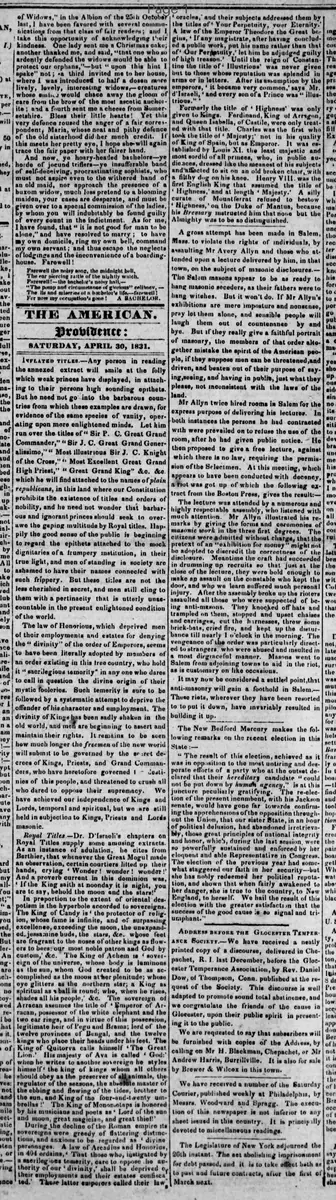
INFLATED TITLES.—Any person in reading the annexed extract will smile at the folly which weak princes have displayed, in attaching to their persons high sounding epithets. But he need not go into the barbarous countries from which these examples are drawn, for evidence of the same species of vanity, operating upon more enlightened minds. Let him run over the titles of "Sir P. C. Great Grand Commander," "Sir J. C. Great Grand Generalissimo," "Most illustrious Sir J. C. Knight of the Cross," "Most Excellent Great Grand High Priest," "Great Grand King" &c. &c. which he will find attached to the names of plain republicans, in this land where our Constitution prohibits the existence of titles and orders of nobility, and he need not wonder that barbarous and ignorant princes should seek to overawe the gaping multitude by Royal titles. Happily the good sense of the public is beginning to regard the epithets attached to the mock dignitaries of a frumpery institution, in their true light, and men of standing in society are ashamed to have their names connected with such frippery. But these titles are not the less cherished in secret, and men still cling to them with a pertinacity that is utterly unaccountable in the present enlightened condition of the world.
The law of Honorius, which deprived men of their employments and estates for denying the "divinity" of the order of Emperors, seems to have been literally adopted by members of an order existing in this free country, who hold it "sacrilegious temerity" in any one who dares to call in question the divine origin of their mystic fooleries. Such temerity is sure to be followed by a systematic attempt to deprive the offender of his character and employment. The divinity of Kings has been sadly shaken in the old world, and men are beginning to assert and maintain their rights. It remains to be seen how much longer the freemen of the new world will submit to be governed by the secret decrees of Kings, Priests, and Grand Commanders, who have heretofore governed the destinies of this people, and threatened to crush all who dared to oppose their supremacy.
We have achieved our independence of Kings and Lords, temporal and spiritual, but we are still held in subjection to Kings, Priests and Lords masonic.
Royal Titles.—Dr. D'Israeli's chapters on Royal Titles supply some amusing extracts. As an instance of adulation, he cites from Berthier, that whenever the Great Mogul made an observation, certain courtiers lifted up their hands, crying "Wonder! wonder! wonder!" And a proverb current in this dominion was, "If the King saith at noonday it is night, you are to say, behold the moon and the stars!"
In proportion to the extent of oriental despotism is the hyperbole accorded to sovereigns. The King of Candy is "the protector of religion, whose fame is infinite, and of surpassing excellence, exceeding the moon, the unexpanded jessamine buds, the stars, &c. whose feet are fragrant to the noses of other kings as flowers to bees: our most noble patron and God by custom," &c. The King of Achem is "sovereign of the universe, whose body is luminous as the sun, whom God created to be as accomplished as the moon at her plenitude; whose eye glitters as the northern star; a King as spiritual as a ball is round; who, when he rises, shades all his people," &c. The sovereign of Arracan assumes the title of Emperor of Arracan, possessor of the white elephant and the two car sittings, and in virtue of this possession, legitimate heir of Pegu and Brama; lord of the twelve provinces of Bengal, and the twelve kings who place their heads under his feet. The King of Quitorva calls himself "The Great Lion." His majesty of Ava is called "God:" when he writes to another sovereign he styles himself "the king of kings whom all others should obey as the preserver of all animals, the regulator of the seasons, the absolute master of the ebbing and flowing of the tides, brother to the sun, and King of the four-and-twenty umbrellas!" The King of Monomotapa is honored by his musicians and poets as "Lord of the sun and moon, great magician, and great thief!"
During the decline of the Roman empire its sovereigns were greedy of flattering distinctions, and anxious to be regarded as "divine personages. A law of Arcadius and Honorius, in 404 ordains, 'That those who, instigated by a sacrilegious temerity, care to oppose the authority of our divinity, shall be deprived of their employments and their estates confiscated.' These latter emperors called their law "oracles," and their subjects addressed them by the titles of "Your Perpetuity, your Eternity."
A law of the Emperor Theodore the Great begins, "If any magistrate, after having concluded a public work, put his name rather than that of 'Our Perpetuity, let him be adjudged guilty of high treason.' Until the reign of Constantine the title of 'Illustrious' was never given but to those whose reputation was splendid in arms or in letters. After its assumption by the emperors, 'it became very common,' says Mr. d'Israeli, 'and every son of a Prince was "illustrious."'
Formerly the title of 'Highness' was only given to Kings. Ferdinand, King of Arragon, and Queen Isabella, of Castile, were only treated with that title. Charles was the first who took the title of Majesty;' not in his quality of King of 'Spain, but as Emperor. It was established by Louis XI. the least majestic and most sordid of all princes, who, in public audiences, dressed like the meanest of his subjects and affected to sit on an old broken chair, with a filthy dog on his knee. Henry VIII. was the first English King that assumed the title of 'Highness,' and at length 'Majesty.' A silly curate of Mountferrat refused to bestow 'Highness,' on the Duke of Mantua, because his Breviary instructed him that none but the Almighty was to be so distinguished.
PROVIDENCE:
SATURDAY, APRIL 30, 1831.
INFLATED TITLES.—Any person in reading the annexed extract will smile at the folly which weak princes have displayed, in attaching to their persons high sounding epithets. But he need not go into the barbarous countries from which these examples are drawn, for evidence of the same species of vanity, operating upon more enlightened minds. Let him run over the titles of "Sir P. C. Great Grand Commander," "Sir J. C. Great Grand Generalissimo," "Most illustrious Sir J. C. Knight of the Cross," "Most Excellent Great Grand High Priest," "Great Grand King" &c. &c. which he will find attached to the names of plain republicans, in this land where our Constitution prohibits the existence of titles and orders of nobility, and he need not wonder that barbarous and ignorant princes should seek to overawe the gaping multitude by Royal titles. Happily the good sense of the public is beginning to regard the epithets attached to the mock dignitaries of a frumpery institution, in their true light, and men of standing in society are ashamed to have their names connected with such frippery. But these titles are not the less cherished in secret, and men still cling to them with a pertinacity that is utterly unaccountable in the present enlightened condition of the world.
The law of Honorius, which deprived men of their employments and estates for denying the "divinity" of the order of Emperors, seems to have been literally adopted by members of an order existing in this free country, who hold it "sacrilegious temerity" in any one who dares to call in question the divine origin of their mystic fooleries. Such temerity is sure to be followed by a systematic attempt to deprive the offender of his character and employment. The divinity of Kings has been sadly shaken in the old world, and men are beginning to assert and maintain their rights. It remains to be seen how much longer the freemen of the new world will submit to be governed by the secret decrees of Kings, Priests, and Grand Commanders, who have heretofore governed the destinies of this people, and threatened to crush all who dared to oppose their supremacy.
We have achieved our independence of Kings and Lords, temporal and spiritual, but we are still held in subjection to Kings, Priests and Lords masonic.
Royal Titles.—Dr. D'Israeli's chapters on Royal Titles supply some amusing extracts. As an instance of adulation, he cites from Berthier, that whenever the Great Mogul made an observation, certain courtiers lifted up their hands, crying "Wonder! wonder! wonder!" And a proverb current in this dominion was, "If the King saith at noonday it is night, you are to say, behold the moon and the stars!"
In proportion to the extent of oriental despotism is the hyperbole accorded to sovereigns. The King of Candy is "the protector of religion, whose fame is infinite, and of surpassing excellence, exceeding the moon, the unexpanded jessamine buds, the stars, &c. whose feet are fragrant to the noses of other kings as flowers to bees: our most noble patron and God by custom," &c. The King of Achem is "sovereign of the universe, whose body is luminous as the sun, whom God created to be as accomplished as the moon at her plenitude; whose eye glitters as the northern star; a King as spiritual as a ball is round; who, when he rises, shades all his people," &c. The sovereign of Arracan assumes the title of Emperor of Arracan, possessor of the white elephant and the two car sittings, and in virtue of this possession, legitimate heir of Pegu and Brama; lord of the twelve provinces of Bengal, and the twelve kings who place their heads under his feet. The King of Quitorva calls himself "The Great Lion." His majesty of Ava is called "God:" when he writes to another sovereign he styles himself "the king of kings whom all others should obey as the preserver of all animals, the regulator of the seasons, the absolute master of the ebbing and flowing of the tides, brother to the sun, and King of the four-and-twenty umbrellas!" The King of Monomotapa is honored by his musicians and poets as "Lord of the sun and moon, great magician, and great thief!"
During the decline of the Roman empire its sovereigns were greedy of flattering distinctions, and anxious to be regarded as "divine personages. A law of Arcadius and Honorius, in 404 ordains, 'That those who, instigated by a sacrilegious temerity, care to oppose the authority of our divinity, shall be deprived of their employments and their estates confiscated.' These latter emperors called their law "oracles," and their subjects addressed them by the titles of "Your Perpetuity, your Eternity."
A law of the Emperor Theodore the Great begins, "If any magistrate, after having concluded a public work, put his name rather than that of 'Our Perpetuity, let him be adjudged guilty of high treason.' Until the reign of Constantine the title of 'Illustrious' was never given but to those whose reputation was splendid in arms or in letters. After its assumption by the emperors, 'it became very common,' says Mr. d'Israeli, 'and every son of a Prince was "illustrious."'
Formerly the title of 'Highness' was only given to Kings. Ferdinand, King of Arragon, and Queen Isabella, of Castile, were only treated with that title. Charles was the first who took the title of Majesty;' not in his quality of King of 'Spain, but as Emperor. It was established by Louis XI. the least majestic and most sordid of all princes, who, in public audiences, dressed like the meanest of his subjects and affected to sit on an old broken chair, with a filthy dog on his knee. Henry VIII. was the first English King that assumed the title of 'Highness,' and at length 'Majesty.' A silly curate of Mountferrat refused to bestow 'Highness,' on the Duke of Mantua, because his Breviary instructed him that none but the Almighty was to be so distinguished.
What sub-type of article is it?
Satire
Constitutional
Moral Or Religious
What keywords are associated?
Inflated Titles
Freemasonry Critique
Royal Vanity
Constitutional Prohibition
Masonic Secrecy
Historical Satire
What entities or persons were involved?
Freemasons
Honorius
Dr. D'israeli
Great Mogul
King Of Candy
King Of Achem
Emperor Of Arracan
King Of Ava
Arcadius
Constantine
Louis Xi
Henry Viii
Editorial Details
Primary Topic
Critique Of Inflated Titles In Freemasonry And Historical Royalty
Stance / Tone
Satirical Criticism Of Vanity And Secret Societies
Key Figures
Freemasons
Honorius
Dr. D'israeli
Great Mogul
King Of Candy
King Of Achem
Emperor Of Arracan
King Of Ava
Arcadius
Constantine
Louis Xi
Henry Viii
Key Arguments
Constitution Prohibits Titles Of Nobility Yet Freemasons Use Inflated Ones
Public Is Beginning To See Masonic Titles As Frippery
Masonic Orders Punish Critics Like Ancient Emperors Punished Deniers Of Divinity
America Independent From Kings But Subjugated To Masonic Kings And Priests
Historical Royal Titles Exemplify Absurd Adulation And Despotism