Thank you for visiting SNEWPapers!
Sign up free
Literary
August 17, 1895
The Grenada Sentinel
Grenada, Grenada County, Mississippi
What is this article about?
A lonely newspaperwoman befriends a street urchin named Montgomery in rainy Washington. He shadows her home for safety and later overhears a major diplomatic scoop near the White House, risking injury to deliver it to her office, earning celebration and pride in their shared profession.
Clipping
OCR Quality
98%
Excellent
Full Text
MONTY'S SCOOP.
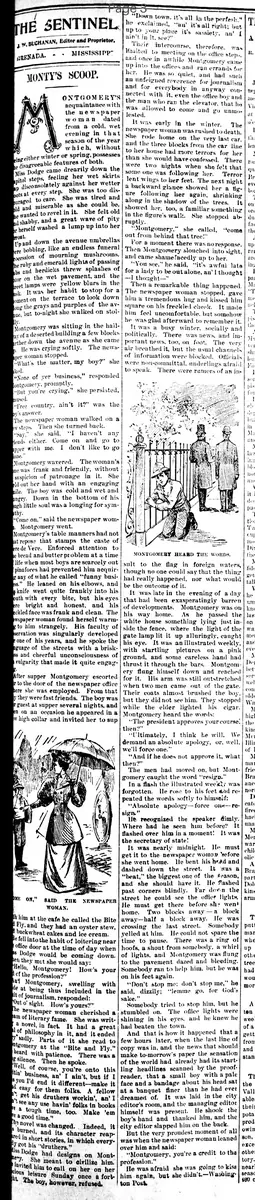
MONTGOMERY'S acquaintance with the newspaper woman dated from a cold, wet evening in that season of the year which, without being either winter or spring, possesses the disagreeable features of both.
Miss Dodge came drearily down the capitol steps, feeling her wet skirts drag disconsolately against her wetter boots at every step. She was too dispirited and miserable as she could be.
She felt old and shabby, and a great wave of pity for herself washed a lump up into her throat.
Up and down the avenue umbrellas were bobbing, like an endless funeral procession of mourning mushrooms. The ruby and emerald lights of passing cabs and berdicks threw splashes of color on the wet pavement, and the street lamps were yellow blurs in the dusk. It was her habit to stop for a moment on the terrace to look down the avenue, but to-night she walked on stolidly along the grays and purples of the avenue.
Montgomery was sitting in the hallway of a deserted building a few blocks further down the avenue as she came up. He was crying softly. The newspaper woman stopped.
"What's the matter, my boy?" she asked.
"None of yer business," responded Montgomery, promptly.
"But you're crying," she persisted.
"Free country, ain't it?" was the boy's answer.
The newspaper woman walked on a few steps. Then she turned back.
"Say," she said, "I haven't any friends either. Come on and go to supper with me. I don't like to go alone."
Montgomery wavered. The woman's tone was frank and friendly, without suspicion of patronage in it. She held out her hand with an engaging smile. The boy was cold and wet and hungry. Down in the bottom of his rough little soul was a longing for sympathy.
"Come on," said the newspaper woman. Montgomery went.
Montgomery's table manners had not that repose that stamps the caste of Vere de Vere. Enforced attention to the bread and butter problem at a time of life when most boys are scarcely out of pinafores had prevented him acquiring any of what he called "funny business." He leaned on his elbows, and his knife went quite frankly into his mouth with every bite, but his eyes were bright and honest, and his freckled face was frank and clean. The newspaper woman found herself warming to him strangely. His faculty of observation was singularly developed for one of his years, and he spoke the language of the streets with a briskness and cheerful unconsciousness of vulgarity that made it quite engaging.
After supper Montgomery escorted her to the door of the newspaper office where she was employed. From that day they were fast friends. The boy was her guest at supper several nights, and then on an occasion he appeared in a new high collar and invited her to sup with him at the cafe he called the Bite and Fly, and they had an oyster stew, buckwheat cakes and ice cream.
He fell into the habit of loitering near the office door at the time of day when Miss Dodge would be coming down.
When they met she would say:
"Hello, Montgomery! How's your end of the profession?"
And Montgomery, swelling with pride at being thus included in the list of journalism, responded:
"Out o' sight. How's yours?"
The newspaper woman cherished a dream of literary fame. She was writing a novel, in fact. It had a great deal of philosophy in it, and it ended sadly. Parts of it she read to Montgomery at the Bite and Fly. He heard with patience. There was a long silence. Then he spoke.
"Well, of course, you're onto this writin' business, an' I ain't, but if I was you I'd end it different—make it glad easy for them folks. A fellow ought to get his druthers workin', an' I don't see any use hayin' folks in books have a tough time, too. Make 'em have a good time."
The novel was changed. Indeed, it was burned, and its characters reappeared in short stories, in which everybody got his "druthers."
Miss Dodge had designs on Montgomery. She meant to civilize him. She invited him to call on her on her precious leisure Sunday once a fortnight. The boy, however, refused.
"Doawn town. it's all in the perfesh," he explained, "an' it's all right; but up to your place it's sassiety, an' I ain't in it, see?"
Their intercourse, therefore, was limited to meeting on the office steps, and once in awhile Montgomery came up into the offices and ran errands for her. He was so quiet, and had such an unfeigned reverence for journalism and for everybody in anyway connected with it, even the office boy and the man who ran the elevator, that he was allowed to come and go unmolested.
It was early in the winter. The newspaper woman was rushed to death. She rode home on the very last car, and the three blocks from the car line to her house had more terrors for her than she would have confessed. There were two nights when she felt that some one was following her. Terror lent wings to her feet. The next night a backward glance showed her a figure following her again, shrinking along in the shadow of the trees. It showed her, too, a familiar something in the figure's walk. She stopped abruptly.
"Montgomery," she called, "come out from behind that tree!"
For a moment there was no response. Then Montgomery slouched into sight, and came shamefacedly up to her.
"You see," he said, "it's awful late for a lady to be out alone, an' I thought—I thought—"
Then a remarkable thing happened. The newspaper woman stopped, gave him a tremendous hug and kissed him square on his freckled cheek. It made him feel uncomfortable, but somehow he was glad afterward to remember it.
It was a busy winter, socially and politically. There was news, and important news, too, on foot. The very air breathed it, but the usual channels of information were blocked. Officials were non-committal, underlings afraid to speak. There were rumors of an insult to the flag in foreign waters, though no one could say that the thing had really happened, nor what would be the outcome of it.
It was late in the evening of a day that had been exasperatingly barren of developments. Montgomery was on his way home. As he passed the white house something lying just inside the fence, where the light of the gate lamp lit it up alluringly, caught his eye. It was an illustrated weekly, with startling pictures on a pink ground, and some careless hand had thrust it through the bars. Montgomery flung himself down and reached for it. His arm was still outstretched when two men came out of the gate. Their coats almost brushed the boy, but they did not see him. They stopped while the elder lighted his cigar. Montgomery heard the words:
"The president approves your course, then?"
"Ultimately, I think he will. We demand an absolute apology, or, well, we'll force one."
"And if he does not approve it, what then?"
The men had moved on, but Montgomery caught the word "resign."
In a flash the illustrated weekly was forgotten. He rose to his feet and repeated the words softly to himself:
"Absolute apology—force one—resign."
He recognized the speaker dimly. Where had he seen him before? It flashed over him in a moment! It was the secretary of state!
It was nearly midnight. He must get it to the newspaper woman before she went home. He bent his head and dashed down the street. It was a "beat," the biggest one of the season, and she should have it. He dashed past corners blindly. Far down the street he could see the office lights. He must get there before she went home. Two blocks away—a block away—half a block away. He was crossing the last street. Somebody yelled at him. He could not spare the time to pause. There was a ring of hoofs, a shout from somebody, a whirl of lights, and Montgomery was flung to the pavement dazed and bleeding.
Somebody ran to help him, but he was on his feet again.
"Don't stop me; don't stop me," he said, dizzily; "lemme go, for God's sake."
Somebody tried to stop him, but he stumbled on. The office lights were shining in his eyes, and he knew he had beaten the town.
And that is how it happened that a few hours later, when the last line of copy was in, and the news that should make to-morrow's paper the sensation of the world had already had its startling headlines scanned by the proofreader, that a small boy with a pale face and a bandage about his head sat at a banquet finer than he had ever dreamed of. It was laid in the city editor's room, and the managing editor himself was present. He shook the boy's hand and thanked him, and the city editor slapped him on the back.
But the very proudest moment of all was when the newspaper woman leaned over him and said:
"Montgomery, you're a credit to the profession."
He was afraid she was going to kiss him again, but she didn't.—Washington Post
MONTGOMERY'S acquaintance with the newspaper woman dated from a cold, wet evening in that season of the year which, without being either winter or spring, possesses the disagreeable features of both.
Miss Dodge came drearily down the capitol steps, feeling her wet skirts drag disconsolately against her wetter boots at every step. She was too dispirited and miserable as she could be.
She felt old and shabby, and a great wave of pity for herself washed a lump up into her throat.
Up and down the avenue umbrellas were bobbing, like an endless funeral procession of mourning mushrooms. The ruby and emerald lights of passing cabs and berdicks threw splashes of color on the wet pavement, and the street lamps were yellow blurs in the dusk. It was her habit to stop for a moment on the terrace to look down the avenue, but to-night she walked on stolidly along the grays and purples of the avenue.
Montgomery was sitting in the hallway of a deserted building a few blocks further down the avenue as she came up. He was crying softly. The newspaper woman stopped.
"What's the matter, my boy?" she asked.
"None of yer business," responded Montgomery, promptly.
"But you're crying," she persisted.
"Free country, ain't it?" was the boy's answer.
The newspaper woman walked on a few steps. Then she turned back.
"Say," she said, "I haven't any friends either. Come on and go to supper with me. I don't like to go alone."
Montgomery wavered. The woman's tone was frank and friendly, without suspicion of patronage in it. She held out her hand with an engaging smile. The boy was cold and wet and hungry. Down in the bottom of his rough little soul was a longing for sympathy.
"Come on," said the newspaper woman. Montgomery went.
Montgomery's table manners had not that repose that stamps the caste of Vere de Vere. Enforced attention to the bread and butter problem at a time of life when most boys are scarcely out of pinafores had prevented him acquiring any of what he called "funny business." He leaned on his elbows, and his knife went quite frankly into his mouth with every bite, but his eyes were bright and honest, and his freckled face was frank and clean. The newspaper woman found herself warming to him strangely. His faculty of observation was singularly developed for one of his years, and he spoke the language of the streets with a briskness and cheerful unconsciousness of vulgarity that made it quite engaging.
After supper Montgomery escorted her to the door of the newspaper office where she was employed. From that day they were fast friends. The boy was her guest at supper several nights, and then on an occasion he appeared in a new high collar and invited her to sup with him at the cafe he called the Bite and Fly, and they had an oyster stew, buckwheat cakes and ice cream.
He fell into the habit of loitering near the office door at the time of day when Miss Dodge would be coming down.
When they met she would say:
"Hello, Montgomery! How's your end of the profession?"
And Montgomery, swelling with pride at being thus included in the list of journalism, responded:
"Out o' sight. How's yours?"
The newspaper woman cherished a dream of literary fame. She was writing a novel, in fact. It had a great deal of philosophy in it, and it ended sadly. Parts of it she read to Montgomery at the Bite and Fly. He heard with patience. There was a long silence. Then he spoke.
"Well, of course, you're onto this writin' business, an' I ain't, but if I was you I'd end it different—make it glad easy for them folks. A fellow ought to get his druthers workin', an' I don't see any use hayin' folks in books have a tough time, too. Make 'em have a good time."
The novel was changed. Indeed, it was burned, and its characters reappeared in short stories, in which everybody got his "druthers."
Miss Dodge had designs on Montgomery. She meant to civilize him. She invited him to call on her on her precious leisure Sunday once a fortnight. The boy, however, refused.
"Doawn town. it's all in the perfesh," he explained, "an' it's all right; but up to your place it's sassiety, an' I ain't in it, see?"
Their intercourse, therefore, was limited to meeting on the office steps, and once in awhile Montgomery came up into the offices and ran errands for her. He was so quiet, and had such an unfeigned reverence for journalism and for everybody in anyway connected with it, even the office boy and the man who ran the elevator, that he was allowed to come and go unmolested.
It was early in the winter. The newspaper woman was rushed to death. She rode home on the very last car, and the three blocks from the car line to her house had more terrors for her than she would have confessed. There were two nights when she felt that some one was following her. Terror lent wings to her feet. The next night a backward glance showed her a figure following her again, shrinking along in the shadow of the trees. It showed her, too, a familiar something in the figure's walk. She stopped abruptly.
"Montgomery," she called, "come out from behind that tree!"
For a moment there was no response. Then Montgomery slouched into sight, and came shamefacedly up to her.
"You see," he said, "it's awful late for a lady to be out alone, an' I thought—I thought—"
Then a remarkable thing happened. The newspaper woman stopped, gave him a tremendous hug and kissed him square on his freckled cheek. It made him feel uncomfortable, but somehow he was glad afterward to remember it.
It was a busy winter, socially and politically. There was news, and important news, too, on foot. The very air breathed it, but the usual channels of information were blocked. Officials were non-committal, underlings afraid to speak. There were rumors of an insult to the flag in foreign waters, though no one could say that the thing had really happened, nor what would be the outcome of it.
It was late in the evening of a day that had been exasperatingly barren of developments. Montgomery was on his way home. As he passed the white house something lying just inside the fence, where the light of the gate lamp lit it up alluringly, caught his eye. It was an illustrated weekly, with startling pictures on a pink ground, and some careless hand had thrust it through the bars. Montgomery flung himself down and reached for it. His arm was still outstretched when two men came out of the gate. Their coats almost brushed the boy, but they did not see him. They stopped while the elder lighted his cigar. Montgomery heard the words:
"The president approves your course, then?"
"Ultimately, I think he will. We demand an absolute apology, or, well, we'll force one."
"And if he does not approve it, what then?"
The men had moved on, but Montgomery caught the word "resign."
In a flash the illustrated weekly was forgotten. He rose to his feet and repeated the words softly to himself:
"Absolute apology—force one—resign."
He recognized the speaker dimly. Where had he seen him before? It flashed over him in a moment! It was the secretary of state!
It was nearly midnight. He must get it to the newspaper woman before she went home. He bent his head and dashed down the street. It was a "beat," the biggest one of the season, and she should have it. He dashed past corners blindly. Far down the street he could see the office lights. He must get there before she went home. Two blocks away—a block away—half a block away. He was crossing the last street. Somebody yelled at him. He could not spare the time to pause. There was a ring of hoofs, a shout from somebody, a whirl of lights, and Montgomery was flung to the pavement dazed and bleeding.
Somebody ran to help him, but he was on his feet again.
"Don't stop me; don't stop me," he said, dizzily; "lemme go, for God's sake."
Somebody tried to stop him, but he stumbled on. The office lights were shining in his eyes, and he knew he had beaten the town.
And that is how it happened that a few hours later, when the last line of copy was in, and the news that should make to-morrow's paper the sensation of the world had already had its startling headlines scanned by the proofreader, that a small boy with a pale face and a bandage about his head sat at a banquet finer than he had ever dreamed of. It was laid in the city editor's room, and the managing editor himself was present. He shook the boy's hand and thanked him, and the city editor slapped him on the back.
But the very proudest moment of all was when the newspaper woman leaned over him and said:
"Montgomery, you're a credit to the profession."
He was afraid she was going to kiss him again, but she didn't.—Washington Post
What sub-type of article is it?
Prose Fiction
What themes does it cover?
Friendship
Political
Moral Virtue
What keywords are associated?
Journalism
Friendship
Scoop
Diplomatic Incident
Street Boy
Washington Dc
What entities or persons were involved?
Washington Post
Literary Details
Title
Monty's Scoop.
Author
Washington Post
Key Lines
"What's The Matter, My Boy?" She Asked.
"Absolute Apology—Force One—Resign."
"Montgomery, You're A Credit To The Profession."