Thank you for visiting SNEWPapers!
Sign up free
Alexandria Gazette, Commercial And Political
Alexandria, Virginia
What is this article about?
Transcript of Mr. Randolph's speech in the U.S. House of Representatives on November 21, advocating recommittal of a bill increasing military pay and altering enlistment rules, which he views as unconstitutional exemptions from civil laws, echoing 1798 principles against arbitrary power. (248 characters)
Merged-components note: Multi-part narrative report of a congressional debate, continued sequentially across components and pages, forming a single coherent story.
Clippings
1 of 2
OCR Quality
Full Text
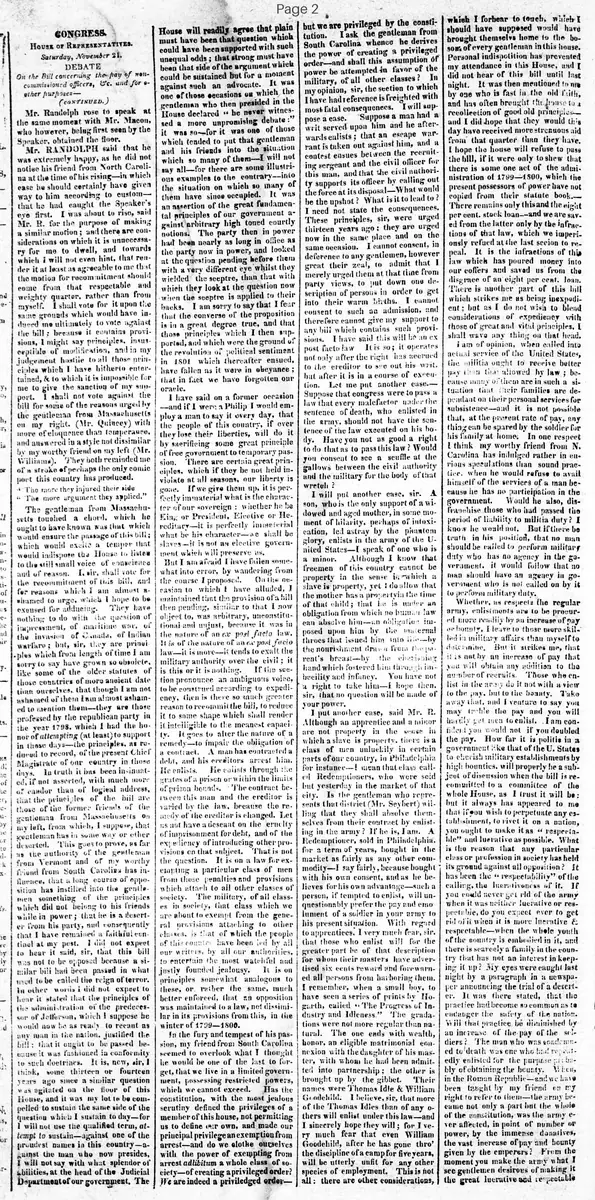
House of Representatives
Saturday, November 21
DEBATE
On the Bill concerning the pay of non-commissioned officers, &c. and for other purposes--
(Continued.)
Mr. Randolph rose to speak at the same moment with Mr. Macon, who however, being first seen by the Speaker, obtained the floor.
Mr. RANDOLPH said that he was extremely happy, as he did not notice his friend from North Carolina at the time of his rising-in which case he should certainly have given way to him according to custom-that he had caught the Speaker's eye first. I was about to rise, said Mr. R. for the purpose of making a similar motion; and there are considerations on which it is unnecessary for me to dwell, and towards which I will not even hint, that render it at least as agreeable to me that the motion for recommittal should come from that respectable and weighty quarter, rather than from myself. I shall vote for it upon the same grounds which would have induced me ultimately to vote against the bill: because it contains provisions, I might say principles, insusceptible of modification, and in my judgement hostile to all those principles which I have hitherto entertained, & to which it is impossible for me to give the sanction of my support. I shall not vote against the bill for some of the reasons urged by the gentleman from Massachusetts on my right, (Mr. Quincy) with more of eloquence than temperance. and answered in a style not dissimilar by my worthy friend on my left (Mr. Williams). They both reminded me of a stroke of perhaps the only comic poet this country has produced.
"The more they injured their side
"The more argument they applied."
The gentleman from Massachusetts touched a chord, which he ought to have known was that which would ensure the passage of this bill: which would excite a temper that would indispose the House to listen to the still small voice of conscience and of reason. I, sir, shall vote for the recommittal of this bill, and for reasons which I am almost ashamed to urge, which I hope to be excused for adducing. They have nothing to do with the question of impressment, of maritime war. of the invasion of Canada, of Indian warfare; but, sir, they are principles which from length of time I am sorry to say have grown so obsolete, like some of the older statutes of those countries of more ancient date than ourselves, that though I am not ashamed of them I am almost ashamed to mention them--they are those professed by the republican party in the year 1798, which I had the honor of attempting (at least) to support in those days-the principles, as reduced to record, of the present Chief Magistrate of our country in those days. In truth it has been insinuated, if not asserted, with much more of candor than of logical address. that the principles of the bill are those of the former friends of the gentleman from Massachusetts on my left, from which, I suppose, that gentleman has in some way or other deserted. This goes to prove, as far as the authority of the gentleman from Vermont and of my worthy friend from South Carolina has influence, that a long course of opposition has instilled into the gentlemen something of the principles which did not belong to his friends while in power; that he is a deserter from his party, and consequently that I have remained a faithful sentinel at my post. I did not expect to hear it said, sir, that this bill was not to be opposed because a similar bill had been passed in what used to be called the reign of terror. in other words I did not expect to hear it stated that the principles of the administration of the predecessor of Jefferson, which I suppose he would now be as ready to recant as any man in the nation, justified the bill: that it ought to be passed because it was fashioned in conformity to such doctrines. It is, now, sir, I think, some thirteen or fourteen years ago since a similar question was agitated on the floor of this House, and it was my lot to be compelled to sustain the same side of the question which I sustain to day-for I will not use the qualified term, attempt to sustain-against one of the proudest names in this country-against the man who now presides, I will not say with what splendor of abilities, at the head of the Judicial Department of our government. The House will readily agree that plain must have been that question which could have been supported with such unequal odds ; that strong must have been that side of the argument which could be sustained but for a moment against such an advocate. It was one of those occasions on which the House declared " he never witnessed a more unpromising debate :" it was so--for it was one of those which tended to put that gentleman and his friends into the situation which so many of them--I will not say all-for there are some illustrious examples to the contrary--into the situation on which so many of them have since occupied. It was an assertion of the great fundamental principles of our government against arbitrary high toned courtly notions. The party then in power had been nearly as long in office as the party now in power, and looked at the question pending before them with a very different eye whilst they wielded the sceptre, than that with which they look at the question now when the sceptre is applied to their backs. I am sorry to say that I fear that the converse of the proposition is in a great degree true, and that those principles which I then supported, and which were the ground of the revolution of political sentiment in 1801 which thereafter ensued. have fallen as it were in abeyance : that in fact we have forgotten our oracle.
I have said on a former occasion -and if I were a Philip I would employ a man to say it every day, that the people of this country, if ever they lose their liberties, will do it by sacrificing some great principle of free government to temporary passion. There are certain great principles, which if they be not held inviolate at all seasons, our liberty is gone. If we give them up, it is perfectly immaterial what is the character of our sovereign : whether he be King or President. Elective or Hereditory-it is perfectly immaterial what be his character-we shall be slaves-it is not an elective government which will preserve us.
But I am afraid I have fallen somewhat into error, by wandering from the course I proposed. On the occasion to which I have alluded. I maintained that the provision of a bill then pending, similar to that I now object to, was arbitrary, unconstitutional and unjust, because it was in the nature of an ex post facto law. It is of the nature of an ex post facto law-it is more--it tends to exalt the military authority over the civil : it is this or it is nothing. If the section pronounce an ambiguous voice, to be construed according to expediency, then is there so much greater reason to recommit the bill, to reduce it to some shape which shall render it intelligible to the meanest capacity. It goes to alter the nature of a remedy-to impair the obligation of a contract. A man has contracted a debt, and his creditors arrest him. He enlists. He enlists through the grgates of a prison or within the limits of prison bounds. The contract between this man and the creditor is varied by the law, because the remedy of the creditor is changed. Let us not have a descant on the cruelty of imprisonment for debt, and of the expediency of introducing other provisions on that subject. That is not the question. It is on a law for exempting a particular class of men from those penalties and provisions which attach to all other classes of society. The military, of all classes in society, that class which we are about to exempt from the general provisions attaching to other classes, is that of which the people of this country have been led by all our writers, by all our authorities. to entertain the most watchful and justly founded jealousy. It is on principles somewhat analogous to these, or, rather the same, much better enforced, that an opposition was maintained to a law, not dissimilar in its provisions from this, in the winter of 1799-1800.
In the fury and tempest of his passion, my friend from South Carolina seemed to overlook what I thought he would be one of the last to forget, that we live in a limited government, possessing restricted powers, which we cannot exceed. Has the constitution, with the most jealous scrutiny defined the privileges of a member of this house, not permitting us to define our own, and made our principal privilege an exemption from arrest-and do we clothe ourselves with the power of exempting from arrest ad libitum a whole class of society-of creating a privileged order? We are indeed a privileged order- but we are privileged by the constitution. I ask the gentleman from South Carolina whence he derives the power of creating a privileged order-and shall this assumption of power be attempted in favor of the military, of all other classes? In my opinion, sir, the section to which I have had reference is freighted with most fatal consequences. I will suppose a case.
Suppose a man had a writ served upon him and he afterwards enlists; that an escape warrant is taken out against him, and a contest ensues between the recruiting sergeant and the civil officer for this man, and that the civil authority supports its officer by calling out the force at its disposal-What would be the upshot ? What is it to lead to ? I need not state the consequences.
These principles, sir, were urged thirteen years ago ; they are urged now in the same place and on the same occasion. I cannot consent, in deference to any gentlemen, however great their zeal, to admit that I merely urged them at that time from party views, to put down one description of persons in order to get into their warm berths. I cannot consent to such an admission, and therefore cannot give my support to any bill which contains such provisions. I have said this will be an ex post facto law It is so; it operates not only after the right has accrued to the creditor to sue out his writ. but after it is in a course of execution. Let me put another case.-
Suppose that congress were to pass a law that every malefactor under the sentence of death, who enlisted in the army, should not have the sentence of the law executed on his body. Have you not as good a right to do that as to pass this law ? Would you consent to see a scuffle at the gallows between the civil authority and the military for the body of that wretch?
I will put another case, sir. A son, who is the only support of a widowed and aged mother, in some moment of hilarity, perhaps of intoxication, led astray by the phantom glory, enlists in the army of the United States-I speak of one who is a minor. Although I know that freemen of this country cannot be property in the sense in which a slave is property, yet I do allow that the mother has a property in the time of that child: that he is under an obligation from which no human law can absolve him--an obligation imposed upon him by the maternal throes that issued him into life by the nourishment drawn from the parent's breast--by the cherishing hand which fostered him through imbecility and infancy. You have not a right to take him-I hope then, sir, that no question will be made of your power.
I put another case, said Mr. R. Although an apprentice and a minor are not property in the sense in which a slave is property, there is a class of men unluckily in certain parts of our country, in Philadelphia for instance-I mean that class called Redemptioners, who were sold but yesterday in the market of that city. Is the gentleman who represents that district (Mr. Seybert) willing that they shall absolve themselves from their contract by enlisting in the army? If he is, I am. A Redemptioner, sold in Philadelphia. for a term of years, bought in the market as fairly as any other commodity-I say fairly, because bought with his own consent, and as he believes for his own advantage-such a person, if tempted to enlist, will unquestionably prefer the pay and emolument of a soldier in your army to his present situation. With regard to apprentices. I very much fear, sir. that those who enlist will for the greater part be of that description for whom their masters have advertised six cents reward and forewarned all persons from harboring them.
I remember, when a small boy, to have seen a series of prints by Hogarth, called "The Progress of Industry and Idleness." The gradations were not more regular than natural. The one ends with wealth, honor, an eligible matrimonial connexion with the daughter of his master, with whom he had been admitted into partnership; the other is brought up by the gibbet. Their names were Thomas Idle & William Goodchild. I believe, sir, that more of the Thomas Ides than of any others will enlist under this law-and I sincerely hope they will; for I very much fear that even William Goodchild, after he has gone thro' the discipline of a camp for five years, will be utterly unfit for any other species of employment. This is not all: there are other considerations, which I forbear to touch, which I should have supposed would have brought themselves home to the bosom of every gentleman in this house.
Personal indisposition has prevented my attendance in this House, and I did not hear of this bill until last night. It was then mentioned to me by one who is fast in the old faith. and has often brought the house to a recollection of good old principles- and I did hope that they would this day have received more strenuous aid from that quarter than they have.
I hope the house will refuse to pass the bill, if it were only to shew that there is some one act of the administration of 1798-1800, which the present possessors of power have not copied from their statute book.- There remains only this and the eight per cent. stock loan--and we are saved from the latter only by the infractions of that law, which we imperiously refused at the last session to repeal. It is the infractions of this law which has poured money into our coffers and saved us from the disgrace of an eight per cent. loan.
There is another part of this bill which strikes me as being inexpedient; but as I do not wish to blend considerations of expediency with those of great and vital principles, I shall wave any thing on that head.
I am of opinion, when called into actual service of the United States, the militia ought to receive better pay than that allowed by law ; because many of them are in such a situation that their families are dependant on their personal services for subsistence--and it is not possible that, at the present rate of pay, any thing can be spared by the soldier for his family at home. In one respect I think my worthy friend from N. Carolina has indulged rather in curious speculations than sound practice, when he would refuse to avail himself of the services of a man because he has no participation in the government.
Would he also, disfranchise those who had passed the period of liability to militia duty? I know he would not. But if there be truth in his position, that no man should be called to perform military duty who has no agency in the government, it would follow that no man should have an agency in government who is not called on by it to perform military duty.
Whether, as respects the regular army, enlistments are to be procured more readily by an increase of pay or bounty, I leave to those more skilled in military affairs than myself to determine. But it strikes me, that it is not by an increase of pay that you will obtain any addition to the number of recruits. Those who enlist in the army do it not with a view to the pay, but to the bounty. Take away that, and I venture to say you may double the pay and you will hardly get men to enlist. I am confident you would not if you doubled the pay. How far it is politic in a government like that of the U. States to cherish military establishments by high bounties, will properly be a subject of discussion when the bill is re-committed to a committee of the whole House, as I trust it will be: but it always has appeared to me that if you wish to perpetuate any establishment, to rivet it on a nation, you ought to make it as "respectable" and lucrative as possible. What is the reason that any particular class or profession in society has held its ground against all opposition? It has been the "respectability" of the calling, the lucrativeness of it. If you could never get rid of the army when it was neither lucrative or respectable, do you expect ever to get rid of it when it is more lucrative & respectable-when the whole youth of the country is embodied in it, and there is scarcely a family in the country that has not an interest in keeping it up? My eyes were caught last night by a paragraph in a news paper announcing the trial of a deserter. It was there stated, that the practice had become so common as to endanger the safety of the nation. Will that practice be diminished by an increase of the pay of the soldiers? The man who was condemned to death was one who had repeatedly enlisted for the purpose of obtaining the bounty. When, in the Roman Republic-and we have been taught by my friend on my right to refer to them-the army became not only a part but the whole of the constitution, was the army ever affected, in point of number or power, by the immense donations, the vast increase of pay and bounty given by the emperors? From the moment you make the army what I see gentlemen desirous of making it the great lucrative and respectable profession of the country; when you thin the ranks of law and of medicine --and in that respect perhaps spare human life if not human blood--we have a new order of society, a new constitution.
Mr. R. then adverted to the last section of the bill. He owned it was with some unpleasant feelings he saw this provision for commutation of service from a five years' enlistment to enlistment during the war. But it was highly possible that upon this as well as other topics, on which he had incidentally and very digressively touched, the House had heard objections and arguments similar to those he had used and infinitely more worthy their attention.
Before he sat down, Mr. R. said he must be permitted to remark, that although he should not, as he intended, from the lateness of the hour of the day, go very far into the book of Chronicles, the Records of 1799--he must be permitted, & the House would excuse him for it, to speak in reference to transactions of the last session, on the subject of Indian savages, who had been brought up in this day's debate. The House may not have troubled its recollection, said he, with the declaration on this subject at that day made by me, and which, however inconsiderately made, I still adhere to. The power of the Indian savages within the limits of the United States, with whom we were in any danger of coming into collision, was broken by the same arm which broke the fetters of British dominion. The peace of Greenville, which followed Wayne's Indian war, put an end to all collision between us and those barbarians; & there never was, from that time up to the transaction at Tippecanoe, any interruption of our ascendancy over them.--
When the present President of the U. States came into power, Mr. R. said, he had announced the pacific disposition of the Indian tribes, who were generally linked together in the Message with the Barbarian powers of Europe. This declaration of their pacific disposition had been reiterated in each Message until that of the last session, as Mr. R proved by quotations which he read. In the Message at the opening of the preceding session, which Mr R. denominated the penultimate session, their pacific disposition was distinctly stated. These continued declarations, he said, were conclusive on the subject of Indians and of Indian warfare.
In my desultory way, continued Mr. R. I will make another remark as to the pay of soldiers. I had always understood that in an army it was the policy of the officers to keep the soldiery poor --I beg to be understood as speaking of regulars only--that as long as the men were flushed with money, they made by so much the worse soldiers-- that their fitness and utility as soldiers was in the inverse proportion to the goodness of their finances.
With respect to the examples of ancient commonwealths, it must be obvious to gentlemen much less well read in them than the gentleman from Georgia who has alluded to them, that there is no analogy in the cases he cited--that their governments were anomalous, having no fixed principles, nothing that we should call civil or rational liberty-- that they were ignorant of the liberty of conscience--that they had not representative government. How then can there be any analogy between them and ourselves, who sit here under a specific and limited authority? None I believe can be pointed out.
It appears to me, sir, if this bill be not re-committed and do not undergo alteration, it will endanger collisions of authority between the state and federal governments. I would ask by what right can the federal government undertake to dispense with the law of a state in a case of contract between two citizens of the same state? I would ask, with deference and submission, whether the state courts will feel themselves bound by this law. In some states they may; but in a majority of the states I trust they will not. And, notwithstanding what the gentleman from South Carolina has said on the subject of the conduct of Massachusetts, it is a matter of notoriety that the opposition of Virginia and Kentucky did put an end to Mr. Adams's war. We took our stand, sir, and on principles for which I have been attempting this day most feebly to contend. we triumphed. The patriotism and good sense of the American people ratified what we did. If you doubt it, look to the authority. At a session of the Virginia Legislature in 1799, certain resolutions were passed which produced nearly the same language on this floor in relation to her as we have to-day heard from the gentleman from South Carolina. They would not be dragooned into the measures of the then administration. These resolutions of Virginia begat in other states intemperate resolves in favor of the war with France. and vituperative language respecting the conduct of Virginia and Kentucky. These resolves were, at the session of the Virginia Assembly ensuing, committed to a committee of which the present Chief Magistrate was chairman, and a report was drafted by him in support of the ground then taken in the states of Virginia and Kentucky. Mr. R. then quoted some of these resolutions, which the reporter has not at hand, in which the legislature deprecate the war with France as unnecessary, and recommend that, instead of expending money on needless armies and navies, the government should husband the public resources, &c. So that, said Mr. R. according to the doctrine of that day, as laid down from an authority not less then respected by those out of power than now by those in power, the true policy of this country was--to do what? Not to raise volunteer or military corps, not to lavish your funds on regular armies, but "to husband the public resources."
I shall, said Mr. R. in conclusion, go no farther, but content myself with having proved that I am an irreclaimable heretic--that I will not, for the sake of expediency, give up principles & opinions with which I came into public life-- that if I am wrong now, it has been my misfortune to have been so for fourteen years--and at least for one period of my life, that I had the fortune of erring with Plato rather than being right with other people.
[Debate to be continued.]
What sub-type of article is it?
What themes does it cover?
What keywords are associated?
What entities or persons were involved?
Where did it happen?
Story Details
Key Persons
Location
House Of Representatives
Event Date
Saturday, November 21
Story Details
Mr. Randolph supports recommittal of a bill on pay for non-commissioned officers and other purposes, arguing it contains unconstitutional provisions akin to ex post facto laws that exempt military personnel from civil obligations like arrest for debt, altering contracts, and interfering with family duties, contrary to republican principles from 1798.